Wednesday Oct 21, 2026
Wednesday Oct 21, 2026
Friday, 3 April 2026 00:28 - - {{hitsCtrl.values.hits}}
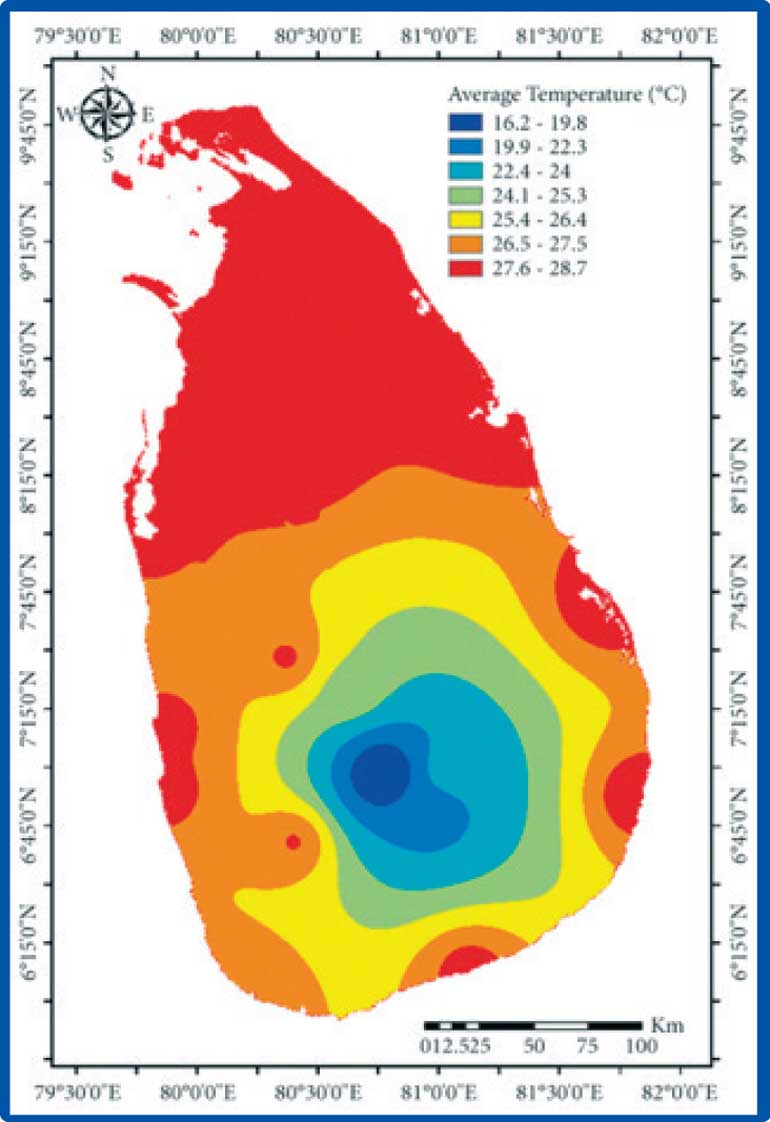

Sri Lanka is currently experiencing unusually elevated temperatures, and weather experts increasingly point to El Niño conditions as a key driver. These global climate phenomena, though originating in the Pacific Ocean, have a strong influence on rainfall, temperature, and water availability across the island. Recent dry spells and high temperatures are consistent with El Niño influences, weakening monsoons and stressing water resources. Climate variability is no longer an abstract concept. It is now a daily reality affecting agriculture, water resources, and energy security. At the centre of this variability lies the El Niño–Southern Oscillation (ENSO), a natural climate cycle that alternates between El Niño and La Niña phases. These are not human-induced phenomena. However, global warming is altering the background conditions in which ENSO operates, potentially intensifying its impacts, making droughts hotter and rainfall events more extreme.
What are El Niño and La Niña?
These are large scale climate signals that influence weather. “El Niño and La Niña are a global climate phenomenon. El Niño and La Niña are natural climate cycles that have existed for thousands of years. They don’t occur on fixed cycle but there is a general pattern typically every two to seven years, which is very irregular. Historical evidence, from coral records, tree rings, and sediment cores, confirms their long-standing presence. The term “El Niño,” meaning “the Christ Child,” was first used by Peruvian Spanish speaking fishermen in the 17th century to describe unusually warm ocean waters appearing around Christmas.
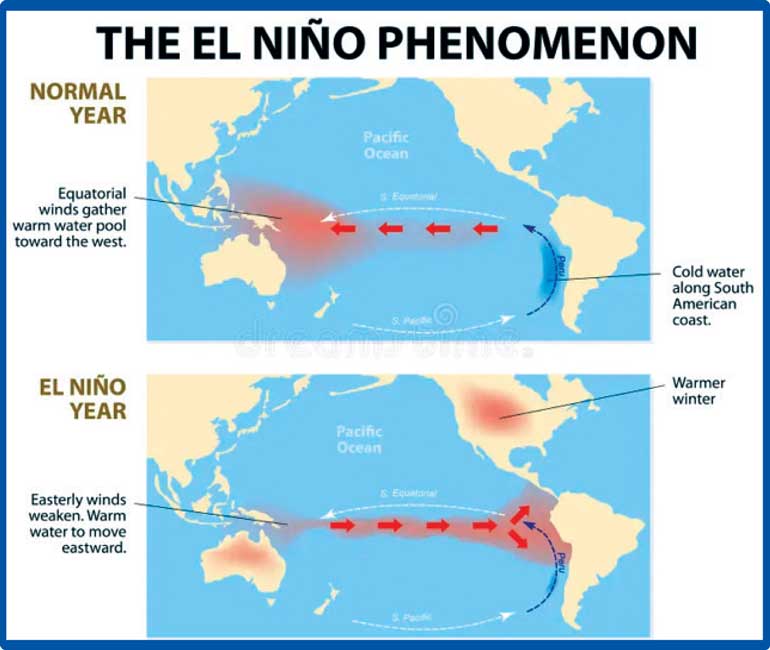
El Niño occurs when sea surface temperatures in the central and eastern Pacific Ocean become unusually warm. This weakens the trade winds that normally push warm water towards Asia. As a result, warm water moves back towards South America. So, the ocean surface becomes warmer. Consequently, rainfall patterns shift, often bringing drought conditions to countries such as Indonesia, Thailand, and Sri Lanka.
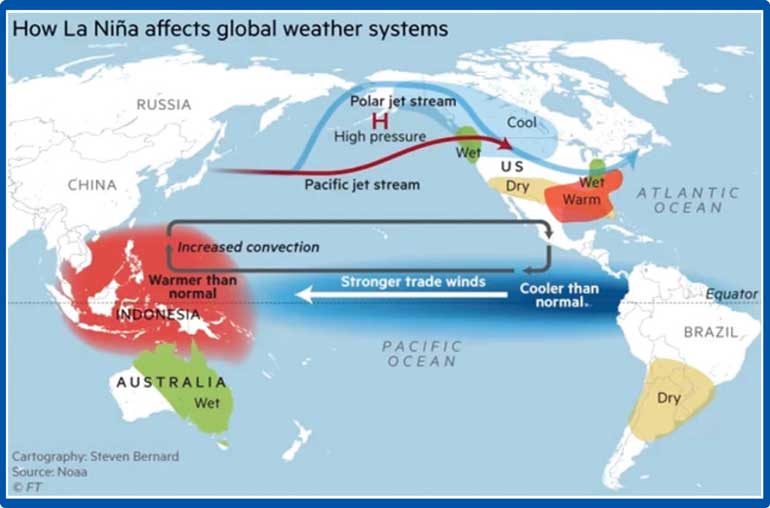
In contrast, La Niña represents the opposite phase. La Niña = “cooling of the Pacific Ocean. Stronger trade winds push warm water towards the western Pacific, (Asia and Australia). More cold water rises from the deep oceans near South America (strong upwelling). Thus, the ocean surface becomes cooler, leading to enhanced monsoon activity and increased rainfall across South and Southeast Asia. During La Niña, the region tends to have warmer waters around Sri Lanka/Indian Ocean, more moisture in the atmosphere and stronger monsoon circulation. Usually La Nina, results in heavier rainfall, especially during the Maha season, reservoirs fill faster, and groundwater is recharged, flooding and waterlogging can damage crops.
In simple terms:
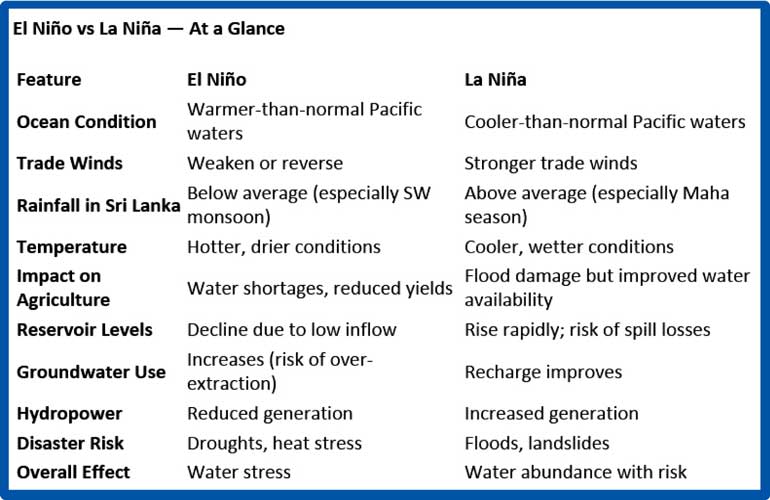
El Niño brings heat and dryness, while La Niña brings rain and potential flooding.
Why Sri Lanka is experiencing high temperatures
The current dry and hot conditions across Sri Lanka are consistent with El Niño influence, which typically:
In the Dry Zone, where farming depends heavily on stored water, even a single weak monsoon can disrupt cultivation. As surface water declines, farmers increasingly turn to groundwater, raising concerns about over-extraction and long-term sustainability.
Impacts of El Nino and La Nina
In Sri Lanka, El Niño years are typically associated with:
By contrast, La Niña periods often bring:
Extreme rainfall events are usually the result of multiple interacting factors, including monsoon dynamics, Indian Ocean temperatures, and local weather systems, not ENSO alone.
Recent weather:
A mixed influence
Some have speculated that recent cyclonic activity, including Cyclone DITWA, was linked to La Niña. However, scientific understanding suggests that such events are shaped by multiple ocean–atmosphere interactions, with La Niña playing, at most, a supporting role. La Niña acts as a background amplifier, not the direct cause.
While La Niña did not directly cause the cyclone, it likely created favourable background conditions, including higher atmospheric moisture and enhanced monsoon activity that intensified rainfall. This distinction is important. Tropical cyclones and depressions are the immediate triggers, whereas large-scale climate patterns like La Niña act as influencing factors that can amplify impacts. In practical terms, during La Niña periods, Sri Lanka faces a higher risk of extreme rainfall events, particularly in vulnerable regions such as the Central Highlands, where steep terrain increases the likelihood of landslides.
A cycle of extremes
Sri Lanka is increasingly experiencing a cycle of extremes: periods of drought followed by intense rainfall, sometimes within the same year. This reflects not just ENSO variability but a broader pattern of climate instability.
Importantly, the climate system does not switch abruptly between El Niño and La Niña. There are often neutral transition phases, during which regional influences can dominate. As a result, Sri Lanka may simultaneously experience localised floods and droughts within short time spans.
Implications for water management
This growing variability places significant pressure on traditional land and water management systems, which were designed for more stable climatic conditions. The challenge today is not simply to respond to extremes, but to anticipate them. Sri Lanka cannot control Pacific Ocean processes, but it can improve its preparedness.
Key priorities include:
Conclusion: From reaction to preparedness
El Niño and La Niña are not new, but their impacts are becoming more pronounced. Sri Lanka is clearly moving towards a pattern of greater climate variability. The key sectors, agriculture, irrigation, groundwater, and disaster management, must shift from reactive responses to anticipatory planning. Sri Lanka cannot control global climate systems. But with better understanding, planning, and management, it can reduce risks and build resilience. In an era of increasing uncertainty, preparedness, not reaction, will determine the country’s water security and agricultural sustainability.
(The author holds a B.Sc. in Agricultural Engineering from Tokyo University and an M.Sc. in Soil and Water Management from the University of Wageningen. He is a specialist in watershed management and soil conservation, and a former Director of the Natural Resources Management Centre, Department of Agriculture, Sri Lanka. He has also worked with FAO in Sri Lanka and Bangladesh)




