Friday Oct 02, 2026
Friday Oct 02, 2026
Tuesday, 19 May 2026 00:25 - - {{hitsCtrl.values.hits}}
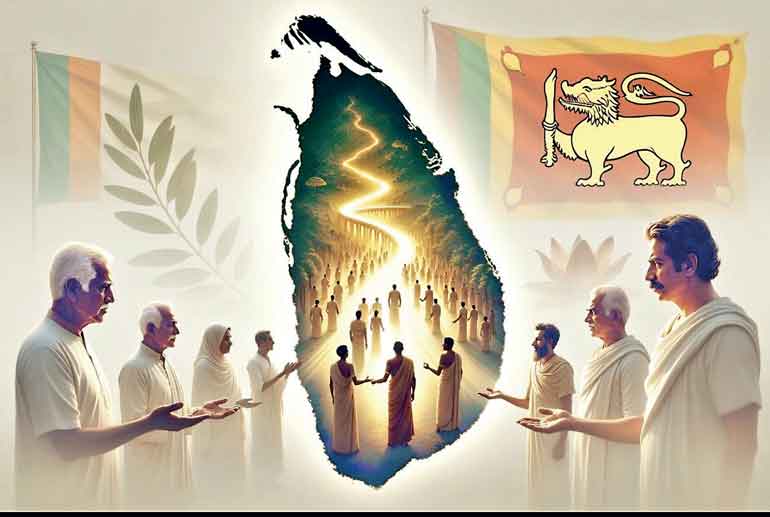
 As Sri Lanka marks National War Heroes’ Day (Ranaviru Day) on 18 May, the country honours the sacrifices made during the 30-year conflict that ended in May 2009. This annual observance serves as a solemn reminder of the heavy human cost borne by security forces personnel, their families, and civilians across all communities. It also reaffirms the restoration of the island’s territorial integrity and sovereignty as a single, united nation.
Only days earlier, political developments in India’s Tamil Nadu state drew attention in Sri Lanka. Actor-turned-politician C. Joseph Vijay was sworn in as Chief Minister on 10 May after his party, Tamilaga Vettri Kazhagam, achieved a significant electoral success. Responses from Sri Lankan leaders reflected the country’s ethnic diversity: President Anura Kumara Dissanayake highlighted the importance of India-Sri Lanka partnership, while some Tamil opposition figures called for attention to longstanding Tamil concerns. Such cross-border interest is not new, yet it underscores the need for Sri Lanka to manage its internal affairs while maintaining constructive regional relations.
A 17-year post war Sri Lanka
Seventeen years after the end of the war, Sri Lanka continues to navigate the complex legacies of that period. Different communities hold distinct memories. For many in the Sinhalese and other communities, the conflict is remembered through the lens of terrorism, including suicide bombings, child recruitment, and widespread violence. For many Tamils, the war and its aftermath are associated with profound loss, displacement, and unresolved grievances. Tamil communities also observe Maaveerar Naal on 27 November to remember their fallen. These commemorations reflect deeply held sentiments and should be respected as expressions of collective mourning, provided they remain within the bounds of law and do not promote violence or separatism.
Sri Lanka’s sovereignty remains fundamental. The island is a single, independent nation with a multi-ethnic population. External actors cannot determine its internal political structures or constitutional arrangements. Successive Indian governments, including the current administration in New Delhi, have consistently recognised Sri Lanka’s unity and territorial integrity. Bilateral relations encompass economic cooperation, security, and people-to-people ties, with both countries sharing an interest in stability in the Indian Ocean region.
A lasting national strength
At the same time, lasting national strength depends on inclusive governance that addresses the aspirations of all citizens. The 13th Amendment to the Constitution, introduced in 1987, established Provincial Councils and devolved powers in several areas including education, health, agriculture, and local infrastructure. Implementation has been uneven, and Provincial Council elections have not been held for several years, partly due to concerns over past events such as the 1990 interim council’s actions and ongoing discussions about electoral reforms.
Economic development offers a unifying pathway. Investment in infrastructure, agriculture, tourism, and industry in the Northern and Eastern provinces can generate opportunities that benefit all communities. Improved livelihoods and connectivity help build stakes in a common future, reducing the space for divisive narratives. Addressing practical issues such as remaining land disputes, support for conflict-affected families, and language rights in public services would contribute to greater trust
The current Government, elected with a clear mandate, faces the challenge of balancing security considerations with the need for meaningful devolution. Holding Northern and Eastern Provincial Council elections at the earliest possible date would allow residents in those provinces to choose their representatives and manage local affairs within the constitutional framework. This step could help reduce feelings of alienation without compromising national unity.
A practical approach involves implementing the 13th Amendment in a phased and transparent manner. Non-sensitive subjects such as education, health services, and rural development can be fully operationalised with appropriate financial resources and capacity building. More sensitive areas like police and land powers require careful calibration, including national safeguards to protect security and strategic interests. Functional cooperation between provinces on shared matters could address regional needs effectively.
Economic development offers a unifying pathway. Investment in infrastructure, agriculture, tourism, and industry in the Northern and Eastern provinces can generate opportunities that benefit all communities. Improved livelihoods and connectivity help build stakes in a common future, reducing the space for divisive narratives. Addressing practical issues such as remaining land disputes, support for conflict-affected families, and language rights in public services would contribute to greater trust.
All stakeholders carry responsibilities. Tamil political parties and community leaders are expected to operate firmly within Sri Lanka’s democratic and constitutional framework, rejecting any advocacy of separatism. Glorification of a proscribed terrorist organisation remains a sensitive matter that affects victims across ethnic lines. At the same time, the state must ensure that security measures are proportionate and that all citizens enjoy equal protection and opportunities. The long-standing fishermen’s dispute between Tamil Nadu and Sri Lanka requires pragmatic management. Technical solutions such as regulated fishing practices, alternative livelihoods, and bilateral coordination can minimise periodic tensions and support coastal communities on both sides of the Palk Strait.
Sri Lanka’s broader context has evolved. The country is focused on economic stabilisation, governance reforms, and fulfilling international commitments under its IMF-supported program. These efforts demand internal cohesion. A new constitution, if advanced, could provide an opportunity to clarify devolution arrangements while reinforcing the unitary character of the state and fundamental rights for every citizen.
All stakeholders carry responsibilities. Tamil political parties and community leaders are expected to operate firmly within Sri Lanka’s democratic and constitutional framework, rejecting any advocacy of separatism
National War Heroes’ Day offers a moment for reflection. The sacrifices of the past secured the country’s unity. The task now is to translate that unity into a functioning, equitable democracy where Sinhalese, Tamils, Muslims, Burghers and others see their identities and aspirations reflected. This does not require erasing historical differences but managing them through dialogue, democratic institutions, and shared development.
Sri Lanka’s sovereignty is best demonstrated not only through defence of territory but through the ability to resolve internal challenges constructively. By moving forward with provincial elections, measured devolution, and inclusive growth, the country can strengthen its resilience and reduce external interest in its domestic politics.
The coming years will test the nation’s capacity for pragmatic statesmanship. A future in which all communities feel ownership of Sri Lanka’s progress is not only desirable but necessary for enduring peace and prosperity. On this day of remembrance, the focus can shift from past divisions toward building institutions and opportunities that serve every Sri Lankan.
Conclusion
Sri Lanka’s sovereignty is not a matter for negotiation, it is the foundational reality upon which the nation stands. Seventeen years after the guns fell silent, the island remains one indivisible country, forged through immense sacrifice and now charting its course as a united, multi-ethnic democracy. No external voice, however well-intentioned or emotionally charged, holds the right to shape Sri Lanka’s internal political architecture. That authority rests solely with its people and their elected representatives.
Yet true sovereignty is not merely the defence of territory; it is the confident exercise of inclusive governance that leaves no citizen behind. The time has come for decisive, pragmatic action: the prompt conduct of Northern and Eastern Provincial Council elections, the full and orderly implementation of the 13th Amendment within the clear boundaries of the unitary state, and a determined national drive toward equitable development that binds every province into a single prosperity.
National War Heroes’ Day offers a moment for reflection. The sacrifices of the past secured the country’s unity. The task now is to translate that unity into a functioning, equitable democracy where Sinhalese, Tamils, Muslims, Burghers and others see their identities and aspirations reflected. This does not require erasing historical differences but managing them through dialogue, democratic institutions, and shared development
The sacrifices honoured on Ranaviru Day were made so that future generations could live in peace, not perpetual apprehension. Let this day of remembrance therefore mark a turning point not a return to old grievances, but a forward march grounded in realism, mutual responsibility, and national self-confidence. Sinhalese, Tamils, Muslims and all communities must choose shared citizenship over division, practical reconciliation over rhetoric, and collective progress over sectional memory.
Sri Lanka possesses the maturity, the constitutional tools, and the democratic mandate to resolve its remaining challenges on its own terms. By doing so with clarity and resolve, the nation will not only secure its sovereignty but demonstrate to itself and the world that unity with justice is not an aspiration, it is an achievable destiny. The path is open. The choice, and the responsibility, belongs to every Sri Lankan.
(The author, SSP (Retired), is the former Head of the Counter-Terrorism Division of the State Intelligence Service of Sri Lanka, and has served as Head of the Sri Lankan Delegation at three BIMSTEC Security Conferences. With over 40 years of experience in policing and intelligence, he writes on regional security, interfaith relations, and geopolitical strategy)
The coming years will test the nation’s capacity for pragmatic statesmanship. A future in which all communities feel ownership of Sri Lanka’s progress is not only desirable but necessary for enduring peace and prosperity. On this day of remembrance, the focus can shift from past divisions toward building institutions and opportunities that serve every Sri Lankan



