Saturday Oct 17, 2026
Saturday Oct 17, 2026
Monday, 31 August 2026 00:24 - - {{hitsCtrl.values.hits}}

For a farmer, climate change rarely arrives as a graph.
It arrives as a field that should have been moist but is turning hard. A tank that is visibly lower than it was a few weeks ago. A vegetable crop that needs another irrigation. A decision on whether to sow today or wait for rain. A bag of seed that can be planted only once. A fertiliser bill that is suddenly more difficult to afford.
And sometimes, just when the farmer has adjusted to drought, the problem changes completely. The rain arrives. Too much of it.
Seedlings are submerged. Fertiliser is washed away. Drains cannot carry the water. Roads become difficult to use. Crops reach harvesting stage when grain cannot be dried properly.
That is the unusual challenge Sri Lanka may be heading into over the coming months.
The emerging weather signal is not simply one of drought. It is a possible dry-wet transition: unusually dry and hot conditions during the present period, followed by the possibility of substantially wetter conditions as we move towards the Second Inter-Monsoon and the early Northeast Monsoon.
For agriculture, that distinction matters enormously. If we prepare only for drought, we could be caught unprepared for flooding and waterlogging. If we assume that heavy rainfall will solve the drought, we could underestimate heat, poor rainfall distribution and late-season water shortages.
The correct response is not to predict one outcome perfectly. It is to prepare agriculture to function reasonably well under several possible outcomes.
The warning signs are already visible
The current dry spell is not theoretical. Monitoring by the International Water Management Institute (IWMI) and the Disaster Management Centre (DMC) shows very large rainfall deficits in important agricultural districts during the Southwest Monsoon period. By 20 August, rainfall deficits compared with the long-term average were around 65 percent in Anuradhapura and Polonnaruwa and more than 80 percent in Vavuniya.
Large parts of the Northern, North Central, Eastern and North-Western Provinces have experienced prolonged dry spells, accompanied by falling soil moisture. This followed an unusually wet First Inter-Monsoon - a sequence that is itself instructive. A good start to the year created a sense of water availability; then the Southwest Monsoon weakened sharply.
Satellite observations also show declining surface-water extent in important reservoirs. Water availability is not uniform across the country, but the general message is clear: in several important production zones, every unit of available water has become more valuable.
Meanwhile, the Department of Meteorology’s August assessment points to a very high probability of a strong or very strong El Nino continuing through the latter part of 2026. But this is where the story becomes more complicated.
El Nino means more than just ‘less rain’
The words “El Nino” have understandably become associated in the public mind with drought. Globally, that is often true in some regions. But Sri Lanka’s climate is influenced by several interacting systems - the Southwest Monsoon, the Northeast Monsoon, the two inter-monsoonal periods, El Nino and the Indian Ocean Dipole.
The effects can change during the year. Historically, El Nino conditions can suppress parts of the Southwest Monsoon affecting Sri Lanka. Yet during the Second Inter-Monsoon, rainfall can increase. If a positive Indian Ocean Dipole also develops, it can further increase the possibility of enhanced rainfall over Sri Lanka during parts of October to December.
In simple terms, imagine two climate dials being adjusted at the same time. One is El Nino in the Pacific Ocean. The other is the Indian Ocean Dipole - a difference in sea-surface temperatures across the Indian Ocean that influences where moisture and rainfall are concentrated. Neither dial determines Sri Lanka’s weather on its own. But together with the monsoons they can significantly alter the odds.
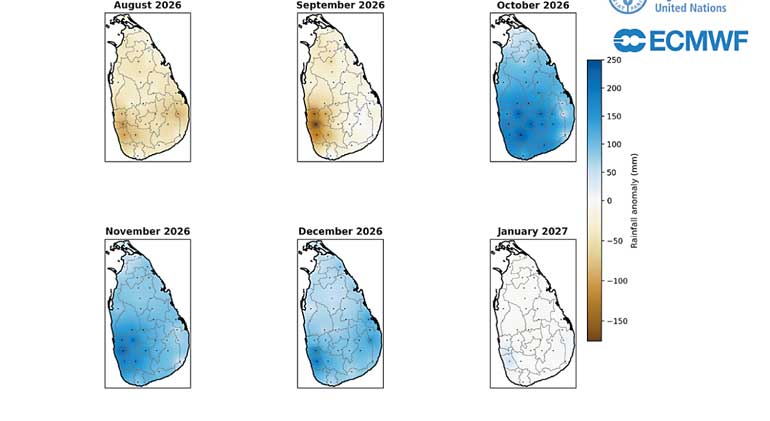
Figure 1. ECMWF rainfall-anomaly outlook: a drier signal in August-September shifts towards wetter conditions in October-December, with January closer to normal.
Source: FAO analysis based on ECMWF seasonal forecast data (51 ensemble members; approximately 36 km spatial resolution).
This is why it would be dangerous to extrapolate today’s dry weather through the entire Maha season. The very fields experiencing moisture stress in August and September could face excessive water several weeks later. And the transition itself may be more damaging than either condition alone.
Dry, hardened soils do not always absorb intense rainfall efficiently. Sudden heavy rainfall can generate runoff, erosion and flash flooding. Delayed planting can compress the season. Replanting can increase costs. Crops planted early to take advantage of water availability may reach flowering or harvesting during wetter weather.
Agriculture therefore faces not one climate risk but a sequence of risks.
Sri Lanka is part of a regional split-screen
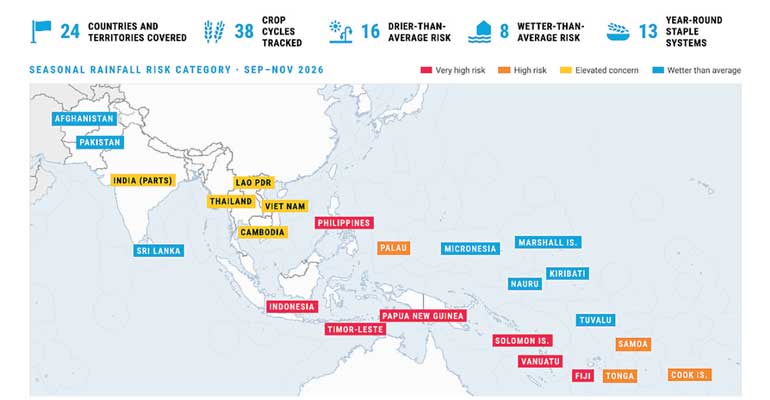
A new Asia-Pacific snapshot prepared by FAO, WFP, WMO and OCHA makes one point especially clear: there is no single regional ‘El Nino weather’. Across 24 countries and territories, it tracks 38 crop cycles. Sixteen are exposed primarily to drier-than-average risk, while eight face wetter-than-average risk; 13 year-round staple systems remain exposed throughout the period. In only a subset of monitored countries, the combined climate and economic shock could leave an additional 8.2 million people facing acute food insecurity. The overall regional impact could be higher.
Across maritime Southeast Asia and the southwest Pacific, Indonesia, Timor-Leste, the Philippines, Papua New Guinea, Solomon Islands, Vanuatu and Fiji are placed in the highest dry-risk category. Farmers there may face delayed planting, irrigation stress, reduced yields and pressure on domestic food supplies. Cambodia, Lao PDR, Thailand, Viet Nam and parts of India are also under elevated dry-risk watch. By contrast, Sri Lanka, Pakistan, Afghanistan and several equatorial and northern Pacific islands are flagged for wetter-than-average risk. The same El Nino episode is therefore producing almost opposite agricultural planning problems across the region.
Figure 2. Seasonal rainfall-risk categories across Asia and the Pacific, September-November 2026. The regional outlook shows drier risks across parts of Southeast Asia and the southwest Pacific, and wetter-than-average risks in Sri Lanka, parts of South Asia and the equatorial and northern Pacific.
Source: FAO, WFP, WMO and OCHA, Asia and the Pacific: Snapshot of El Niño, Indian Ocean Dipole & Middle East Crisis, 24 August 2026.
For Sri Lanka, the Snapshot identifies October to January as the decisive window because the wetter signal overlaps with the establishment and early growth of Maha rice. Above-average rainfall can recharge reservoirs and support cultivation. But excess rainfall during planting can waterlog fields, cause flooding and delay field operations. Whether the same rainfall is helpful or damaging will depend on its intensity, distribution, drainage and the stage of the crop.
This comparison matters for policy. Indonesia may need to conserve irrigation water and guard against a delayed wet-season onset. Sri Lanka may need to conserve water in August and September, then pivot rapidly towards drainage, replanting support and harvest protection as rainfall strengthens. The common regional requirement is not a common intervention. It is the ability to change the intervention as the risk changes.
Planting Maha 2026/27
Farmers understandably want a date. When should Maha cultivation begin? There is enormous pressure on governments to provide one. But the most technically responsible answer may be that Sri Lanka should not have one planting date for the whole country.
Conditions are too different. A farmer under a major irrigation system with adequate reservoir storage faces a different decision from a farmer dependent on a small village tank. A farmer in a flood-prone lowland faces a different risk from one cultivating in a water-scarce upland. A district with sufficient water to establish a crop early should not necessarily follow the same calendar as one dependent entirely on effective monsoon rainfall.
The Irrigation Department’s own planning illustrates this reality. For the 2026/27 Maha season, its short-term planning covered 378 irrigation schemes and roughly 694,000 acres. Eighty-nine schemes, covering about 296,000 acres, were identified for starts before the onset of the monsoon, while 289 schemes covering nearly 398,000 acres were expected to start after onset. This is encouraging because it reflects exactly the principle Sri Lanka now needs: one national decision framework, but multiple local cultivation decisions.
The question should therefore change from: “When should Sri Lanka plant?” to: “Under what conditions should this particular irrigation scheme or district plant?” That is a much better question.
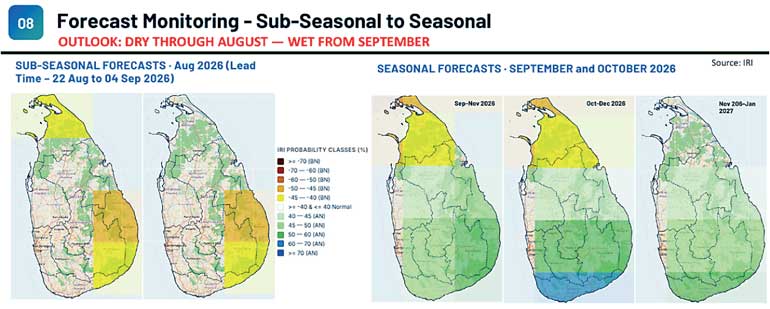
Figure 3. The near-term forecast remains dry, while seasonal probabilities strengthen the wetter signal from September into October-December.
Source: IWMI-DMC ENSO Outlook Bulletin, 20 August 2026; IRI. Forecasts are probabilistic, not deterministic.
Water availability not aspiration must determine cultivated area
One of the most difficult decisions during a dry period is determining how much land should be cultivated. The instinct is understandably to maximise acreage. But planting more land than available water can sustain may simply distribute insufficient water across a larger area.
A smaller area successfully brought to harvest can be economically and socially preferable to a much larger area that fails midway through the season. Every irrigation scheme should therefore have a realistic seasonal water budget. That means accounting not only for agriculture but also for drinking water, livestock needs, conveyance losses and the need to retain some water for later stages of the crop.
It also means thinking beyond Maha. Water exhausted in an attempt to maximise Maha acreage could create problems for Yala 2027. This is not an argument for reducing cultivation unnecessarily. It is an argument for matching cultivation to assured water, and then revisiting the decision as rainfall and reservoir inflows change.
Farmer’s second chance – Replanting readiness
One of the most important lessons from climate shocks is surprisingly simple: do not use everything at the first opportunity.
When the first substantial rain arrives after a drought, there is enormous pressure to plant quickly. But the first rain is not always the beginning of a reliable rainy season. A false onset followed by another dry spell can force farmers to plant twice. Heavy rainfall shortly after sowing can have the same result.
A farmer who loses the first planting has already lost seed, labour, machinery costs and often fertiliser. If there is no seed available for replanting, a weather event lasting a few days can turn into the loss of an entire season.
Sri Lanka therefore needs something stronger than normal seasonal seed distribution. It needs a strategic seed and replanting reserve. Certified seed should be available for more than one planting window. Part of the national and district seed stock should be deliberately ring-fenced and not released during the first round of cultivation.
The reserve should include appropriate varieties for different planting windows, including shorter-duration varieties where technically recommended. And this should not be understood simply as buying bags of seed and putting them into warehouses. A functioning seed reserve requires decentralised storage, quality testing, stock rotation, arrangements with public and private seed producers and clear triggers for rapid release.
In a volatile season, seed is not merely an agricultural input. It is agricultural insurance.
Financial ability and resilience
Seed alone will not solve the problem. A farmer may have seed but still be unable to afford fertiliser, crop protection, machinery or another round of land preparation after a failed planting. Climate risk is therefore interacting with economic risk.
The pressure is not unique to Sri Lanka. The regional Snapshot describes a fuel-fertiliser-food transmission chain. Fuel costs move first, raising transport, irrigation and machinery costs. Fertiliser pressure follows during the production cycle. Food prices rise later, when higher production and transport costs reach markets. By mid-April 2026, Brent crude was more than 50 percent above its level at the start of the year. Urea peaked at USD 857 per tonne, more than twice pre-crisis levels, while the FAO Food Price Index reached a two-year high. A climate shock landing while this cost transmission is still moving through the farm economy can be more damaging than the same rainfall anomaly in a normal price year.
For Sri Lanka, the regional assessment classifies the situation as a convergence risk rather than a climate risk alone: a wetter-than-average signal during the main rice season is interacting with high fuel, fertiliser and food-system pressures. That distinction is practical, not semantic. One failed sowing, a second round of land preparation or an extra pumping cycle may be technically manageable, but financially impossible for a vulnerable smallholder.
That convergence is especially important in a country still recovering from a serious economic crisis, where many rural households have limited capacity to absorb another production shock. The Snapshot notes that diesel and gasoline remain around 44 percent and 41 percent above pre-crisis levels, respectively, while Sri Lanka remains exposed to imported fertiliser and international wheat markets. Targeted agricultural input support can therefore play an important role.
Rather than universally distributing inputs, support can be directed towards vulnerable smallholders in high-risk production areas. Digital fertiliser or agricultural-input vouchers are particularly useful because they can preserve farmer choice, make use of functioning local markets and potentially be scaled quickly when conditions require.
The objective should not be to replace normal agricultural markets. It should be to prevent a temporary climate shock from pushing vulnerable farmers out of production.
Growing the crop is only half the job
There is another risk that deserves much more attention: harvest. If early Maha cultivation shifts crop maturity into a wetter period, Sri Lanka could face a situation where a reasonably good crop is produced but significant value is lost during harvesting and post-harvest handling.
Paddy harvested during wet weather is difficult to dry. High moisture reduces quality and increases storage risks. Roads may be disrupted. Temporary storage may be inadequate. Vegetable supply chains can be even more vulnerable because produce is highly perishable.
The country therefore needs to prepare not only for production but for harvest-weather risk. Drying facilities, moisture meters, tarpaulins, hermetic storage, crates, flood-safe temporary storage and alternative transport arrangements may not attract headlines. But they can determine whether a farmer eventually sells the crop that was successfully produced.
In a difficult climate year, preventing a 10 percent post-harvest loss can be just as valuable as achieving a 10 percent yield increase.
The information exists. The challenge is turning it into decisions
Sri Lanka has considerable technical capacity. The Department of Meteorology produces forecasts. The Irrigation Department monitors reservoirs. Agriculture agencies track crop conditions. Satellite systems can monitor rainfall, vegetation, surface water and soil moisture. The Disaster Management Centre coordinates hazard information. Research institutions are producing increasingly sophisticated climate analysis.
The next step is to ensure that these streams of information meet in one operational decision system. At national and district level, agriculture, meteorology, irrigation and disaster-management agencies should maintain a continuously updated picture of rainfall forecasts, actual rainfall, soil moisture, tank and reservoir storage, irrigation releases, crop establishment and growth stage, reported losses, seed and fertiliser availability, and expected harvesting conditions.
That information must then become a simple farmer-facing message. A farmer does not need an ensemble climate model. The farmer needs to know: Should I prepare the field now? Should I plant this week or wait? Which variety is appropriate if planting is delayed? Is irrigation assured? Should I keep seed for replanting? Is heavy rainfall likely during my harvest window?
The value of climate science is ultimately measured by whether it improves these decisions.
Development partners can help before the emergency
This is also an important moment for Sri Lanka’s development partners. Too often international assistance arrives after agricultural damage has already occurred. There is an opportunity to reverse that logic.
Development assistance over the coming months should focus on agricultural continuity - maintaining farmers’ ability to plant, replant and bring a crop safely to market.
Four areas deserve particular attention: strategic seed and replanting reserves; targeted fertiliser and agricultural-input assistance for vulnerable producers; protection of the harvest through drying, moisture testing, storage and logistics; and flexible anticipatory-action financing that can be released quickly when agreed climate and agricultural triggers are reached.
The last is particularly important. Traditional projects often require us to decide months in advance whether funding is for drought response or flood response. Nature does not respect those budget headings.
A district experiencing severe water stress in September may face flooding in November. Financing should therefore have enough flexibility to respond to the problem that actually materialises. That could mean seed today, drainage clearance next month, replanting assistance later, or post-harvest support at the end of the season.
A relatively small amount of money deployed before or immediately after a climate shock can protect a much larger investment already made in land preparation, seed, fertiliser, irrigation, labour and machinery. That is not simply emergency assistance. It is good economics.
We should prepare for scenarios, not headlines
There is a temptation whenever El Nino develops to frame the coming season in dramatic terms. That would be a mistake. Forecasts are probabilistic. A strong El Nino does not guarantee a particular rainfall outcome in every district of Sri Lanka. Nor does the possibility of wetter conditions later in the year mean that floods are inevitable.
The purpose of a forecast is not to announce a disaster before it happens. It is to give us enough lead time to make better decisions.
Sri Lanka therefore needs to prepare simultaneously for several plausible outcomes. Rainfall may become broadly adequate and the season may be manageable. Rain may arrive early and intensely, causing establishment problems. Rainfall may remain delayed or poorly distributed. Or the country may experience perhaps the most difficult sequence of all - dry conditions, followed by intense rainfall, followed again by insufficient late-season water.
A resilient agricultural system should be able to adjust to all four.
The measure of success
By the middle of next year, the success of Sri Lanka’s response should not be judged by whether we predicted every rainfall event correctly. That is impossible. It should be judged by whether farmers had options.
Sri Lanka has several weeks of valuable lead time. We should use them. Protect the water that remains. Protect the seed. Keep a reserve for replanting. Help vulnerable farmers remain in production. Clear the water channels. Prepare for harvesting in wet weather. Watch the reservoirs and soil moisture as closely as the seasonal forecasts. And be prepared to change course as the season reveals itself.
The coming months may give Sri Lanka both too little water and too much. The smartest agricultural strategy is not to choose which one to prepare for. It is to be ready for both. After all, climate resilience does not mean eliminating uncertainty. It means building systems capable of functioning despite uncertainty.
(The author is the FAO Representative for Sri Lanka and the Maldives)




