Monday Oct 12, 2026
Monday Oct 12, 2026
Wednesday, 26 August 2026 00:27 - - {{hitsCtrl.values.hits}}
 Sri Lanka set a 5% inflation target in October 2023 under the flexible inflation-targeting framework legally supported by the Central Bank of Sri Lanka Act of 2023. The Act provides for the target to be reviewed every three years, and the first review is expected in late 2026. The review comes at an important moment, as Sri Lanka’s recent inflation outturn, generally speaking, has been well below the target, prompting debate over whether the 5% target should be retained or reduced substantially. This article contributes to that debate by assessing the issue through technical evidence, international experience, inflation-targeting practices, and relevant global best practices.
What should guide the inflation target review?
An inflation target review should be a diagnostic exercise, not a mechanical decision to change the target. It should be based on technical analysis, a cost-benefit assessment of any revision, and clear public communication. The review allows the central bank and Government to assess whether the existing target remains appropriate, whether any parameters need fine-tuning, and how best to explain the target and policy responses to the public. It also provides an opportunity to strengthen transparency, accountability, and public understanding of the inflation-targeting framework. It is also important to remember that reviewing the inflation target does not necessarily mean changing it.
International experience shows that changes to inflation targets are infrequent and, when needed, are usually gradual. Countries that adopted inflation targeting during periods of high inflation, such as Brazil, the Czech Republic, Poland, Indonesia and Georgia, generally used multi-year disinflation paths to bring inflation and expectations down sustainably. These adjustments were transparent, gradual, and supported by credibility gains, rather than abrupt changes in response to short-term inflation outturn. Many mature inflation-targeting economies, including India, Philippines, Thailand, and Mexico, have either maintained their targets or converged gradually to a medium-term target and kept it unchanged.
Furthermore, only a few countries have included stakeholders or public engagement in the inflation target review process, and this was typically introduced only at a mature stage of IT. By contrast, CBSL has begun public engagement during its first review, within three years of introducing the first statutory target. This reflects the high level of transparency CBSL has brought to the review process.
What is the global experience with inflation targets?
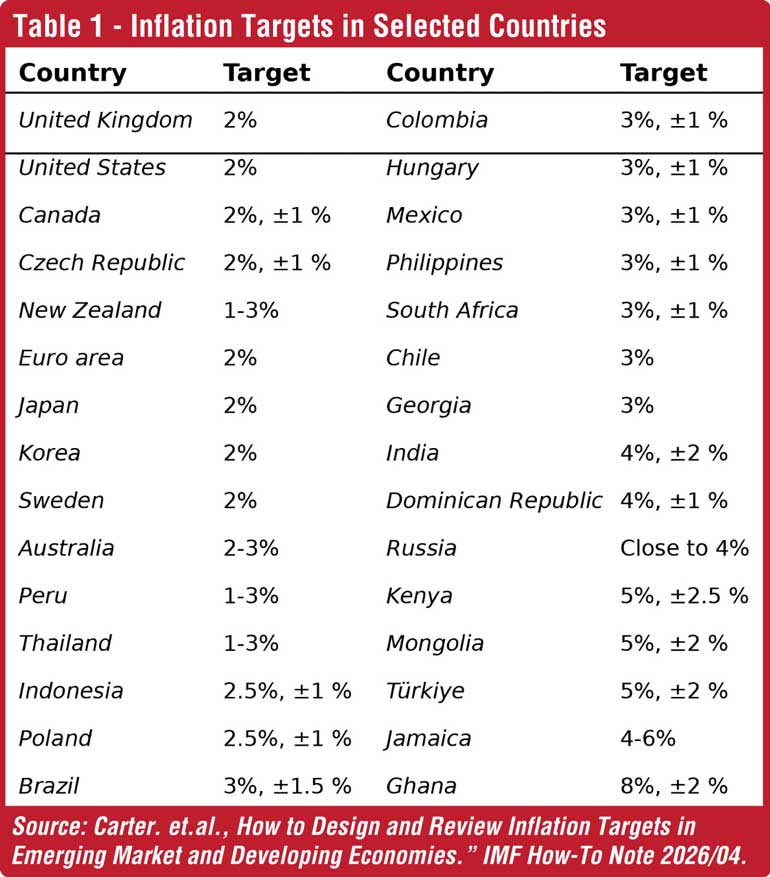
Countries adopt different inflation targets tailored to their economic conditions (Table 1). These targets can take various forms, such as a point target (2%), a point target with a band (2%, ±1 %), or a band target (1-3%). The width of the band also varies depending on country characteristics. A common observation is that advanced economies, which generally have lower trend inflation and lower inflation volatility, tend to set lower inflation targets than other countries. Most Emerging Market and Developing Economies (EMDEs) and early adopters of IT frameworks set relatively higher targets, usually with a band, to accommodate supply-side volatility. Meanwhile, some mature EMDEs, with a proven track record of inflation control, better-anchored inflation expectations, and strong credibility in their IT frameworks, have gradually lowered their targets over time.
Why is recent inflation a poor guide to set future target?
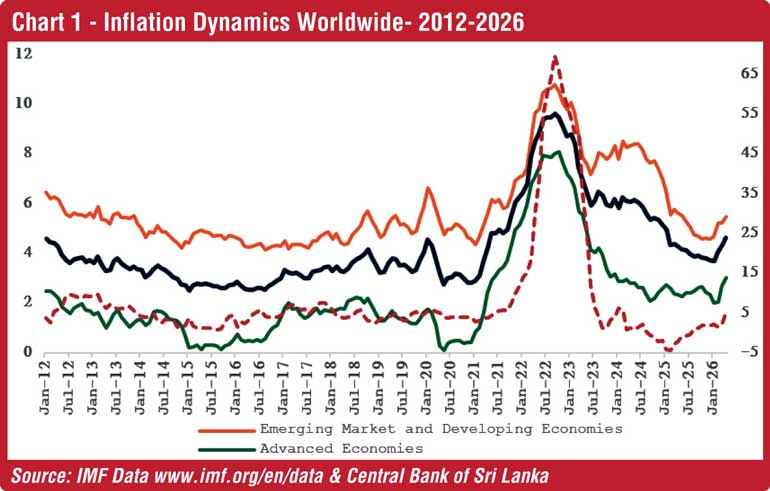
Inflation followed an unusual pattern worldwide in the post-pandemic period. From 2021 to early 2022, inflation accelerated because of both demand and supply pressures. As economies reopened, demand for goods and services strengthened, supported by fiscal stimulus and loose monetary policy in many economies. At the same time, supply bottlenecks persisted, commodity prices surged, and second-round effects from global price shocks added further pressure. Sri Lanka’s inflation episode was more complex. In addition to global drivers, domestic factors, including sharp currency depreciation, food price increases following supply shocks, and large one-time energy price adjustments and spillovers, pushed inflation to historically unprecedented levels. Subsequent monetary policy responses and the gradual normalisation of global commodity prices supported disinflation from 2023. Sri Lanka’s disinflation was steeper than in many countries and was followed by temporary deflation from late 2024 to mid-2025. However, a reversal of the disinflationary trend has begun to emerge worldwide, following the energy price shock and supply disruptions triggered by the Middle East conflict in early 2026. In Sri Lanka, too, inflation surged from 2.2% in February to 7.3% in July 2026, with inflation likely to remain elevated in the near term.
Chart 1 offers several important insights. First, inflation dynamics worldwide and in Sri Lanka have been abnormal since 2021. Second, average inflation in advanced economies is generally lower than in EMDEs. In the absence of major global shocks, inflation in advanced economies has typically hovered around 2%, while inflation in EMDEs has been around 5%-6%. Third, Sri Lanka’s inflation dynamics, shown on the right axis, were broadly comparable to those of EMDEs. Fourth, many countries likely missed their inflation targets in the post-pandemic period as inflation deviated sharply from historical trends. This shows that inflation trends since 2021 have been atypical and should not be used to infer an appropriate inflation target for the future.
Higher inflation targets and wider tolerance bands in EMDEs, compared with advanced economies, are empirically justified. EMDEs are more exposed to food and energy price volatility, and these items account for a larger share of their consumption baskets. This makes inflation higher and more volatile. EMDEs are also more exposed to global shocks through exchange rate depreciation and stronger pass-through to inflation. Cross-country studies also point to weaker fiscal and monetary policy institutions, less-anchored expectations, and communication gaps as factors shaping inflation dynamics in EMDEs. These factors remain important when setting inflation targets.
The Balassa–Samuelson effect also helps explain the persistent positive inflation gap between EMDEs and advanced economies. In fast-growing EMDEs, productivity gains in the tradable sector, especially exports, allow firms to pay higher wages. These wage increases can spread to the non-tradable sector, where productivity growth is usually lower, pushing up costs and prices. A somewhat higher inflation target may therefore be justified in fast-growing, open EMDEs if this effect is persistent. Empirical evidence supports the effect, although estimates vary across countries. Recent estimates for India, for example, place it at about 1.7%–2.2%.
Would a sizeable reduction in Sri Lanka’s inflation target be prudent at this stage? 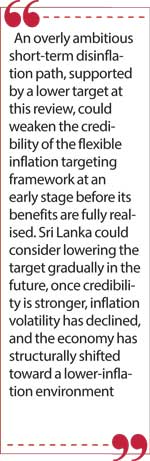
The long-term socioeconomic benefits of low inflation are well documented. However, reducing inflation to a low and less volatile level in EMDEs is not straightforward. A structural reduction in inflation takes time and requires several supporting conditions and policies. Mechanically lowering the inflation target as a shortcut to low inflation could have unintended consequences. The key arguments against notably lowering inflation target in this review are summarised below.
Should the target shift from headline inflation to core inflation?
The debate in Sri Lanka has also raised the question of whether the target should shift from headline inflation to core inflation. Core inflation remains useful as it captures underlying inflation trends and helps guide monetary policy decisions. However, using core inflation as the formal target has important drawbacks for credibility and transparency. The public experiences inflation mainly through the prices of frequently purchased goods and services, especially food and energy. Their inflation expectations are also shaped by these prices. If the central bank targets an inflation measure that excludes such items, the public may find the target less credible, and expectations could diverge from it. Core inflation targeting can also make monetary policy communication more difficult. Since credibility and well-anchored expectations are central to successful inflation targeting, most countries use headline inflation as the formal target. Thailand, Korea, and the Czech Republic used core inflation targets at initial stages but later moved to headline inflation. Today, headline inflation is the formal target in majority of IT countries, with Uganda being a notable outlier.
In practice, core and headline inflation tend to converge over time, although the speed of convergence differs across countries. Headline inflation may rise temporarily because of supply-side shocks, such as increases in food or energy prices. If these shocks are temporary, the gap between headline and core inflation should close over time, provided there are no significant second-round effects or changes in inflation expectations. In general, headline inflation tends to return to core inflation after a temporary supply shock. However, if the shock is large and persistent, headline inflation can remain above core inflation for longer. Over time, higher food or energy prices may affect other goods and services, raise inflation expectations, and create wage pressures. These effects can eventually push core inflation higher as well. For this reason, central banks closely monitor both headline and core inflation, paying attention to supply-side shocks in addition to demand pressures that are directly relevant for monetary policy. Yet, headline inflation is used to set public inflation targets.
Should the inflation target move from the Colombo Consumer Price Index (CCPI) to the National Consumer Price Index (NCPI)?
The national measure of inflation has several merits, as it provides wider coverage of both geographic regions and the consumption basket. However, at this stage, it also has some weaknesses as a formal inflation target. First, food has a much larger weight in the NCPI than in the CCPI (39% compared with 26%). As a result, NCPI inflation is more vulnerable to volatility from supply-side disruptions and is less responsive to monetary policy. Second, the data release lag is long, with NCPI published after 21 days, compared with the immediate release of the CCPI. This limits its usefulness for timely policy decisions. Third, the NCPI has a much shorter data series, starting only in 2014, compared with the CCPI, which dates back to 1953. This makes the NCPI less suitable for macroeconomic modelling and inflation forecasting, both are important for monetary policy formulation.
Reliable inflation forecasting based on high-frequency data and indicators is central to an IT framework. Therefore, adopting an NCPI-based inflation target at this initial stage could raise credibility concerns. Over time, as Sri Lanka’s statistical system matures, data become timelier, and the NCPI series becomes sufficiently long, Sri Lanka could revisit the case for moving toward a nationally representative inflation measure as the formal target.
Conclusion
There is no compelling reason to make a notable reduction in Sri Lanka’s inflation target at this stage. Although inflation outturn in 2024/25, following the historic inflation peak, has been well below the current target, this alone does not justify changing the target for the next three years. This conclusion is especially relevant given the uncertain global geoeconomic environment and Sri Lanka’s ongoing domestic macroeconomic recovery. Moreover, an abrupt reduction of more than half of the original target at an early stage of inflation-targeting adoption, as some have proposed for Sri Lanka, would be globally unprecedented and impractical. It is therefore premature to make any sizeable change to the inflation target. An overly ambitious short-term disinflation path, supported by a lower target at this review, could weaken the credibility of the flexible inflation targeting framework at an early stage before its benefits are fully realised. Sri Lanka could consider lowering the target gradually in the future, once credibility is stronger, inflation volatility has declined, and the economy has structurally shifted toward a lower-inflation environment.
(The author currently serves as the Alternate Executive Director at the Executive Board of the International Monetary Fund (IMF) and is a former Director of the Economic Research Department of the Central Bank of Sri Lanka (CBSL). The views expressed in this article are her own and do not necessarily reflect those of the IMF or the CBSL)
References




