Saturday Oct 17, 2026
Saturday Oct 17, 2026
Friday, 17 July 2026 00:25 - - {{hitsCtrl.values.hits}}
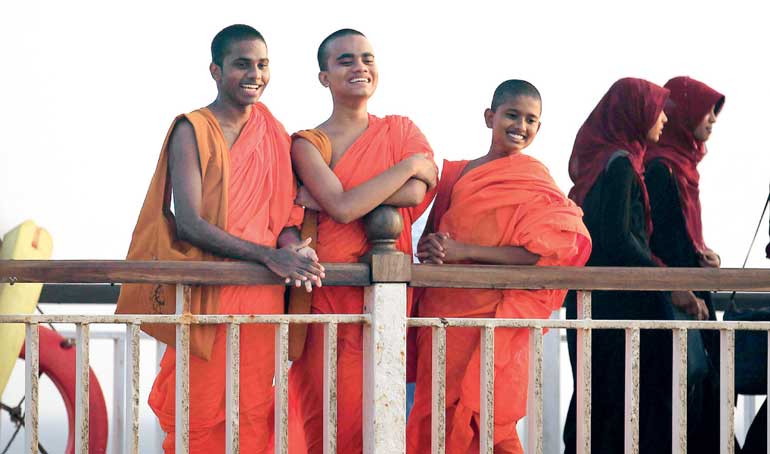
Recognising the central place of Buddhism in Sri Lanka’s civilisational history does not diminish the contributions of Hindus, Muslims, Christians, or any other community. On the contrary, a nation that is confident in its own heritage is better able to respect and celebrate the heritage of others
 For generations, discussions about Sri Lanka’s future have focused on economic policy, foreign investment, debt restructuring, taxation, political reform, and constitutional change. These are all essential matters. Yet one of the nation’s greatest strategic assets is often overlooked, not because it lacks importance, but because it has too often been viewed only through the narrow lens of religion rather than as the very foundation of Sri Lanka’s civilisation.
That asset is Sri Lanka’s Buddhist heritage.
This is not an argument for establishing a religious state, nor is it an invitation to diminish the rights, dignity, or contributions of Hindus, Muslims, Christians, or any other community that has enriched our island over centuries. Rather, it is an argument that Sri Lanka possesses a unique civilisational inheritance capable of strengthening ethical leadership, national identity, education, environmental stewardship, international diplomacy, and social harmony if understood and applied wisely.
Unique place in world history
Sri Lanka occupies a unique place in world history. For more than two thousand years it has been one of the principal custodians of the Theravāda Buddhist tradition. According to long-standing historical tradition, it was in Sri Lanka that the Pāli Canon was first committed to writing, preserving an invaluable body of Buddhist teachings for future generations. This achievement was not merely a religious milestone; it was one of humanity’s great accomplishments in preserving ethical and philosophical knowledge.
That legacy belongs not only to Sri Lankan Buddhists but to the world.
The wisdom of our ancient kings
Throughout Sri Lanka’s history, many of its greatest kings understood that governing a nation required more than political authority or military strength. They recognised that power without wisdom was dangerous.
While ministers, engineers, physicians, military commanders, and scholars advised on the practical affairs of the kingdom, the Maha Sangha often provided moral and ethical guidance on questions of justice, compassion, restraint, education, reconciliation, and the responsibilities of kingship. The relationship between the Crown and the Sangha was not one of political control, but of moral counsel.
History suggests that this partnership strengthened the nation. During many of these periods, Sri Lanka developed remarkable irrigation systems, prosperous agricultural economies, respected centres of learning, magnificent architecture, and a civilisation admired throughout Asia. The kings did not surrender their authority, nor did the Sangha govern the kingdom. Instead, political leadership was guided by enduring ethical principles.
This historical experience should not be dismissed as merely a chapter of the past. It offers a timeless lesson for modern governance.
A lesson for today’s leaders
Modern Sri Lanka is a democratic republic, not an ancient kingdom. Our institutions are different, and rightly so. Government must remain accountable to the Constitution, Parliament, the rule of law, and the people. Yet democracy should never mean governing in isolation from the accumulated wisdom of our civilisation.
Political leaders should actively seek the counsel of the senior Buddhist clergy while also listening respectfully to Hindu, Muslim, Christian, and other religious leaders, together with distinguished educators, scientists, economists, jurists, business leaders, and representatives of civil society.
Such consultation should never replace democratic decision making. Rather, it should enrich it by ensuring that national policies are informed not only by economics and politics, but also by ethics, history, social responsibility, and long-term national interest.
The greatest leaders throughout history have never assumed they possessed all wisdom themselves. They sought counsel before making decisions that shaped the destiny of nations.
Restoring the nation’s moral compass
The need for ethical leadership has perhaps never been greater.
Many Sri Lankans feel that our society is gradually losing qualities that once defined our national character: honesty, respect for elders, personal discipline, compassion, civic responsibility, courtesy, humility, public service, and concern for the common good.
These concerns are not unique to Sri Lanka. Around the world, rapid technological change, consumerism, political polarisation, misinformation, and declining trust in institutions have challenged long-established moral and civic values.
Economic recovery alone cannot restore the soul of a nation.
A country may become wealthier while becoming poorer in integrity, trust, compassion, and public responsibility. Sustainable national greatness requires both material progress and moral progress.
Buddhism as a national strategic asset
For more than two thousand years, Buddhism has provided Sri Lanka with a profound ethical tradition rooted in wisdom, compassion, moderation, truthfulness, mindfulness, and responsibility.
These principles should not be viewed as belonging exclusively to Buddhists. They are universal human values that resonate with the highest teachings of every great religious and philosophical tradition represented in Sri Lanka.
Sri Lanka should therefore regard its Buddhist civilisation not merely as a religious inheritance but as one of its greatest national assets.
Just as Italy draws strength from its Renaissance heritage, Japan from its cultural traditions, Greece from its classical civilisation, and India from its ancient philosophical legacy, Sri Lanka should confidently present itself as the global home of Theravāda Buddhist scholarship, Pāli studies, meditation, ethical leadership, manuscript preservation, archaeology, peace studies, and interfaith dialogue.
This would strengthen education, research, tourism, cultural diplomacy, international cooperation, and Sri Lanka’s standing in the world.
A heritage that unites rather than divides
Recognising the central place of Buddhism in Sri Lanka’s civilisational history does not diminish the contributions of Hindus, Muslims, Christians, or any other community.
On the contrary, a nation that is confident in its own heritage is better able to respect and celebrate the heritage of others.
Sri Lanka’s civilisation has been enriched by every religious and ethnic community that has called this island home. Our future prosperity depends upon preserving both our Buddhist foundations and our pluralistic national character.
The finest expression of Buddhist civilisation is not dominance.
It is compassion.
It is justice.
It is wisdom.
It is humility.
It is service.
Building the next generation
If Sri Lanka is to achieve lasting national greatness, ethical values must once again become part of everyday life.
Our schools should educate young people not only in mathematics, science, languages, technology, and commerce, but also in character, civic responsibility, environmental stewardship, honesty, compassion, respect for diversity, and service to society.
Public institutions should reward competence, integrity, and accountability above political patronage.
Business leaders should measure success not only by profit but also by responsibility to employees, communities, and the nation.
Political leaders should remember that public office is a sacred public trust carrying a duty to serve future generations rather than short term political interests.
Parents, teachers, religious leaders, universities, the media, and civil society all share responsibility for nurturing the ethical foundations upon which every successful nation ultimately depends.
A call to national renewal
Sri Lanka has already given one priceless gift to humanity by preserving the Theravāda Buddhist tradition and ensuring the survival of the Pāli Canon.
The challenge before this generation is to offer a second gift.
To demonstrate that an ancient civilisation can also become a modern, prosperous, innovative, democratic, and compassionate nation.
To show that scientific progress and spiritual wisdom are not opposing forces but complementary strengths.
To prove that ethical leadership remains the strongest foundation upon which lasting prosperity can be built.
If Sri Lanka can unite modern democratic governance, economic excellence, scientific advancement, and technological innovation with the timeless ethical wisdom cultivated on this island for more than two millennia, it has every opportunity to become one of the most respected nations in Asia and the Indian Ocean region.
History remembers civilisations not only for the wealth they accumulated, but for the values they upheld and the example they offered to humanity.
Sri Lanka possesses that opportunity once again.
May we have the wisdom to recognise it.
(The author is a Former Ambassador of Sri Lanka - France / Netherlands/ Monaco and Cofounder Diplomatic Council)




