Monday Oct 12, 2026
Monday Oct 12, 2026
Thursday, 14 May 2026 00:20 - - {{hitsCtrl.values.hits}}
 With India poised to become the world’s third-largest economy, Sri Lanka must treat its nearest neighbour not as a trade rival but as its most consequential export destination.
A billion-person market and the opportunity Sri Lanka is missing
India sits fewer than 30 kilometres across the Palk Strait, growing at a pace few economies in history have matched. Its GDP is projected to expand by 6.5–7.6% in 2026.1 Its 1.455 billion people — roughly 17% of humanity — represent a rapidly expanding consumer class seeking premium goods, quality food, specialist textiles, and services.2 For Sri Lanka, the question is not whether India is an opportunity. The question is why it has not been seized.
Sri Lanka is the only country on earth with a free trade agreement with this economic giant and a geographic footprint that places it within overnight shipping distance of India’s southern ports.
A shifting world order — and why India is now a strategic imperative
Sri Lanka’s case for pivoting to India has always been logical. What has changed is that it has become structurally necessary. Three shifts in global trade have weakened Western markets and elevated India to strategic primacy.
First, the Trump tariff shock. In April 2025, the US imposed sweeping tariffs — Sri Lanka’s rate settled at 20%, effectively doubling export costs. Apparel, the bulk of US-bound exports, has been hit hardest: an estimated $634 million in annual revenue is at risk and up to 15,000 jobs hang in the balance.
Second, the EU–India ‘Mother of All Deals’. On 27 January 2026, the EU and India announced a landmark FTA covering 2 billion people and a combined GDP of $27 trillion. It eliminates duties on nearly 99.5% of Indian exports to the EU, wiping out Sri Lanka’s GSP+ zero-tariff advantage overnight. Yet it also creates an opening: as India scales to capture EU market share, it will need premium inputs — Ceylon tea, coconut derivatives, specialty spices — that Sri Lanka supplies. The answer is not to compete with India in Brussels; it is to supply upward into
India’s EU-facing chains.7
Taken together, these shifts transform the India relationship from an option into a defensive imperative. The US market is unreliable without an FTA; the EU advantage is gone. India is the one large market where Sri Lanka holds binding treaty access, an unmatched geographic position, and a counterpart growing at 6–7% annually.
Sri Lanka’s export basket and the India bilateral
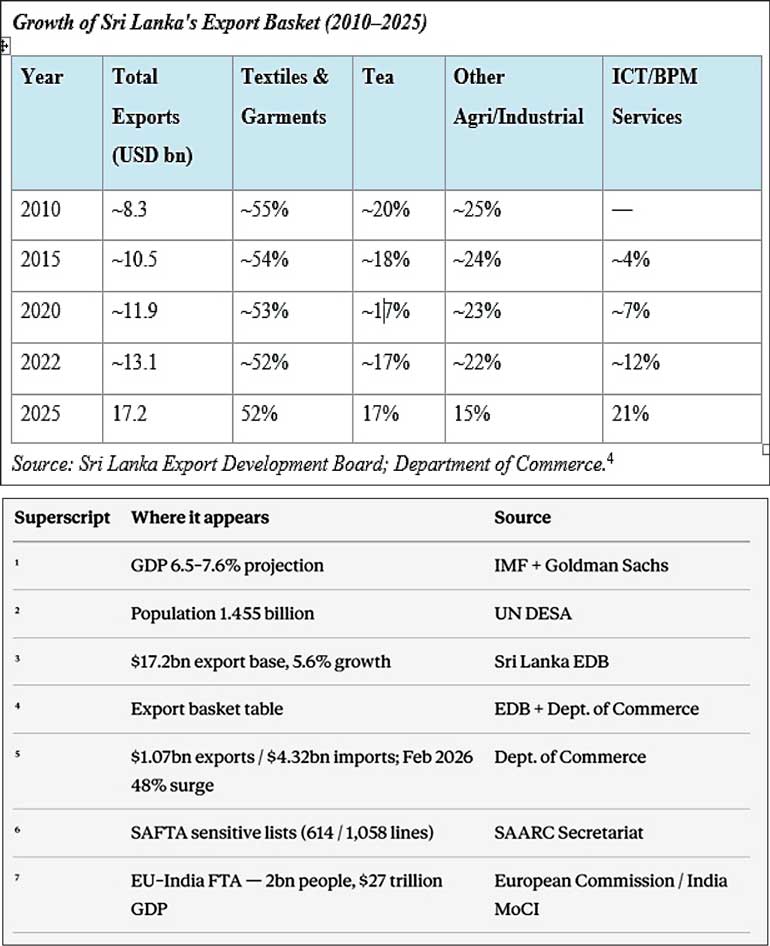
Sri Lanka’s total export base reached $17.2 billion in 2025 (up 5.6%), with textiles at 52%, tea at 17%, other agri-industrial at 15%, and a fast-growing ICT/BPM services share of 21%.3
Against this base, Sri Lanka exported just $1.07 billion to India in 2024, against imports of $4.32 billion — a deficit that reflects execution failures, not structural incompatibility. February 2026 exports hit $264 million, a 48% year-on-year increase: momentum is building.5
The tariff architecture: Opportunity hiding in plain sight
The ISFTA, in force since 2000, covers over 60% of Sri Lanka’s India-bound exports; SAFTA reduces tariffs to 0–5% on most goods. The critical caveat is the Sensitive List: India’s list for non-LDC SAFTA members covers 614 product lines; Sri Lanka’s runs to 1,058 — protectionist carve-outs in exactly the categories with the greatest bilateral potential.6The immediate opportunity is in aggressively capturing categories already open.
Four priority sectors for export expansion
Textiles and Apparel: Ethical production credentials and quality standards position Sri Lanka to supply the premium segment of India’s growing garment market.
Agri-Products and Processed Foods: Tea, spices, and coconut derivatives have strong receptivity in India. Branded Ceylon tea and certified organic products command multiples of bulk commodity prices.
ICT and BPM Services: English-language proficiency, time-zone alignment, and strong educational standards give Sri Lanka credible niches in legal process outsourcing, financial back-office, and specialist outsourcing.
Shipbuilding and Maritime Logistics: A surge in vessel exports to India signals an underreported opportunity. Sri Lanka’s maritime geography and port infrastructure position it as a natural regional logistics hub complementing India’s own ambitions.
From raw commodity to premium brand: The value-addition imperative
Value addition must be the organising principle. Sri Lanka exports bulk tea and raw spices where it should be exporting branded, certified products at two to three times the unit value. Equally urgent: upgrading phytosanitary and food safety certification, where administrative gaps — not product quality — cause most delays at the Indian border. Proximity to Chennai, Tuticorin, and Kochi makes just-in-time supply chain integration achievable, but it requires trade diplomacy to match.
The strategic imperative
The analytical case is settled. What remains is execution. Sri Lanka’s trade policy has been reactive — responding to shocks rather than positioning the country within regional value chains. The India opportunity demands the opposite: a sustained, multi-year campaign to certify exporters, build logistics, and develop brand equity in the Indian market. The architecture is in place. Coordinated action from the private sector and trade institutions is what is required now. India will become the world’s third-largest economy regardless. The only variable is whether Sri Lanka is a beneficiary or a bystander.
The Palk Strait is not an obstacle. It is Sri Lanka’s most underutilised trade asset.
(The author began his career in the banking sector, where he built an illustrious track record before transitioning into education in 2007. Since then, he has held senior leadership roles including Regional Director of CIMA and Executive Director of IIHE, while also serving as a lecturer for MBA programs across both local and British universities. Bradley has contributed directly to national education policy, serving on two Education Reform Commissions under Minister S.B. Dissanayake and Minister Susil Premjayantha. His work bridges practice and policy, combining strategic leadership with a commitment to shaping classrooms as engines of national transformation. He could be reached via email at [email protected])




