Friday Oct 02, 2026
Friday Oct 02, 2026
Friday, 2 October 2026 00:24 - - {{hitsCtrl.values.hits}}
 The Department of Census and Statistics recently announced that Sri Lanka’s economy has grown by 4.2% in the second quarter of 2026. Whilst this may be below the desired five percent GDP growth mark, Sri Lanka's economic recovery since the crisis of 2022 is one of the most significant turnarounds in the country's recent history.
In 2026, we see that Inflation is at a moderate eight percent, foreign reserves have strengthened at seven billion dollars, remittances have picked up depicting a twenty percent growth tourism has rebounded but flat this year due to the middle eastern crisis whilst exports are growing at eight percent plus. Let’s accept it from a macro end it is a happy story
By most macroeconomic indicators, Sri Lanka has successfully moved from crisis management to stabilisation. Yet an important question remains unanswered: has economic stabilisation translated into household prosperity?
The latest data from PepperCube Consultants suggests that the answer is still largely no. When examined collectively, the PepperCube Propensity Savings Index, FMCG Retail Audit, Cost of Living Tracker and Economy and Growth Tracker paint a remarkably consistent picture that the Sri Lankan household is under severe challenge. The household finances remain fragile, consumer confidence remains weak and spending behaviour continues to reflect caution rather than optimism. The emerging reality is that Sri Lanka has achieved economic stabilisation, but household recovery is lagging behind.
The savings gap tells the story
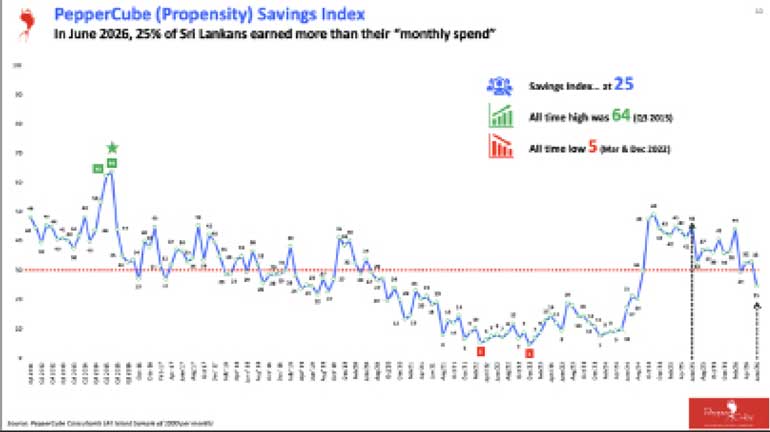
The PepperCube Propensity Savings Index, which measures the percentage of Sri Lankans whose monthly income exceeds monthly expenditure. In June 2026, the index stood at 25, meaning only one in four Sri Lankans earns more than they spend each month. Conversely, 75% of households either break even or spend beyond their income, leaving limited room for savings, investment or financial security. At first glance, this appears to be progress.
Whilst this data is staggering, a point to note is that in the height of the economic crisis in 2022, the index had collapsed to an all-time low of 5, indicating that almost the entire population was struggling financially but there after it recovered drastically to an all-time high of 49% of the population's income being higher than the monthly expenditure. But sadly this number has crashed to twenty five percent which explains why only fifteen percent of the credit card users settle the full credit card bill. This is the reality we must address as a nation.
This is why some argue that IMF programs in a country do more bad than good to a human being.
Household recovery remains fragile
The importance of the savings data extends beyond personal finance. Savings capacity is one of the strongest indicators of household resilience. Families with savings can absorb unexpected medical expenses, invest in education, improve housing conditions and prepare for economic shocks. Families without savings remain vulnerable, regardless of what macroeconomic indicators suggest. The current index indicates that almost 75% of the Sri Lankan households continue to live within tight financial constraints. This helps explain why many consumers remain unconvinced by the broader recovery narrative. Households do not evaluate the economy through GDP growth rates, foreign reserve accumulation or fiscal indicators. They evaluate it through daily experiences such as grocery bills, school expenses, utility charges and transport costs. Whilst inflation has slowed significantly, price levels remain far higher than before the crisis. The burden on household budgets therefore remains substantial.
FMCG demand decline by 7%
The PepperCube FMCG Retail Store Audit June, 2026 edition provides further evidence that purchasing power remains under pressure. In June 2026, FMCG sales declined by 7% in volume and 6% in value compared with May 2026 across 39 branded categories. This is a significant decline and difficult to dismiss as a routine monthly fluctuation.
More importantly, volume declined faster than value. This suggests consumers are purchasing fewer products rather than simply benefiting from lower prices. In practical terms, households appear to be adjusting to financial pressure by: Buying smaller quantities, Delaying purchases, Trading down to cheaper alternatives, Prioritising essential categories.
Although year-to-date FMCG growth remains positive, the fact that value growth continues to outpace volume growth suggests consumption remains constrained. In healthy consumer markets, growth is generally driven by increasing volumes. In Sri Lanka's case, part of the growth appears to be supported by pricing rather than a meaningful expansion in consumer demand. The data suggests that consumers remain focused on managing expenditure rather than increasing consumption says a lot about the Sri Lankan quality of life.
The consumer confidence problem
The recovery challenge becomes even clearer when examining public perceptions of the economy. According to PepperCube's Economy and Growth Tracker, 44% of respondents believe the economy declined during the last 12 months, whilst only 20% believe there has been growth. Looking ahead, confidence remains weak. Thirty-nine percent expect the economy to deteriorate over the next 12 months, compared to only 18% who expect growth. This is not good news for corporate Sri Lanka that drives business only in the domestic market.
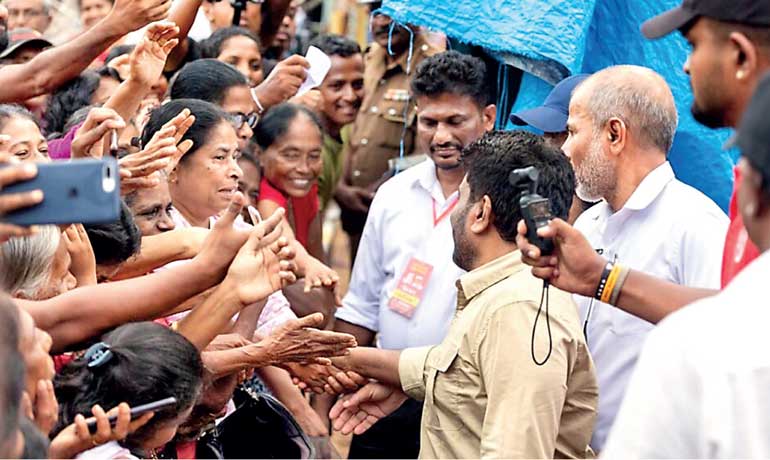
Similarly, when respondents were asked about future development activity, 40% expected development projects to be stopped, whilst only 12% believed development would accelerate. These findings are significant because economic performance is influenced not only by actual conditions but also by expectations. Consumers who anticipate worsening conditions tend to postpone discretionary spending, avoid major purchases and maintain conservative spending habits. This creates a self-reinforcing cycle where weak confidence suppresses demand, which in turn slows broader economic momentum. The Government must address this issue with an economic stimulus so that one can jump start the economy. We need this type of economic development given that the President is meeting the masses as per the rallies in Anuradhapura and Jaffna.
Cost of living remains the dominant concern
Perhaps the strongest explanation for weak consumer sentiment comes from PepperCube's Cost of Living Tracker. The June 2026 findings show that 84% of Sri Lankans believe their cost of living has increased during the past year, whilst only 1% believe it has declined. I guess this explains the lower demand seen in the private sector education industry of Sri Lanka. Many students are opting out of Advance Level education and taking the route of “ Foundation studies and top up degree pathways which are not the best for developing the brain with depth of thinking.
More significantly, 63% expect the cost of living to increase further over the next 12 months, compared to just 4% who expect costs to fall. This indicates that cost-of-living concerns remain deeply entrenched. From a behavioural perspective, these perceptions matter enormously. Consumers who expect prices to rise continue to behave defensively even if official inflation figures improve. They prioritise necessities, seek value offerings and avoid discretionary spending. This is precisely the behaviour reflected in both the FMCG and savings data. I guess the El Niño phenomenon will aggravate the situation.
A recovery gap is emerging
A deeper analysis reveals that macroeconomic indicators have improved faster than household finances. Government revenues have recovered. Tourism has stabilised even with the middle eastern war, The financial system has stabilised with a positive Rs. 197 billion income over expenditure.
However the household savings remain weak, consumer confidence subdued and spending patterns continue to reflect financial caution. This gap between the macroeconomic indicators and the Household reality is not unusual following a major economic crisis. In many countries, household recovery typically lags behind economic stabilisation. However, the longer this gap persists, the greater the risk that public confidence in the recovery weakens; this means it has a negative effect on the political leadership like what we see in Sri Lanka today. Economic success ultimately depends not only on fiscal stability and growth figures but also on whether households experience tangible improvements in living standards. The Government must understand that ‘Governance’ is not a currency that can be traded in the long term. There will be a fall out and we must avoid such an issue at any cost.
The next phase of reform
Sri Lanka's first phase of recovery focused rightly on restoring stability. Inflation control, debt restructuring and fiscal consolidation were necessary priorities. We have achieved this as a nation. The next phase must focus on transmission. In other words, policymakers must ensure that macroeconomic gains translate into stronger household finances. This requires attention to four priorities: Accelerating real income growth through productivity and expanding export-oriented industries capable of generating sustainable wage growth. We have no option but pursue deeper trade with India under the Comprehensive Economic Partnership Agreement (CEPA) or a similar trade pact. India’ is billing at 7% plus GDP growth.
Improving the investment climate to support job creation, measuring progress through household indicators such as savings rates, consumer confidence and real wage growth alongside traditional macroeconomic metrics must become a way of life at a political level rather than the Governance thrust becoming priority. Let’s accept it, a recovery cannot be considered complete if most households remain unable to build financial reserves.
Next steps
The PepperCube data offers both encouragement and caution. The encouraging news is that Sri Lanka is no longer in crisis. The improvement in savings capacity, combined with stronger macroeconomic indicators, demonstrates that stabilisation efforts have delivered results. The caution is that stabilisation has not yet become prosperity. Three out of four Sri Lankans remain unable to save regularly.
Consumer confidence remains weak, FMCG demand has softened and cost-of-living concerns continue to dominate household thinking. The evidence suggests that Sri Lanka's recovery is real, but it remains largely a macroeconomic recovery. The next challenge is ensuring that it becomes a household recovery as well. Sri Lanka's recovery story will remain unfinished.
(The author is an alumnus of Harvard University. He serves in Sri Lanka and internationally)



