Tuesday Sep 22, 2026
Tuesday Sep 22, 2026
Tuesday, 22 September 2026 04:51 - - {{hitsCtrl.values.hits}}
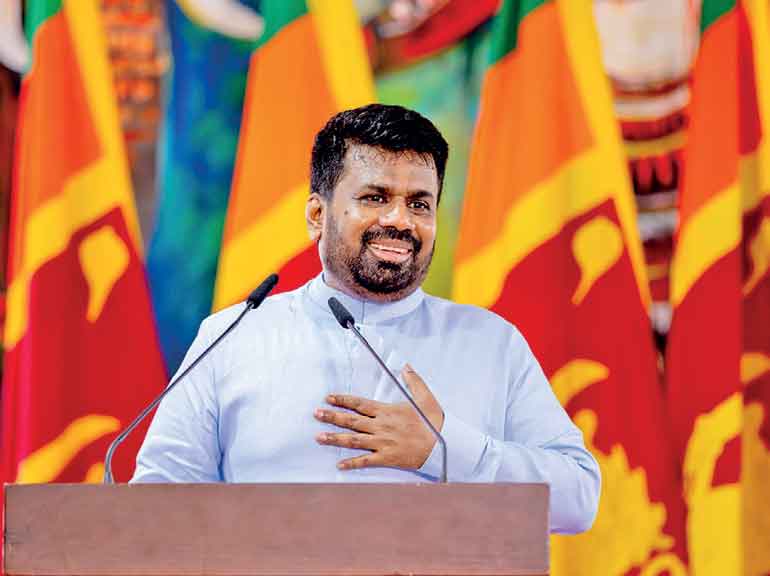
President Anura Kumara Dissanayake
 Sri Lanka’s political transformation since the economic collapse of 2022 is one of the most remarkable democratic realignments in contemporary South Asia. A protest movement that began amid shortages of fuel, food, medicine and foreign exchange ultimately discredited much of the traditional political establishment. Two years later, voters elected Anura Kumara Dissanayake as president and handed his National People’s Power (NPP) coalition an unprecedented parliamentary mandate.
The transition initially appeared to demonstrate the resilience of Sri Lankan democracy. A political movement rooted in the Janatha Vimukthi Peramuna (JVP) — a party that twice attempted to seize power through armed insurrection — had reached the presidency through the ballot box.
But Sri Lanka has now entered a more difficult phase of its democratic experiment.
The central question is no longer whether the NPP possesses democratic legitimacy. It unquestionably does. The question is what a Government with an overwhelming parliamentary majority does with that legitimacy — and whether institutional checks remain sufficiently strong when electoral power becomes highly concentrated.
The controversy surrounding the proposed Twenty-Second Amendment to the Constitution has brought this question into sharp focus.
From Aragalaya to electoral revolution
The origins of the NPP’s extraordinary electoral breakthrough lie in the economic and political collapse of 2022.
Sri Lanka’s foreign exchange crisis produced shortages of basic necessities, lengthy fuel queues and widespread economic hardship. Public frustration developed into the Aragalaya, or “struggle”, a decentralised protest movement demanding not only the resignation of President Gotabaya Rajapaksa but a broader transformation of political governance.
Sri Lanka must demonstrate that “system change” means not merely changing who exercises power, but changing how power itself is constrained.
That will be the real democratic test of the NPP era
The slogan “system change” captured an important feature of the uprising. Protesters were not simply demanding another rotation among the established political families. They were challenging corruption, patronage, dynastic politics and a political system widely perceived to have become detached from ordinary citizens.
Rajapaksa fled the country and resigned in July 2022. But the immediate political settlement did not produce the transformation many protesters expected. Parliament elected Ranil Wickremesinghe president to complete Rajapaksa’s term. His administration restored a degree of economic stability and negotiated with the International Monetary Fund, but its dependence on the existing parliamentary establishment created a persistent legitimacy problem.
This gap between economic stabilisation and political legitimacy created an opening for the NPP.
Dissanayake’s victory in September 2024 was therefore not an isolated electoral event. It was, in important respects, the institutional continuation of the anti-establishment political energy unleashed in 2022.
He received 5.63 million votes, or 42.31% of first-preference votes, in the presidential election. Because no candidate secured an absolute majority, Sri Lanka counted preferential votes for the first time in its presidential electoral history. The subsequent parliamentary election transformed this presidential victory into overwhelming legislative power: the NPP won 159 of Parliament’s 225 seats.
The scale of that victory fundamentally changed Sri Lankan politics.
The NPP was no longer an insurgent political alternative challenging the establishment. It had become the establishment.
The JVP’s historical shadow
That transformation cannot be understood without examining the history of the JVP.
The JVP emerged from Sri Lanka’s radical Marxist politics and mobilised disaffected young people, particularly from rural Sinhala lower- and middle-class backgrounds. It organised two armed insurrections — the first in 1971 and the second between 1987 and 1989.
Both episodes occupy painful places in Sri Lanka’s political memory.
The 1971 insurrection represented an attempt by a revolutionary youth movement to overthrow the state. The 1987–89 uprising was longer and considerably more violent, taking place amid the Indo-Sri Lanka Accord, Indian military intervention and intense political instability. The JVP and its associated forces were responsible for killings and intimidation, while the state’s counter-insurgency campaign involved widespread extrajudicial violence and disappearances.
Reducing today’s JVP simply to this history would nevertheless be analytically misleading.
The organisation subsequently abandoned armed struggle and entered parliamentary politics. Dissanayake himself played an important role in its evolution toward electoral competition. The creation of the broader NPP coalition in 2019 further sought to reposition the movement beyond the JVP’s traditional Marxist constituency.
Its economic politics have also moderated. The JVP historically championed extensive state intervention and Marxist economic policies, but the NPP Government has operated far more pragmatically since entering office, including maintaining engagement with the IMF and international creditors.
This evolution is politically significant. A movement with a revolutionary past has demonstrated that radical political organisations can be incorporated into democratic competition.
Yet history continues to shape perceptions.
During my visit to Sri Lanka from 4 to 15 September 2026, discussions with academics, former officials and citizens revealed an anxiety that is difficult to capture through election statistics alone. Some interlocutors repeatedly returned to the JVP’s historical experience and questioned whether the movement’s democratic transformation is irreversible.
These views should not be mistaken for evidence that the Government intends to recreate the politics of the 1970s or 1980s. Nor can conversations during a field visit be treated as representative public-opinion data.
Opposition leaders describe the amendment as a threat to judicial independence and accuse the Government of attempting to consolidate one-party rule. The Government rejects that interpretation and argues that the reform will strengthen judicial capacity and reduce delays. Both claims are now part of Sri Lanka’s political contest. The more important democratic test may therefore be how that contest is managed
But the persistence of these fears matters politically.
Democratic legitimacy depends not only on winning elections but also on persuading citizens that institutions will remain protected when political power changes hands.
A small-state democratic paradox
Sri Lanka’s predicament also needs to be understood through the politics of small states.
Small states are frequently analysed internationally in terms of vulnerability to larger powers. Sri Lanka’s location at the centre of the Indian Ocean has made this external dimension particularly visible. Colombo must navigate relations with India, China, the United States, Japan and other partners while simultaneously managing debt restructuring and dependence on international financial institutions.
But small-state vulnerability has a domestic dimension as well.
Where political, economic and administrative institutions are concentrated within a relatively small political system, changes in governing coalitions can rapidly reshape the distribution of institutional power. Informal networks, personalised politics and the weakness of institutional counterweights can magnify the effects of a large electoral majority.
Sri Lanka has repeatedly experienced this problem.
The danger is not peculiar to the NPP. Successive Sri Lankan Governments have attempted to alter the constitutional balance among the presidency, parliament, judiciary and independent institutions. Constitutional amendments have repeatedly become instruments through which Governments restructure political authority.
This historical pattern makes the Twenty-Second Amendment especially important.
Why the 22nd Amendment matters
The proposed amendment was presented to Parliament on 18 August 2026.
Among its central provisions is an increase in the retirement age of Supreme Court judges from 65 to 67 and Court of Appeal judges from 63 to 65. Related judicial reforms would also expand judicial capacity.
The Government presents a straightforward institutional justification.
Sri Lanka suffers from severe court backlogs. The Government argues that increasing the number of judges, expanding regional access to appellate justice, retaining experienced judges and extending judicial retirement ages form part of a broader attempt to improve the efficiency of the justice system.
Those arguments deserve serious consideration. Judicial delay is itself a rule-of-law problem.
But critics argue that changing the tenure arrangements of incumbent superior-court judges raises a different constitutional question: whether a Government with a two-thirds parliamentary majority should be able to alter the expected tenure of sitting judges.
The Centre for Policy Alternatives has challenged the amendment before the Supreme Court, arguing that judicial independence is constitutionally connected to the sovereignty of the people and that applying altered retirement rules to incumbent judges requires particular constitutional scrutiny.
The controversy has therefore moved beyond technical questions about retirement ages.
It concerns the boundaries of constitutional power.
During my September field visit, several people with whom I discussed the amendment expressed a much darker interpretation. Some described the proposal not as an attempt to strengthen the judiciary but as a possible first step towards bringing an independent institution within the political orbit of an overwhelmingly powerful Government. A few explicitly used the language of an emerging authoritarian or one-party political order.
Democratic legitimacy depends not only on winning elections but also on persuading citizens that institutions will remain protected when political power changes hands
These are allegations and fears, not established facts.
The distinction is essential.
Sri Lanka has not ceased to be an electoral democracy. The NPP Government came to office through competitive elections. Courts continue to exercise constitutional authority. Opposition parties operate publicly. Civil society organisations have challenged Government legislation. Critics have demonstrated against the proposed judicial reforms.
Indeed, the controversy surrounding the amendment itself demonstrates that institutional resistance remains alive.
But that does not make the concerns irrelevant.
Constitutional democracy is best protected before institutional erosion becomes entrenched, not afterwards.
24 September as a democratic test
The political confrontation will intensify on 24 September.
Parliament has scheduled the Second Reading debate on the Twenty-Second Amendment and the related Judicature Amendment for 24 and 25 September, subject to the Speaker’s announcement following the Supreme Court’s determination.
At the same time, opposition parties and civil society organisations are planning a large protest near Parliament against the amendment.
The significance of the demonstration should neither be exaggerated nor dismissed.
Opposition leaders describe the amendment as a threat to judicial independence and accuse the Government of attempting to consolidate one-party rule. The Government rejects that interpretation and argues that the reform will strengthen judicial capacity and reduce delays.
Both claims are now part of Sri Lanka’s political contest.
The more important democratic test may therefore be how that contest is managed.
A Government confident in its electoral mandate should have little reason to fear peaceful protest, judicial scrutiny, critical journalism or opposition mobilisation. Equally, opponents of the Government bear responsibility for contesting constitutional changes through peaceful democratic institutions rather than treating political disagreement as grounds for destabilising the state.
Sri Lanka’s history makes both responsibilities important.
Civil liberties beyond the amendment
The debate over judicial independence also intersects with broader concerns about civil liberties.
The NPP entered office promising to abolish the Prevention of Terrorism Act (PTA), a law long criticised for facilitating arbitrary detention and abuse. Yet its use continued after the change of Government. Human Rights Watch reported that police use of the PTA increased from 38 cases during 2024 to 49 during the first five months of 2025.
This matters because the credibility of democratic transformation depends on whether institutions inherited from previous Governments are dismantled or simply inherited by new political leaders.
The same principle applies to regulation of civil society, freedom of expression and national-security legislation.
Governments rarely describe restrictions on liberty as authoritarian measures. They justify them through security, efficiency, stability or administrative necessity. Democratic safeguards therefore depend less on declared intentions than on the institutional limits placed on Governmental power.
From revolutionary left to governing left?
There is also an unresolved ideological question surrounding the NPP.
Some Sri Lankans I spoke with during my September visit expressed concern that, once sufficiently entrenched, the Government might return to a more interventionist or ideologically left-wing form of governance associated with the JVP’s historical identity.
That possibility should not simply be assumed.
The evidence since 2024 points to considerable pragmatism. Despite its ideological origins, the Government has worked within Sri Lanka’s market economy, continued negotiations with the IMF and international creditors and sought to maintain relationships with competing external partners.
This suggests adaptation rather than a straightforward return to orthodox Marxism.
The more consequential question is therefore not whether the NPP is “left-wing”. Democracies routinely elect Governments of the left and right.
The Aragalaya challenged excessive power, unaccountable Government and an entrenched political elite. The electoral revolution of 2024 then gave one political movement an extraordinary concentration of democratic power with which to dismantle that old system. This creates what might be called the paradox of system change. Transforming a political system requires power. But the concentration of power necessary to transform institutions can itself threaten the institutional restraints that democracy requires
The question is whether ideological objectives — whatever their orientation — remain constrained by constitutional institutions, political pluralism and individual rights.
The unfinished meaning of system change
Sri Lanka’s political trajectory since 2022 contains a profound irony.
The Aragalaya challenged excessive power, unaccountable Government and an entrenched political elite. The electoral revolution of 2024 then gave one political movement an extraordinary concentration of democratic power with which to dismantle that old system.
This creates what might be called the paradox of system change.
Transforming a political system requires power. But the concentration of power necessary to transform institutions can itself threaten the institutional restraints that democracy requires.
The NPP therefore faces a choice that reaches beyond the 22nd Amendment.
It can use its exceptional mandate to construct institutions capable of restraining future Governments — including itself. Or it can allow the logic of electoral majoritarianism to weaken the checks that distinguish democratic authority from unconstrained rule.
Sri Lanka’s experience matters beyond its shores.
As a strategically located small state navigating economic vulnerability and geopolitical competition, Sri Lanka requires credible domestic institutions. Judicial independence, political pluralism and predictable constitutional Government are not luxuries separate from economic recovery or foreign policy. They are part of the institutional foundation on which both depend.
The transformation of the JVP from armed insurgency to electoral Government remains one of the most remarkable developments in Sri Lanka’s post-independence politics. That history need not determine the NPP’s future.
But it raises the standard by which the present Government will inevitably be judged.
The most convincing demonstration that the JVP has permanently left its revolutionary past behind will not come from speeches about democracy. It will come from accepting the restraints of democracy when those restraints are inconvenient.
The Aragalaya showed that Sri Lankan citizens can challenge entrenched political power. The 2024 elections showed that they can transform that dissatisfaction into peaceful electoral change.
The next stage is more difficult.
Sri Lanka must demonstrate that “system change” means not merely changing who exercises power, but changing how power itself is constrained.
That will be the real democratic test of the NPP era.
(The author is Dean, Faculty of International Liberal Arts and Sciences, Fukuoka Women’s University, Japan)




