Monday Oct 12, 2026
Monday Oct 12, 2026
Monday, 12 October 2026 03:11 - - {{hitsCtrl.values.hits}}
What struck me most during my September fieldwork was not fear in the dramatic sense. It was a quieter unease. Many people still support the idea of political change. Many remain angry about corruption under previous governments. Many believe the old political class deserved to be challenged. But new questions are emerging
 Sri Lanka’s 2024 political transition was historic.
After an unprecedented economic crisis, the Aragalaya protest movement, deep public anger over corruption and widespread frustration with established political elites, voters chose a radically different political force. Anura Kumara Dissanayake and the National People’s Power (NPP) came to office promising to dismantle privilege, end corruption, strengthen social justice and create a new political culture.
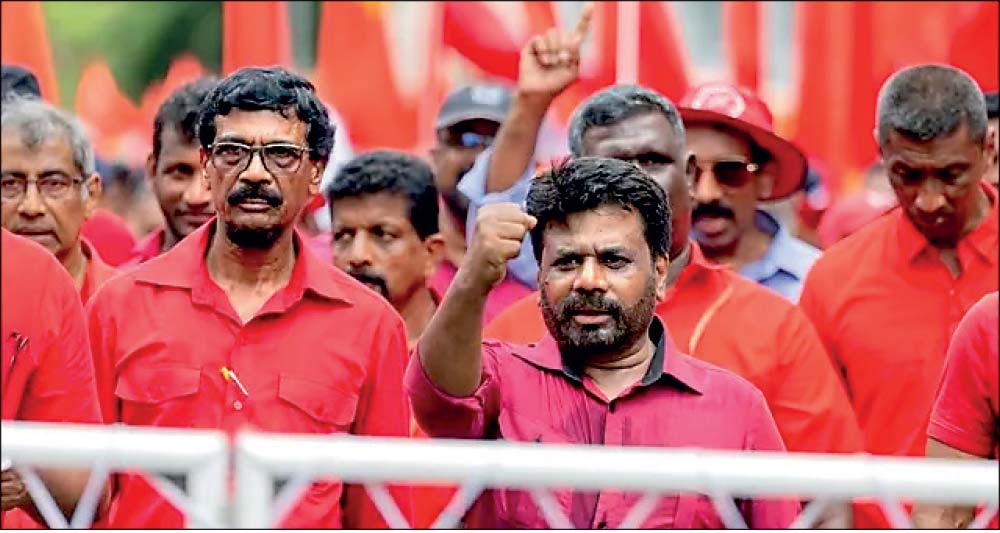
At the centre of the NPP stands the Janatha Vimukthi Peramuna (JVP). For many Sri Lankans, the 2024 election represented hope. It offered the possibility of breaking with a political order that had become associated with patronage, dynastic politics and economic mismanagement.
More than two years later, however, another question is beginning to emerge. Has the JVP fully transformed itself into a party of competitive democracy, or is Sri Lanka gradually moving towards a political system in which one movement seeks to dominate institutions for the long term?
This question should not be dismissed as partisan hostility. Nor should it be exaggerated into a claim that Sri Lanka has already become authoritarian. Sri Lanka remains a functioning democracy. Opposition parties operate openly. Newspapers criticise the Government. Courts continue to review legislation. Civil society and professional organisations remain active.
But history teaches us that democratic erosion rarely begins with the cancellation of an election. It often begins much earlier.
Why the JVP’s past still matters
The JVP was not founded as a conventional parliamentary party.
It attempted to seize State power through armed insurrection in 1971. During the 1987–89 period, it again became involved in violent revolutionary politics, and many ordinary citizens, public officials, political opponents and others lost their lives.
It is equally necessary to remember that the State itself committed grave abuses during the same period, including disappearances, torture and extrajudicial killings.
The purpose of recalling this history is not to permanently condemn the present-day JVP for its past.
The party abandoned armed struggle and entered democratic politics. By 2024, it had reached power through elections.
That transformation deserves recognition. But a revolutionary past creates an additional democratic responsibility. The question is not whether the JVP still intends to take power through violence. Clearly, it does not. The more important issue is whether the deeper political instinct of one-party historical mission has fully disappeared.
In my own recent field research in Sri Lanka, conducted from 4 to 15 September 2026, I spoke with academics, intellectuals, former security officials, political actors, Buddhist clergy and ordinary citizens. Since returning to Japan, I have continued to receive information and views daily through long-standing networks in Sri Lanka.
One concern has appeared repeatedly: Will the JVP eventually seek to turn its current electoral dominance into long-term institutional dominance?
This concern is not limited to committed Opposition supporters. It is also expressed by people who welcomed the defeat of the old political establishment.
What is said in Sinhala also matters
International observers often understand Sri Lankan politics primarily through English-language reporting. That is insufficient. Much of the country’s real political communication takes place in Sinhala and Tamil.
Statements made at local meetings, party gatherings, television discussions and constituency events do not always reach English-language media. Through my field research and continuing local contacts, I have repeatedly encountered reports of JVP figures using language to the effect that the movement will remain in power for generations, or asking rhetorically what would be wrong with one-party rule.
Such remarks, by themselves, do not prove Government policy. Political rhetoric is often exaggerated. Yet they should not be dismissed simply because they are not easily searchable in English. What matters is whether this rhetoric begins to correspond with institutional change. That is where concern becomes legitimate.
22nd Amendment and judicial confidence
One area that deserves careful scrutiny is the 22nd Amendment. The Government has presented the reform as an institutional measure concerning judicial tenure and continuity. There are reasonable arguments for extending the service of experienced judges. Therefore, it would be wrong to claim that judicial reform itself proves political interference.
The real issue is broader. Sri Lanka is now entering a period in which judicial arrangements, constitutional reform and electoral reform may all be reconsidered. The NPP has already made clear its intention to introduce a new Constitution and to reform the electoral system.
Again, none of these objectives is inherently anti-democratic. Sri Lanka has debated constitutional and electoral reform for decades. But when a Government enjoys an overwhelming parliamentary majority, institutional reform must be accompanied by unusually strong transparency.
The democratic question is simple: Will the rules of future political competition be written through broad national consensus, or mainly by the political force that currently benefits from them? That distinction will matter greatly.
Anti-corruption must not become selective justice
The second area concerns anti-corruption investigations. The NPP received a powerful mandate to challenge corruption. That mandate should be respected. Sri Lanka urgently needs credible investigations into misuse of public funds, abuse of office and political corruption. No former president, minister or opposition politician should be protected merely because of status or political influence.
But anti-corruption campaigns create their own democratic danger when enforcement appears selective. During my fieldwork, I repeatedly heard concerns that investigations might eventually weaken those Opposition politicians most capable of challenging the NPP electorally. Such concerns are not proof that investigations are politically motivated.
Each case must be judged on evidence. But the Government must recognise that public confidence depends on one principle above all: The same law must apply to both Government and Opposition.
If Opposition politicians are aggressively investigated while credible allegations involving Government-linked figures receive less attention, the credibility of the entire anti-corruption programs will suffer. A genuine anti-corruption movement must be prepared to investigate its own side.
Religion, tradition and social counterweights
Another emerging concern relates to Buddhism, religious institutions and traditional social structures. Sri Lanka’s Buddhist clergy has historically played an important role in education, community life, social mobilisation, politics and national identity.
That role has often been controversial. Monks, like all political actors, should be open to criticism. The State should also maintain an appropriate distance from religious institutions. But secular governance is different from attempting to weaken religion as an independent source of social authority.
Some Buddhist monks, intellectuals and ordinary citizens I met expressed concern that the JVP’s historical Marxist outlook may still shape the way parts of the movement view religion and tradition.
Again, this concern should not be overstated. There is insufficient basis to claim that the Government is systematically suppressing Buddhism. But the larger democratic principle is important.
A healthy democracy depends not only on elections. It also depends on independent institutions outside the State: universities, religious organisations, professional associations, media, trade unions and civil-society groups.
When governments begin to regard all independent centres of authority as obstacles, democratic pluralism weakens.
Lessons from Venezuela and Nicaragua
Comparisons with Venezuela and Nicaragua should be made carefully. Sri Lanka is not Venezuela. Nor is it Nicaragua. But their experiences offer useful warnings about process. Hugo Chávez came to power in Venezuela through democratic elections and with strong popular support. He promised to overturn a corrupt and discredited establishment.
Institutional change followed. Judicial reform was justified. Political structures were redesigned. Opposition figures increasingly faced restrictions. Over time, competitive democracy became significantly weaker. Nicaragua followed a different but related path.
Daniel Ortega, whose political roots lay in the Sandinista revolutionary movement, returned to power through elections. Over time, control over the judiciary, legislature and electoral institutions became increasingly concentrated. The Government later moved against civil society, opposition parties and even the Catholic Church. Neither country became authoritarian overnight.
That is the important lesson. Every individual measure could initially be defended: judicial efficiency, electoral reform, anti-corruption, national unity, administrative reform, or modernisation. The problem became visible only when these measures accumulated.
Sri Lanka’s quiet anxiety
What struck me most during my September fieldwork was not fear in the dramatic sense. It was a quieter unease. Many people still support the idea of political change. Many remain angry about corruption under previous governments. Many believe the old political class deserved to be challenged. But new questions are emerging:
And ultimately: If voters decide to remove the NPP from power at a future election, will the political system still make that possible? That is the decisive question.
The JVP has a historic opportunity
The JVP today has an opportunity that few revolutionary movements receive. It can demonstrate that a party with a violent revolutionary past can genuinely transform itself into a democratic governing party.
But that transformation will not be proven simply by winning elections. It must be demonstrated through institutions. The Government should ensure that judicial reform is transparent. Constitutional and electoral reform should involve the opposition, legal community and civil society.
Anti-corruption laws should apply equally to political allies and opponents. Universities, media, religious organisations and professional associations should remain free to criticise the Government.
And above all, the NPP must protect the possibility of its own electoral defeat. That is the ultimate democratic test. A democratic party is not merely one that can win an election. It is one that is willing to lose an election and peacefully hand power to its opponents.
Sri Lankan voters chose change in 2024. They voted against an old political order. They did not vote for permanent rule by any single movement. The JVP’s place in Sri Lankan history will therefore not be determined only by whether it succeeded in coming to power. It will be determined by whether it preserves the democratic institutions that allow another party, one day, to replace it.
(The author is a Professor of International Relations, Dean, Faculty of International Liberal Arts and Sciences, Fukuoka Women’s University, Japan)




