 Ultimately, the success of Budget 2027 should be measured not merely by how much revenue the Government collects, but by how effectively that revenue improves the lives of the people of Sri Lanka. Sri Lanka's future lies not merely in tax revenue, but in production, investment, employment, entrepreneurship, fiscal discipline and public confidence. Budget 2027 must therefore become an opportunity to transform economic recovery into genuine and lasting prosperity for the nation
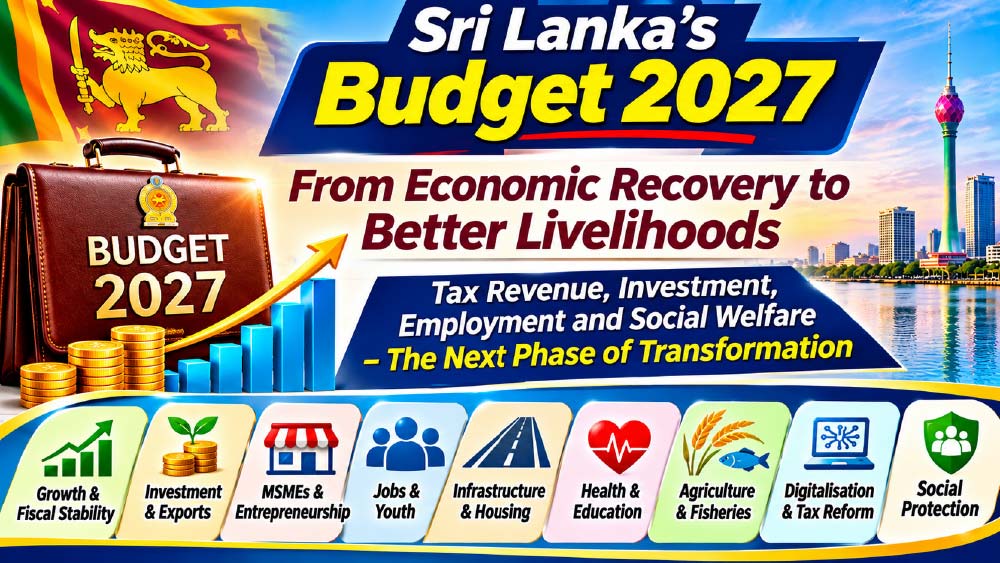
- Tax Revenue, Investment, Employment and Social Welfare – The Next Phase of Economic Transformation
 Sri Lanka’s Budget 2027 represents an important attempt to move the country beyond economic stabilisation towards a more sustainable model of economic transformation. Following years of financial crisis, fiscal adjustment and considerable hardship among households and businesses, the central challenge is no longer simply restoring macroeconomic stability. It is translating that stability into higher productivity, stronger investment, employment opportunities and improved living standards.
Presented under the theme “A Thriving Nation – A Beautiful Life”, Budget 2027 seeks to strengthen economic growth while addressing the expectations of citizens who continue to experience the consequences of the economic crisis. Its success, however, will ultimately depend not on the scale of financial allocations announced, but on the effectiveness with which these resources are converted into measurable economic and social outcomes.
Fiscal consolidation and the challenge of sustainable growth
The Government has estimated revenue and grants of Rs. 6,180 billion for 2027, against total expenditure of Rs. 7,933 billion. The resulting budget deficit is Rs. 1,753 billion, equivalent to approximately 4.5% of GDP. The expenditure figure includes additional provisions associated with the reconstruction requirements arising from Cyclone Ditwah. The underlying expenditure estimate is Rs. 7,673 billion, with a further Rs. 260 billion carried forward through supplementary provisions. Public investment has been allocated Rs. 2,000 billion, including provisions associated with reconstruction.
This represents a significant commitment to capital expenditure at a time when the country continues to face considerable fiscal constraints. The Government has established a medium-term objective of achieving economic growth of 7% or higher, maintaining revenue at not less than 16% of GDP and gradually increasing it towards 20% in the longer term. These objectives are important, but their achievement requires a careful balance between revenue mobilisation, expenditure management, debt sustainability and economic expansion.
Government revenue is estimated at approximately 15.8% of GDP in 2027. Although this represents a substantial improvement from the levels experienced during the crisis, achieving the medium-term revenue target remains challenging.
At the same time, interest payments continue to absorb a significant portion of public resources. The estimated allocation for interest payments is Rs. 2,643 billion, highlighting the continuing burden of public debt on fiscal space. The policy challenge is therefore twofold: increasing revenue without unnecessarily burdening productive economic activity, and improving expenditure efficiency so that public resources generate greater economic and social returns.
Moving beyond tax revenue towards a production-based economy
Tax revenue remains essential for maintaining fiscal stability, financing public services and reducing dependence on borrowing. Nevertheless, a sustainable increase in revenue cannot rely exclusively on higher tax rates or additional taxation of existing compliant taxpayers. Sri Lanka requires a broader and more productive economic base capable of generating employment, exports, investment and taxable income.
The proposed personal income tax revisions represent an important step towards providing relief to individual taxpayers. From 1 April 2027, the annual tax-free threshold is proposed to increase from Rs. 1.8 million to Rs. 1.95 million, equivalent to a monthly threshold of Rs. 162,500. The revised progressive tax structure introduces a 12% tax band and widens several existing income brackets. The maximum marginal tax rate remains 36%, but the income level at which it applies is increased. These changes provide additional relief to salaried employees and other individual taxpayers, particularly those in the middle-income categories. They may also help improve disposable income and ease some household financial pressures.
However, the long-term sustainability of personal income tax relief depends on broadening the tax base, improving compliance and bringing more economic activity into the formal system. The Government must therefore strengthen digital tax administration, improve information-sharing between institutions and reduce opportunities for tax evasion, while ensuring that compliant taxpayers are treated fairly.MA more transparent, predictable and efficient tax system would strengthen taxpayer confidence and improve the environment for private investment.
Investment incentives and export competitiveness
Private sector investment is essential for Sri Lanka to achieve sustained economic growth. Public investment alone cannot generate the scale of employment, innovation and export expansion required for economic transformation. Budget 2027 proposes enhanced capital allowances for eligible Board of Investment-approved enterprises engaged in export-oriented manufacturing and tourism development activities.
Qualifying enterprises with a minimum investment of $ 3 million may opt for an enhanced capital allowance equivalent to 200% of qualifying capital expenditure, subject to the prescribed conditions. This proposal could strengthen the attractiveness of Sri Lanka as an investment destination, particularly for export-oriented manufacturing, tourism infrastructure and other productive activities.
Nevertheless, tax incentives are only one component of the investment decision. Investors also require policy consistency, efficient administrative procedures, reliable energy supply, competitive logistics, skilled labour, access to finance and a predictable regulatory environment. Investment incentives should therefore be evaluated against measurable outcomes such as additional capital formation, export earnings, employment creation, technology transfer and productivity improvements.
A well-designed incentive framework should reward genuinely additional investment rather than provide concessions for activities that would have taken place without them.
Youth, entrepreneurship and the capital market
One of the notable proposals in Budget 2027 is the “A Share for Everyone” initiative, which seeks to introduce eligible students aged 18 and above to investment in the Colombo Stock Exchange through a share allocation valued at Rs. 10,000. This initiative has the potential to promote financial literacy, investment awareness and long-term savings among young people.
However, its value should extend beyond the distribution of shares. Students should also be provided with appropriate education on capital markets, investment risks, financial planning, corporate governance and responsible investment. The proposed SME Listing Support Mechanism is another important initiative. It could encourage smaller enterprises to access capital markets, improve corporate governance and reduce excessive dependence on conventional bank financing.
For Sri Lanka, developing a broader investment culture and strengthening capital market participation are important elements of financial inclusion and economic modernisation.
MSMEs: Financing the engines of employment
Micro, small and medium enterprises (MSMEs) remain among the most important contributors to employment, regional economic activity and household income. Budget 2027 allocates approximately Rs. 67.7 billion for interest subsidies and refinancing arrangements intended to facilitate around Rs. 174 billion in concessionary financing for MSMEs through State and private banking institutions. These financing arrangements are expected to support working capital requirements, investment in machinery, technology improvements, business expansion and employment creation.
The effectiveness of these programs, however, depends on more than the availability of funds. Entrepreneurs must be able to access financing through transparent, simplified and practical procedures. Credit assessment should recognise the realities of small businesses while maintaining appropriate safeguards against excessive lending and non-performing loans.
Financial assistance should also be complemented by business development services, accounting and financial management support, digitalisation, market access and export readiness. Particular attention should be given to women-led enterprises, rural businesses, young entrepreneurs and enterprises operating in sectors with significant employment potential. The objective should be to transform MSMEs from survival-oriented businesses into productive, competitive and sustainable enterprises.
Infrastructure, housing and regional development
Infrastructure investment is an essential foundation for economic transformation. Budget 2027 allocates significant resources for roads, railways, rural connectivity, water supply, housing and regional development. The allocation of Rs. 251 billion for highways and railway development reflects the importance attached to transport infrastructure and connectivity. Improved transport networks can reduce logistics costs, facilitate movement of goods, connect producers with markets and strengthen tourism and regional economic activity.
However, infrastructure investment should not be evaluated merely by the number of projects commenced or completed. Its economic value depends on whether it reduces production costs, improves access to markets and generates sustainable benefits. Housing is another important component of the Budget.
Under the “A Place of One’s Own – A Beautiful Life” program, the Government aims to construct 70,000 houses for low-income households, including 10,000 houses during 2027. The assistance per house is proposed to increase from Rs. 1 million to Rs. 1.5 million. Housing programs can improve living standards, create employment in construction and related industries, and support local economic activity.
Nevertheless, implementation should be supported by transparent beneficiary selection, appropriate infrastructure, access to essential services and effective monitoring of construction quality. Regional development must also receive sustained attention.
Economic growth cannot be concentrated exclusively in Colombo and other major urban centres. The allocation of Rs. 50 billion for district development programs provides an opportunity to strengthen regional infrastructure, improve local economic activity and address disparities in development.
Health, education and human capital
Economic growth is closely linked to the quality of human capital. Budget 2027 allocates Rs. 131 billion for capital expenditure in the health sector, while education-related allocations include Rs. 35 billion. These investments should be viewed not merely as public expenditure but as long-term investments in productivity, workforce quality and national development. A healthy population, a skilled workforce and a quality education system are essential for attracting investment and sustaining economic competitiveness.
Sri Lanka must also address the growing importance of technical education, digital skills, vocational training and industry-oriented qualifications. The education system should increasingly connect learning with employment opportunities, entrepreneurship and the skills required by emerging industries. Improving public health services, educational access and the quality of human resources would strengthen the country's ability to participate in higher-value economic activities.
Agriculture, fisheries and the rural economy
Agriculture and fisheries remain important sources of livelihood, particularly in rural and coastal communities. Budget 2027 allocates Rs. 6.2 billion for fisheries sector development, including fishery harbour infrastructure, research and inland fisheries development.
The Government has also set an objective of increasing fisheries export earnings from $ 300 million to $ 600 million by 2030. Achieving this target requires more than financial allocations. The sector needs modern technology, improved cold-chain facilities, quality assurance, export certification, sustainable resource management and stronger market access. Similarly, agricultural development should increasingly focus on productivity, value addition, technology adoption, storage facilities, efficient distribution and reducing post-harvest losses.
The objective must be to move beyond subsistence-oriented production towards commercially viable, competitive and market-oriented agriculture. Rural economic development should therefore be integrated with transport infrastructure, financial services, digital connectivity and entrepreneurship.
Digitalisation, tax administration and public accountability
Digital transformation is becoming an essential component of economic competitiveness and public sector efficiency. Budget 2027 increases the allocation for the digital economy to Rs. 28.5 billion, supporting institutional strengthening, digital Government transformation, digital industry development and wider adoption of digital services.
The expansion of digital public services could reduce administrative costs, improve transparency and make Government services more accessible to citizens and businesses. Digitalisation also has significant implications for tax administration.An integrated digital tax system, supported by reliable taxpayer information, electronic transactions, improved data analytics and effective compliance monitoring, can help broaden the tax base and reduce revenue leakage.
However, digital transformation must be accompanied by institutional reform, data protection, cybersecurity, staff capacity development and appropriate governance arrangements. Public accountability is equally important. Every major Budget program should have clearly defined implementation deadlines, responsible institutions, measurable performance indicators and transparent monitoring arrangements.
The public should be able to assess not only how much money has been allocated, but also what has been achieved through those allocations. Regular reporting on project progress, expenditure performance, employment outcomes and economic benefits would strengthen public confidence and improve fiscal accountability.
From Budget allocations to measurable economic outcomes
Budget 2027 provides opportunities to strengthen economic recovery through investment, entrepreneurship, infrastructure development, social protection and digital transformation.
However, the ultimate success of the Budget cannot be measured solely by the volume of revenue collected or expenditure incurred. The more important questions are whether businesses become more productive, whether new employment opportunities are created, whether household incomes improve, whether exports expand and whether the cost-of-living pressures faced by citizens are meaningfully reduced.
Sri Lanka must also ensure that economic growth is inclusive. Vulnerable households, low-income earners, persons with disabilities, elderly citizens and communities affected by economic or natural disasters require effective and targeted support. Social protection programs should be designed to protect those who genuinely need assistance while strengthening opportunities for economic participation and self-reliance. At the same time, fiscal discipline, efficient public expenditure and responsible debt management must remain central to the country's economic policy.
Conclusion: From revenue mobilisation to real economic prosperity
Sri Lanka's economic recovery has created an opportunity to move towards a more productive, investment-oriented and inclusive economy. Budget 2027 seeks to support this transition through personal income tax relief, MSME financing, investment incentives, housing, infrastructure, health, education, agriculture, fisheries and digitalisation. The challenge now is implementation. Government institutions must translate Budget proposals into practical programs, while the private sector must respond through investment, innovation, entrepreneurship and employment creation.
Financial institutions, professional bodies and other stakeholders also have an important role in supporting productive investment, strengthening financial management and improving business competitiveness. The country's future cannot depend exclusively on increasing tax revenue or expanding public expenditure. Sustainable prosperity must be built through production, investment, productivity, employment, entrepreneurship, fiscal discipline and public confidence.
Ultimately, the success of Budget 2027 should be measured not merely by how much revenue the Government collects, but by how effectively that revenue improves the lives of the people of Sri Lanka. Sri Lanka's future lies not merely in tax revenue, but in production, investment, employment, entrepreneurship, fiscal discipline and public confidence. Budget 2027 must therefore become an opportunity to transform economic recovery into genuine and lasting prosperity for the nation.
(The author is Managing Partner of A.G. Sarma, Chartered Accountants)



