Sri Lanka’s national Budget for 2027 marks a strategic pivot. While the 2025 Budget focused on economic stability and 2026 targeted production, investment, digitalisation and institutional reforms, the 2027 Budget zeroes in on the economic transformation required for sustained, inclusive growth. The proposals were widely welcomed by business bodies, including the apex Ceylon Chamber of Commerce and the Hotel Association of Sri Lanka.
The economy is in a markedly better place. Economic growth hit 5% in 2025, and remains above 4% this year despite the severe impact of external shocks and geopolitical tensions, such as Cyclone Ditwah and the Iran War. Foreign exchange and fiscal buffers are significantly healthier. Gross foreign reserves reached $ 7.1 billion in October 2026 (roughly 3.4 months of import cover), and Government revenues doubled as a percentage of GDP between 2022 and 2025. Boosted by surging tourism receipts, strong remittance inflows and improved tax administration, central Government debt declined from 114% of GDP in 2022 to 95% in 2025. This fiscal discipline prompted Fitch Ratings to upgrade Sri Lanka’s credit rating from ‘CCC+’ to ‘B-’ earlier this year, providing a pathway back to global capital markets. However, challenges remain: foreign direct investment flows have been disappointing, inflation remains in the high single digits, poverty levels are stubbornly elevated, and the country’s economic complexity value has stagnated since 2022.
To permanently exit the shadow of the 2022 debt crisis, Sri Lanka must foster a more outward-oriented, productive and inclusive economy. This requires capitalising on opportunities in tourism, the digital economy, niche manufacturing and agriculture. The 2027 Budget aims to make that leap, though transformation will require sustained political will to overcome historical domestic distortions, weak institutions and previous policy missteps.
Supporting cost-effective public and private investment with high fiscal multipliers is the critical first step. The Government announced a substantial LKR 2 trillion (4% of GDP, $ 6 billion) public investment program. The Budget seeks to provide tax relief through revised tax slabs, increase capital expenditure and stimulate growth, all while maintaining strict fiscal discipline as Sri Lanka approaches the end of its 17th IMF Extended Fund Facility (EFF) in March 2027.
How to support growth and economic transformation: Alignment between the ODI Global/CEPA report and the 2027 Budget
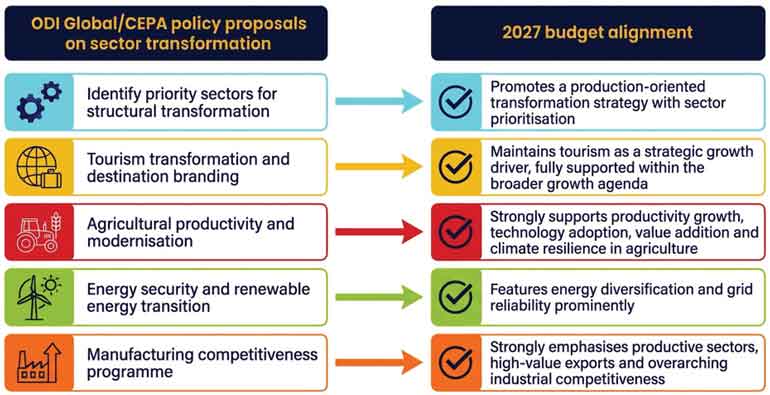
The 2027 Budget strongly aligns with the broader trajectory of the ODI Global and CEPA growth report, which outlined 30 proposals to sustain growth through 2030. While the Budget embraces many of the report’s recommendations on macroeconomic stability, productivity, export promotion, investment, digitalisation and State capacity, greater specificity is needed regarding trade integration, labour-market reform, working with the IMF and capacity-building within the State.
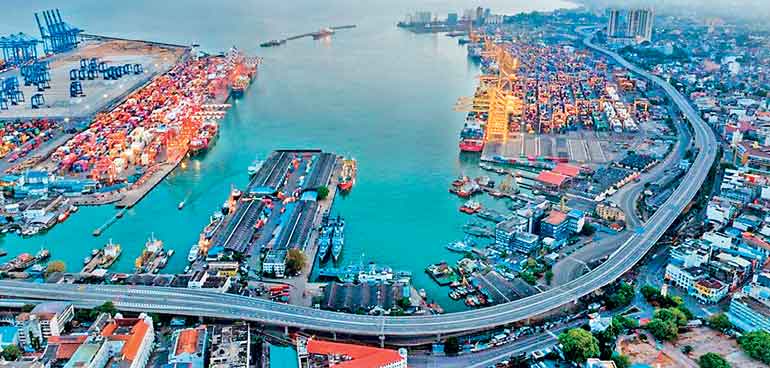
The Port of Colombo remains central to Sri Lanka’s economic transformation, as the 2027 Budget prioritises export-oriented growth and deeper global trade integration
Accelerating free
trade agreements
A key recommendation from our recent research is to evolve the current goods-only India-Sri Lanka FTA into a deeper, comprehensive agreement. Encouragingly, the Budget signals a renewed commitment to regional integration: “We expect to update the existing Free Trade Agreements and enter into new trade agreements with more countries in order to connect Sri Lanka to the global trade network…An officials’ committee has already been appointed by the Cabinet of Ministers to expand the existing Free Trade Agreement with India.” The Budget also prioritises the Regional Comprehensive Economic Partnership (RCEP), a new FTA with China, and Comprehensive Economic Partnership Agreements with the United Arab Emirates and Oman.
While this is good progress, the global trade landscape is shifting rapidly. With world trade projected to outperform IMF and WTO forecasts in 2026, and India aggressively pursuing FTAs with the EU and the UK, Sri Lanka must inject urgency into its trade agenda and rapidly build its institutional negotiation capacity. Our forthcoming work includes suggestions for how a deeper FTA with India can unlock substantial economic dividends for Sri Lanka.
Targeting sectors for economic transformation
The ODI Global/CEPA report emphasises the need for targeted sector transformation, and the 2027 Budget is broadly aligned. However, this welcome focus now requires rapid execution. Crucially, Sri Lanka must avoid a return to the top-down, State-directed approaches of the 1970s or 2019-2022, where public officials attempted to ‘pick winners’ with open-ended subsidies.
Sri Lanka’s economy has successfully stabilised following a deep crisis. However, insulating the country from future shocks requires a relentless commitment to economic transformation. The 2027 Budget sets a strong, forward-looking direction that echoes several core ODI/CEPA proposals. Yet, against a backdrop of global economic volatility, the window for action is narrow
Instead, policymakers must urgently collaborate with the private sector to remove structural bottlenecks – such as cumbersome business regulations, infrastructure gaps, skill shortages and limited SME finance – to unlock the potential of the broader productive economy. Following the blueprint of successful East Asian economies, any State incentives and support must strictly be targeted, time-bound and performance-based to ensure global market competitiveness.
Prioritising the digital economy
The 2027 Budget rightly positions the digital economy as a major pillar of Sri Lanka’s future growth model, moving beyond recovery towards a knowledge- and technology-based economy. To remain competitive, Sri Lanka must transition from relying on low wages and natural resources to competing on skills, innovation, technology adoption and digital connectivity. As highlighted in a recent ODI Global / SLASSCOM report, many trading firms already leverage e-commerce for global reach, but critical gaps in customs logistics, cross-border payments, cybersecurity and digital literacy require urgent, targeted policy intervention.
Navigating the next phase of IMF engagement
Ahead of the 2024 election, there were calls to renegotiate the existing IMF program; however, the incoming Government prudently opted for continuity. Current economic indicators validate this course of action, and the 2027 Budget maintains this pragmatic trajectory. Further engagement with the IMF will be essential post-2027 to manage external debt repayments while financing domestic development. Positively, the Budget confirms that a committee, led by the Deputy Minister of Finance and Planning, is already evaluating options for a successor IMF program.
Drawing on insights from our recent high-level ODI Global roundtable, convened on the margins of the IMF-World Bank Annual Meetings in Bangkok this October, the blueprint for maintaining growth under IMF program is clear. The roundtable brought together senior officials – including the Deputy Governor of the Central Bank of Tanzania and the Zambian High Commissioner to the UK – alongside think tank leaders and representatives from the IMF and World Bank to distil lessons from Bangladesh, Sri Lanka, Thailand, Tanzania and Zambia.
Key takeaways for Sri Lanka and other debt-distressed nations include:
1.
Tailored IMF programs: IMF program have evolved from a one-size-fits-all template to highly customised frameworks covering adjustment, financing and structural reforms. Countries need to prepare better.
2.
Stabilisation success: In the Asian and African contexts analysed, IMF programs have successfully tackled balance of payments crises, supported positive growth trajectories, curbed inflation, mobilised revenue and rebuilt foreign exchange reserves.
3.
Complex creditor coordination: A multi-creditor landscape complicates debt restructuring, demanding patient diplomacy and sophisticated coordination.
4. The necessity of domestic transformation policies: IMF programs work best as stabilising platforms that crowd in private investment, but governments must do the heavy lifting by implementing comprehensive economic transformation policies.
5.
Proactive future planning: Debt-distressed countries should actively explore early options for follow-on IMF engagement, whether through full-disbursement programs or surveillance-only arrangements.
Building policy consensus and State capacity
Delivering this ambitious reform agenda requires a fundamental shift in State capacity and political consensus. Sri Lanka’s economic history is defined by the partial and inconsistent implementation of policies, a cycle that has repeatedly constrained growth. To break this pattern, two urgent institutional reforms are required:
n
Establish an independent growth commission: Drawing on successful models from South Korea, Malaysia, Singapore, Vietnam and India, this body would formulate and insulate a long-term national growth plan.
n
Elevate public sector training: Sri Lanka must establish a world-class public policy and administration training school for civil servants and parliamentarians, delivered in partnership with a leading international university. Furthermore, existing bodies, such as the Sri Lanka Institute of Development Administration, should be twinned with elite international counterparts in Malaysia and Australia.
The road ahead
Sri Lanka’s economy has successfully stabilised following a deep crisis. However, insulating the country from future shocks requires a relentless commitment to economic transformation. The 2027 Budget sets a strong, forward-looking direction that echoes several core ODI/CEPA proposals. Yet, against a backdrop of global economic volatility, the window for action is narrow.
The Government must urgently implement its growth policies. Immediate priorities must include:
- Streamlining business procedures for trading firms
- Executing new FTAs to capitalise on shifting global trade dynamics
- Laying the groundwork for a successor IMF program
- Launching an independent growth commission to guide policy formulation and rapidly build State capacity
(te Velde is Director of the International Economics Group, ODI Global. Wignaraja is Chairman of the Board of Governors of the Institute of Policy Studies and Visiting Senior Fellow, ODI Global)