Monday Oct 12, 2026
Monday Oct 12, 2026
Monday, 24 August 2026 04:33 - - {{hitsCtrl.values.hits}}
 Rejecting the mischaracterisation, however, is not the same as ignoring the report altogether. Sri Lanka Customs and the Department of Commerce must now be prompted to tighten oversight of ROO declarations and strengthen their own capacity to detect circumvention. Meanwhile, the Board of Investment should read it as a warning
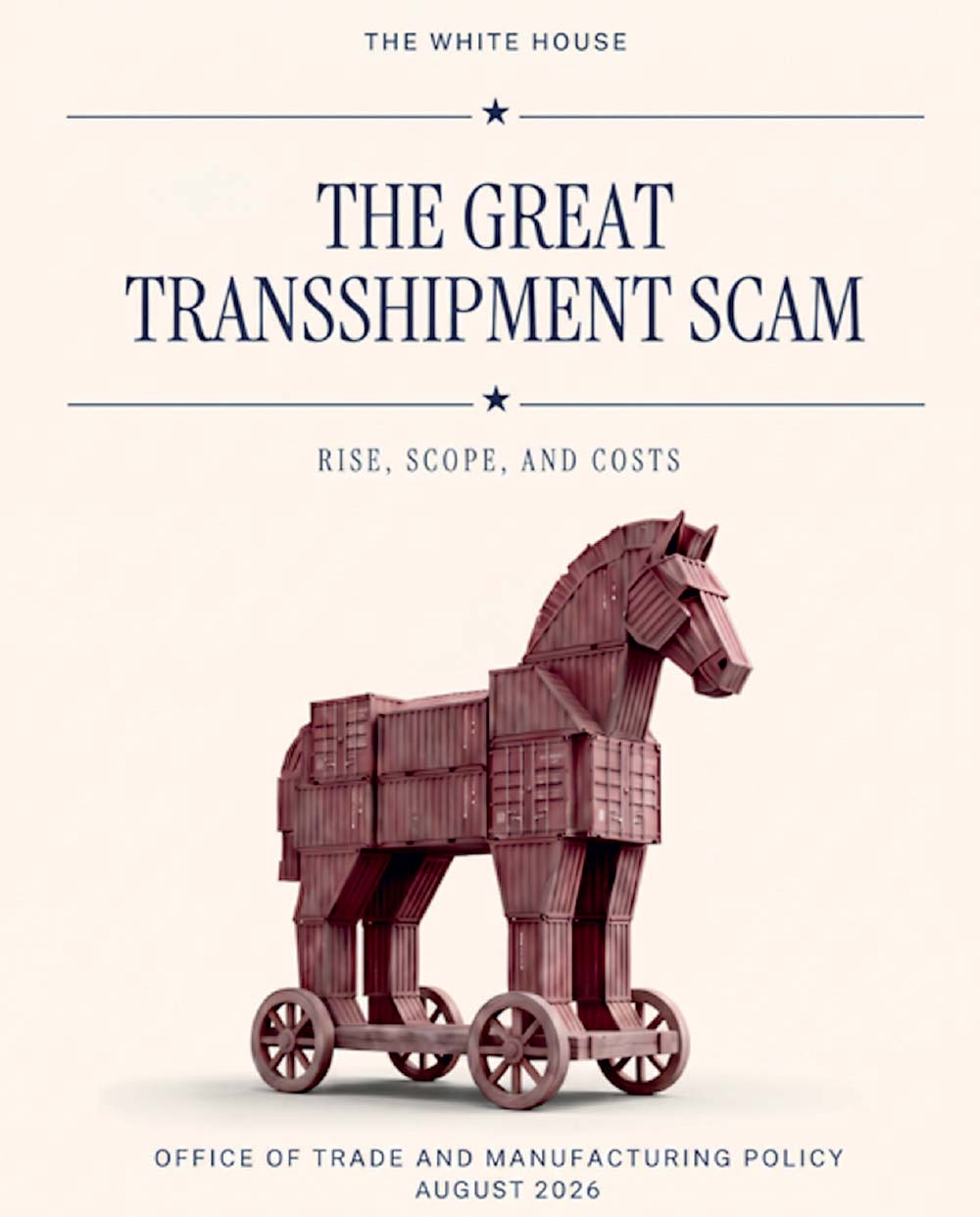
 The White House's ‘Great Transshipment Scam’ report released last week brands Sri Lanka a "Tier 3" risk economy despite conceding it presents no material evidence against the country. Sri Lanka's efforts at building regional logistics and manufacturing capabilities are a legitimate development aspiration, and trade authorities should reject the mischaracterisation contained in the report.
A flimsy report
Produced by the White House Office of Trade and Manufacturing Policy (primarily led by Trump trade hawk, Peter Navarro), the report casts a wide net: over 40 countries, sorted into three tiers by their supposed proximity to a "Shadow Transhipment Network" allegedly built to help Chinese exporters dodge US tariffs. Sri Lanka is listed in a so-called ‘Tier 3’ - the "Small, Opportunistic Chinese Targets" - and is separately filed under "Southeast Asian Microhubs" alongside Bangladesh, Cambodia, Laos and the Philippines, credited with little more than "light manufacturing, export processing, assembly operations and regional distribution" [1]. Even Sri Lankan media covering the report have noted the obvious: no "specific allegation, investigation, enforcement action or financial estimate relating directly to Sri Lanka is presented" [2]. Oddly, the report’s own executive summary admits that, "some of the shift reflects legitimate changes in production, investment, and sourcing" [1].
Analysts covering the report's reception across Southeast Asia have already warned that Washington risks "blurring the line between deliberate tariff evasion and legitimate supply-chain diversification" [5]. A prominent Malaysian former trade official put it plainly in a recent op-ed, calling the underlying premise a "misapprehension that the rules-based international trade system is one big scam" [3].
What trade allows
In international trade rules, transshipment through a third country is lawful, while deliberate tariff evasion is unlawful. Rules of Origin (ROO) exist precisely to make this distinction. Sri Lankan apparel manufacturers, rubber tyre producers, ceramics exporters, and boat-building and light-engineering firms operate factories that meet these standards. They employ thousands of workers, hold long-term buyer relationships with reputable global brands, and are audited routinely on compliance, labour standards and ROO certification. Conflating this legitimate industrial and export activity with a paperwork scam damages the country’s reputation. It unfairly invites greater suspicion by US importers on Sri Lankan certificates of origin, and can raise compliance costs and delays at the border.
What really is transhipment?
It is worth being precise about the term Washington is weaponising, because the report deliberately blurs a distinction that logistics and shipping professionals treat as basic. In its ordinary, technical sense, transhipment simply means a container coming off one vessel is unloaded and reloaded onto another ship bound for a different destination – something that happens routinely, and legally, at the Port of Colombo, one of the busiest transhipment hubs in our part of the world. Nothing happens to the goods themselves beyond a change of vessel. Illegal transhipment is different. It occurs when goods actually made in Country A are falsely declared (through falsified Customs documentation and Certificates of Origin) as originating in Country B, specifically to claim a lower tariff rate meant for Country B.
There is another piece to this – where there is legitimate processing and value addition taking place in the country, before being shipped off to the intended export market, by way of substantial transformation occurring. To deem that substantial transformation has taken place there would be a tariff-shift. The processing of the good caused its HS (Harmonised System) classification to change (at the 4- or 6-digit level) reflecting a change in the good’s essential character/type/value, not merely its point of shipment.
The White House report collapses these distinctions, characterising genuine global supply chain shifts as ‘illegal’, and worse – drawing Sri Lanka into the fold with offering no evidence of such activities actually happening in Sri Lanka.
Respecting legitimate trade ambitions
The Sri Lankan economy is emerging out of an economic crisis and returning to fragile growth amidst global uncertainty. Successive governments have endeavoured to position the island as a logistics, transhipment, and export-diversification hub for South Asia. Growing port volumes and compettiveness, stated desires to expand export zones, and improve trade facilitation, are all part of a legitimate development push. To have that same ambition recast - however loosely - as evidence of complicity in tariff fraud is not only factually thin, it is also strategically self-defeating for Washington's own stated aim of encouraging diversification away from China. Sri Lanka should be treated as exactly the kind of alternative manufacturing and logistics partner the United States claims to want. Instead, it has been filed alongside jurisdictions accused of running "screwdriver factories" for Beijing (the report’s own words), with no distinction drawn and no opportunity to respond prior to a unilateral report being published.
Sri Lankan authorities should issue a formal and firm statement pushing back on the report's characterisation of Sri Lanka, and set out a positive narrative of what exactly the country’s export and logistics sectors actually do
Actions needed
Sri Lankan authorities should issue a formal and firm statement pushing back on the report's characterisation of Sri Lanka, and set out a positive narrative of what exactly the country’s export and logistics sectors actually do. The narrative must include examples of respected companies doing things well in the light manufacturing sector - verified rules-of-origin compliance, genuine value addition, and adherence to long-standing certification regimes.
Sri Lanka should also raise the matter directly with US trade officials and through diplomatic channels in Washington, requesting the specific evidence basis - if any exists - for the country's inclusion. It cannot allow an unsubstantiated label to go uncountered in the public record.
Cautionary note
Rejecting the mischaracterisation, however, is not the same as ignoring the report altogether. Sri Lanka Customs and the Department of Commerce must now be prompted to tighten oversight of ROO declarations and strengthen their own capacity to detect circumvention. Meanwhile, the Board of Investment should read it as a warning against entertaining low-value, footloose investment relocating purely to exploit any tariff differentials, and should keep the focus on seeking quality FDI that builds genuine, good quality manufacturing and logistics capability.
(The author is Director of Centre for a Smart Future (CSF), a public policy think tank, and has been a consultant on trade and competitiveness strategies to countries in Asia, Africa, and the Carribbean. He was formerly Advisor to the Minister of International Trade, a Special Advisor to the Minister of Industry and Commerce, and Macroeconomic Advisor at the Presidential Secretariat. The views expressed here are the author's personal views)
References
[1] White House Office of Trade and Manufacturing Policy, The Great Transshipment Scam, August 2026. https://www.whitehouse.gov/wp-content/uploads/2026/08/The-Great-Transshipment-Scam.pdf
[2] Zulfick Farzan, "Sri Lanka Emerges on Global Supply Chain Radar in White House Report," News First, 17 August 2026. https://www.newsfirst.lk/2026/08/17/sri-lanka-emerges-on-global-supply-chain-radar-in-white-house-report
[3] Rebecca Fatima Sta Maria, "The great US trade misclassification - Malaysia must push back," The Edge Malaysia, 17 August 2026. https://theedgemalaysia.com/node/814777
[4] Deborah Elms, "Does US trade policy see 'scams' in every transaction?," Hinrich Foundation, 18 August 2026. https://www.hinrichfoundation.com/research/article/trade-governance/us-trade-policy-and-unfair-trade-practices
[5] Sam Beltran, "US transshipment 'scam' claims put Asean exporters in a bind," South China Morning Post - This Week in Asia, 18 August 2026. https://www.scmp.com/week-asia/politics/article/3364381/us-transshipment-scam-claims-put-asean-exporters-bind




