Saturday Oct 03, 2026
Saturday Oct 03, 2026
Tuesday, 3 March 2026 05:00 - - {{hitsCtrl.values.hits}}
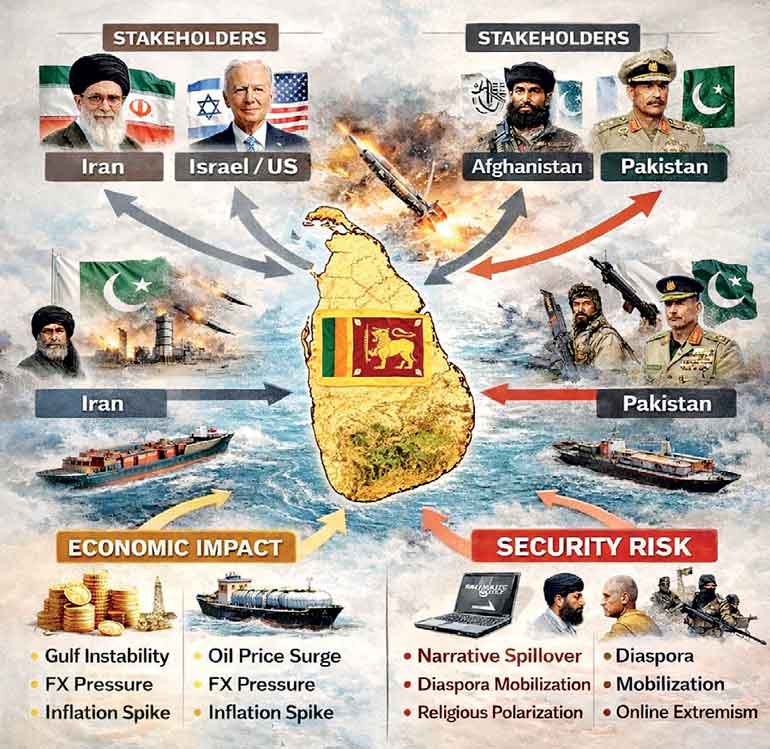
 Escalating hostilities between Iran and Israel, alongside instability along the Afghanistan–Pakistan frontier, have introduced fresh uncertainty into the global security environment. Missile exchanges, retaliatory strikes, and heightened military alerts are already influencing energy markets and strategic calculations.
For Sri Lanka, this is not a distant geopolitical drama. It is a potential external shock with economic, diplomatic, and social implications. The island cannot shape events in the Middle East. But it can and must manage its exposure.
Strategic interpretation
This conflict is best categorised as:
A sovereignty–counterterror hybrid confrontation within a historically disputed frontier, intensified by domestic security pressures rather than external orchestration.
It is not currently a great-power proxy war. It is a regional security collision with potential secondary ripple effects.
Economic exposure: Structural, not symbolic
Sri Lanka’s vulnerability to Middle Eastern instability is grounded in three realities: remittances, energy, and trade routes.
Remittances
A substantial share of Sri Lanka’s foreign exchange earnings originates from workers in Gulf states. Any prolonged regional instability affecting aviation, labour markets, or commercial confidence in the Gulf could disrupt remittance flows.
Even marginal declines would exert pressure on reserves and currency stability at a time when macroeconomic consolidation remains fragile.
Energy security
Sri Lanka’s petroleum imports are closely linked to Gulf supply chains. If tensions threaten maritime routes particularly around the Strait of Hormuz the consequences would be immediate:
nHigher global oil prices
nIncreased freight and insurance costs
nDomestic inflationary pressure
Fuel, electricity generation, transport, and food distribution costs would all rise. For households and businesses already navigating economic recovery, the pass-through effect could be significant.
Shipping and insurance
Sri Lanka’s position along Indian Ocean shipping lanes amplifies both opportunity and risk. Regional conflict often triggers war-risk insurance surcharges. Higher premiums translate into more expensive imports. The Government must therefore conduct scenario modelling not reactively, but preemptively.
The security dimension: Narrative spillover
The more subtle risk lies in the social domain. Foreign conflicts often migrate into domestic discourse through emotionally charged narratives. Sri Lanka’s past experience demonstrates that external grievances, when amplified digitally, can intensify identity anxieties at home. The risk is not military spillover. It is a narrative spillover.
Three dynamics require attention:
1.Digital amplification: Graphic and unverified content circulates rapidly, shaping perceptions before facts stabilise.
2.Identity framing: Conflicts abroad can be reframed locally in communal terms.
3.Reactionary polarisation: Emotional responses in one community may provoke suspicion in another.
Sri Lanka cannot afford renewed cycles of mistrust.
The responsibility of leadership
At moments of international volatility, responsible leadership becomes decisive.
Political actors must avoid:
Religious leaders should emphasise humanitarian concern and peace rather than geopolitical positioning. Sri Lanka’s plural society must not be turned into a symbolic extension of foreign battlefields.
Media institutions bear equal responsibility. Verification must precede amplification. Casualty figures and dramatic claims in the early hours of conflict are often fluid and contested.
Disciplined public communication is not weakness; it is statecraft.
Diplomatic balance
Sri Lanka’s strategic advantage has historically been its ability to maintain equilibrium among competing global actors.
In a polarising international environment, that balance becomes more valuable and more difficult.
The prudent course is:
Small states suffer disproportionately when major powers escalate. Strategic neutrality protects national interest.
Pakistan–Afghanistan instability: A parallel risk
Simultaneous tensions along the Afghanistan–Pakistan border add another layer of uncertainty. Although geographically distant, such instability can generate ideological shockwaves across digital ecosystems.
Modern conflicts travel faster through information networks than through physical borders. Sri Lanka’s security agencies must monitor narrative contagion without resorting to heavy-handed securitisation that could itself generate grievance.
The objective is early detection, not public alarm.
Policy contingency priorities
In practical terms, Sri Lanka should quietly activate a precautionary grid:
Economic preparedness
None of these measures require dramatic public announcements. They require administrative discipline.
Most likely trajectory
Historically, Middle Eastern confrontations escalate rapidly but are often contained through quiet diplomacy. States with high strategic exposure rarely seek uncontrolled war.
The most probable outcome remains calibrated escalation followed by mediated de-escalation.
However, markets react to perceived risk, not eventual restraint. Even limited conflict can produce disproportionate economic volatility.
Sri Lanka’s challenge is to withstand volatility without amplifying it domestically.
Protecting social cohesion
The island’s greatest asset is its lived understanding of conflict’s cost. That memory should guide conduct now.
Communal harmony must not be strained by imported narratives. Foreign wars should remain foreign.
Leaders across communities must reinforce a simple message: Sri Lanka’s stability is a shared responsibility.
If external events are internalised emotionally, the consequences could outlast the conflict itself.
Stability as strategy
Sri Lanka cannot determine the trajectory of Middle Eastern geopolitics. But it can determine the quality of its own response. Economic prudence, disciplined diplomacy, and social restraint form the foundation of resilience.
The global order may be entering a period of turbulence. That reality demands preparation and not polarisation. In volatile times, the most strategic act is stability.
(The author is SSP (Retired), and the former Head of the Counter-Terrorism Division of the State Intelligence Service of Sri Lanka, and has served as Head of the Sri Lankan Delegation at three BIMSTEC Security Conferences. With over 40 years of experience in policing and intelligence, he writes on regional security, interfaith relations, and geopolitical strategy and is the Managing Director of Smart Security Solutions Ltd)



