Friday Sep 18, 2026
Friday Sep 18, 2026
Friday, 18 September 2026 00:22 - - {{hitsCtrl.values.hits}}
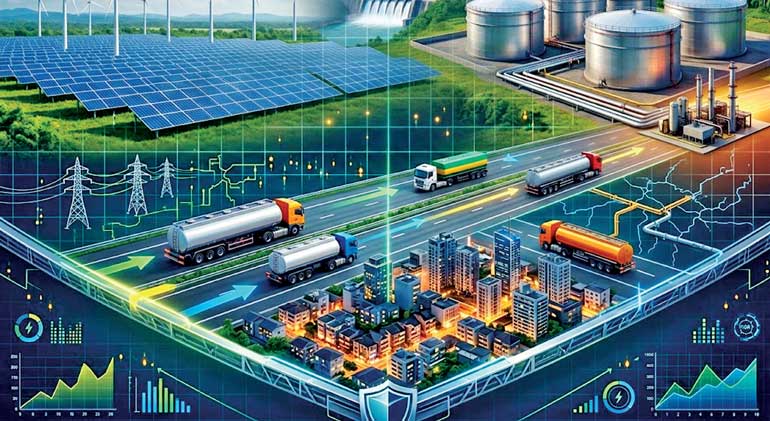
 In Paris, at the headquarters of the International Energy Agency (IEA), I found myself making a point that should matter far beyond the LPG industry.
The gathering, jointly convened by the IEA and the World Liquid Gas Association, brought together representatives of 17 governments and more than 80 senior energy leaders. The subject was global LPG supply resilience — the kind of phrase that sounds comfortably technical until a conflict, a shipping disruption or a price shock turns it into a kitchen-table issue.
For Sri Lanka, this is not theory. We know what it feels like when energy insecurity becomes social insecurity. We have seen queues, shortages, rationing, foreign exchange pressure and the political consequences of fragile supply chains. In an island economy, the distance between a disrupted cargo and a national crisis is shorter than most people imagine.
That is why my message in Paris was simple: resilience cannot be improvised during a crisis. It has to be built before one.
For too long, countries such as Sri Lanka have thought of themselves as being at the end of the global energy supply chain — price takers, cargo receivers, exposed consumers of decisions made elsewhere. We wait for vessels, absorb global volatility, and hope that logistics, finance and geopolitics behave themselves.
That is not a strategy. It is a vulnerability.
Sri Lanka has an opportunity to think differently. We are geographically positioned near some of the busiest sea lanes in the world. We sit between energy-producing regions in the Middle East and fast-growing demand centres across South Asia. We already possess port infrastructure, maritime relevance and, in Hambantota, a strategically located 30,000 metric ton LPG terminal.
The question is whether we see these assets merely as domestic infrastructure, or as part of a wider regional energy-security proposition. Small economies often underestimate the strategic value of infrastructure. A storage terminal is not glamorous. It does not photograph like a skyscraper or sound as futuristic as artificial intelligence. But in a disrupted world, storage is power. Optionality is power. The ability to receive, hold, redirect and supply energy is power.
This is especially true for LPG. In many developing economies, LPG is not just another fuel. It supports households, small businesses, hotels, restaurants, transport, industry and cleaner cooking transitions. For millions of people, it is the bridge between traditional biomass and a cleaner, safer, more modern form of daily energy use.
Yet the global LPG system remains exposed. Supply is concentrated. Trade routes are vulnerable. Freight markets can tighten quickly. Geopolitical events can move prices faster than governments can respond. Import-dependent countries, particularly in Asia and Africa, are often left managing the consequences rather than shaping the solutions.
That should change.
Sri Lanka’s energy-security conversation has understandably focused on procurement, pricing and affordability. These are important. But the deeper question is structural: what infrastructure do we need so that the next crisis does not find us equally exposed?
This is where Hambantota matters. Properly positioned, it can be more than a terminal serving one national market. It can become part of a regional resilience network — supporting storage, transshipment, emergency supply, commercial partnerships, and diversified sourcing for South Asia.
This does not happen automatically. Infrastructure becomes strategic only when policy, capital, commercial discipline, and international partnerships align around it. A terminal on its own is an asset. A terminal connected to a credible regional strategy is leverage.
The lesson from Paris was that energy security is becoming less national and more networked. Governments worry about strategic reserves. Companies worry about supply continuity. Developing economies worry about affordability. Shipping routes, ports, storage, traders, regulators, and financiers are now part of the same conversation.
Sri Lanka should want to be in that conversation.
We should not define ourselves only by the crisis we experienced. We should define ourselves by the systems we build afterwards. The country’s location, port assets and private-sector capabilities give it a chance to contribute to regional resilience rather than simply suffer from global disruption.
There is also a broader point about national confidence. Too often, Sri Lanka speaks about its constraints more fluently than its assets. We are quick to explain why we are small, indebted, import-dependent or vulnerable. This was apparent even in my speech as i subconsciously recognised us as that “Small island”. All true. But not the whole truth. Small countries can still be strategically useful. Singapore did not become relevant because of its land mass. The UAE did not become a logistics and energy hub by accident. Strategic relevance is built by identifying where geography, infrastructure and capital meet global need.
Sri Lanka cannot copy those models wholesale. But it can certainly learn from the mindset.
At the IEA, I was struck by how seriously global institutions and large energy companies are now thinking about resilience. The discussion was not about chasing the cheapest cargo in normal times. It was about what happens when normal times disappear.
That is the world Sri Lanka must prepare for. A world of geopolitical shocks, rerouted vessels, tighter financing, climate pressure, energy transition debates, and rising demand from developing economies that still need reliable, affordable fuel.
In such a world, resilience will not belong only to the biggest economies. It will belong to countries that build useful infrastructure, credible institutions and trusted partnerships before the next disruption arrives.
Sri Lanka has the raw ingredients to play a more meaningful role. What it needs now is a sharper national energy-security strategy — one that treats storage, ports and regional supply capacity as strategic instruments and not as isolated assets.
The point I made in Paris was not that Hambantota alone can transform Sri Lanka’s energy future. It cannot. No single terminal can.
But it can be a beginning. It can be proof that Sri Lanka does not have to remain merely a destination at the end of someone else’s supply chain. It can be a node. A buffer. A partner. A contributor to regional security.
For an island that has felt the consequences of energy fragility so painfully, this shift in thinking matters.
Resilience is not built in the middle of a queue. It is built in advance — in terminals, ports, contracts, partnerships, and the courage to see national assets differently.
Sri Lanka’s next energy chapter should not be written from a place of vulnerability. It should be written from Hambantota, Colombo, and every other point where geography can be turned into strategy.
(The author is the Group Executive Vice Chairman of LAUGFS Holdings, a prominent technology entrepreneur, and a recognised APAC thought leader in Digital Transformation. With a career spanning over 12 years, he has built deep cross-functional expertise across Management, Finance, Global Marketing, and Information Technology and Interactive Entertainment. He also holds a Bachelor’s degree from Aston University (UK) and an MBA from the Postgraduate Institute of Management (PIM), University of Sri Jayewardenepura)




