Wednesday Oct 21, 2026
Wednesday Oct 21, 2026
Wednesday, 2 September 2026 00:20 - - {{hitsCtrl.values.hits}}
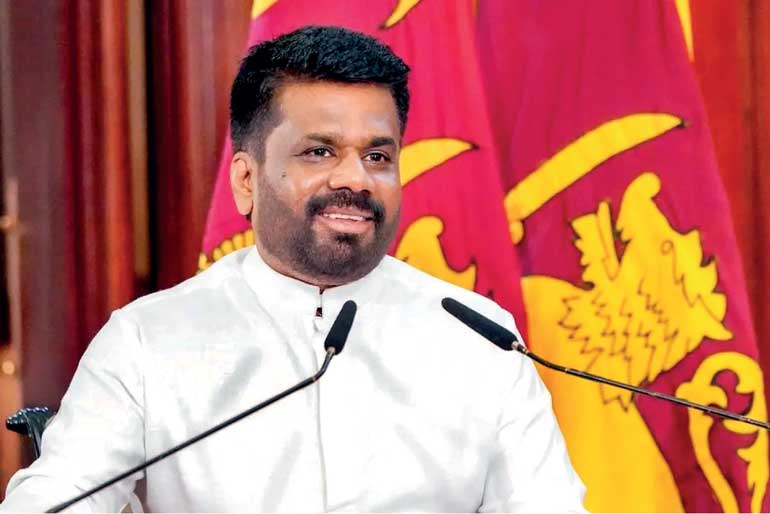
President and Finance Minister Anura Kumara Dissanayake
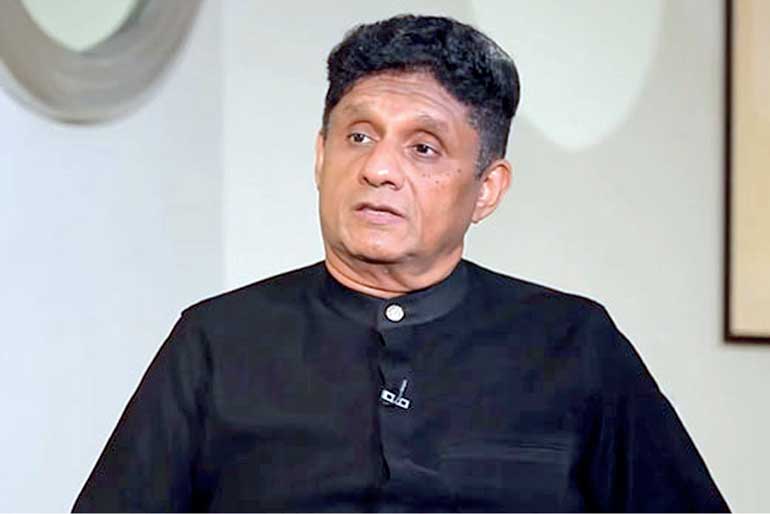
Opposition Leader Sajith Premadasa
“It’s the economy, stupid.” - James Carville (During 1992 Presidential election)
By Tisaranee Gunasekara
NINETY two of formal private sector employees in Sri Lanka earn less than 100,000 rupees a month, according to EPF data.
This startling revelation, made at a recent Sri Lanka Korea Business Council panel discussion, should have caused a furore, with the Government and the Opposition racing against each other to use this proof of extreme wage inequality as a politico-propaganda weapon.
Should have, but didn’t; because for the Government and for the Opposition, political life begins and ends with 22. 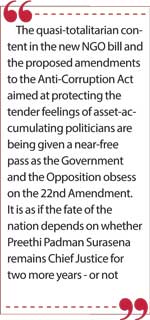
The quasi-totalitarian content in the new NGO bill and the proposed amendments to the Anti-Corruption Act aimed at protecting the tender feelings of asset-accumulating politicians are being given a near-free pass as the Government and the Opposition obsess on the 22nd Amendment. It is as if the fate of the nation depends on whether Preethi Padman Surasena remains Chief Justice for two more years - or not. After all, the real issue with the 22nd Amendment is not its content but its timing. The Government wants the 22nd Amendment in place before CJ Surasena retires in December. The Opposition doesn’t mind the 22nd Amendment if it is enacted after CJ Surasena retires. The rest is just verbiage.
One of the many critical issues lost in this tsunami of self-serving slogans is Lankan economy’s deeply entrenched structural inequalities and their socio-political consequences.
This year, Sri Lanka regained upper-middle income status, an achievement the Government celebrated, justly, while staying mum on a related fact. According to the Purchasing Power Parity (PPP) measurement used for upper-middle income countries (with poverty line set at $ 8.3 – Rs. 2,724 – per day), Sri Lanka’s poverty rate for 2026 would be a mind-boggling 65.4%. In other words, Sri Lanka is an upper-middle income country with almost two-thirds of its population living in poverty!
According to the World Bank’s Sri Lanka Development Update 2026, “The economic recovery has been unable to reverse crisis induced welfare losses. 33% of households experienced moderate or severe food insecurity in 2025” (Weathering the Storm). “Many households are yet to experience benefits associated with regained upper-middle-income status,” warned UN Assistant Secretary General Kanni Wignaraja during her recent visit to Colombo. As long as our economic strategy continues to place a disproportionate share of the burden of recovery on the poor and the middle classes (via exorbitant indirect taxes), benefits of growth will continue to be concentrated in the hands of a wealthy minority. According to World Bank calculations, by 2028, our poverty rate will go down only very marginally to 63.4% (https://documents1.worldbank.org/curated/en/099213205052641407/pdf/IDU-df6d36cb-59f0-4e01-af7b-4893b4d08e24.pdf).
The IMF is not the villain of this particular piece. Deputy minister Wasantha Piyatissa was wrong when he stated that, “Under the present IMF agreement, it is not possible for the Government to make further financial commitments to expand social welfare” (https://srilankabrief.org/welfare-funding-squeezed-under-imf-programme-sri-lankan-minister-says/). On the contrary, the IMF has been pushing Colombo to spend more and not less on welfare. It has set not a ceiling but a mandatory floor on social spending – a minimum and not a maximum.
The IMF is opposed to blanket subsidies but is fully supportive of targeted subsidies (thus its opposition to tax breaks for businesses, local or foreign). In November 2024, the IMF reminded the new Government that, “While Sri Lanka met most performance criteria, it consistently missed social spending targets” (https://publicfinance.lk/en/topics/imf-calls-on-government-to-increase-social-spending-1732492064). As the World Bank pointed out, Sri Lanka’s spending on “public wages and capital projects and on sectors such as health, social protection, and education are all comparatively low” (Better Spending for All). Today, for instance, Sri Lanka ranks near the bottom on public education.
In its 2024 presidential election manifesto, the NPP promised A thriving nation and A beautiful life. Two years on, Sri Lanka remains a land where the top one-third thrive while the rest struggle to keep their heads above the tide level. 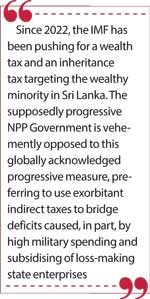
Working but poor
Sri Lanka’s economic policy is shaped not for the wellbeing of a majority of Lankans but for the benefit of about 1000 people, warned Advocata Chairman, Murtaza Jafferjee. About 100 families are blocking competition and enterprise, he revealed (https://www.dailymirror.lk/business-main/Stop-worshipping-growth-start-measuring-poverty-economists-tell-government/245-348224).
A warning the Government and the Opposition were at one in ignoring.
The world provides ample examples of what happens to nations when governments dance to the tune of the richest 1%.
Journalist Brian Goldstone’s Pulitzer-winning non-fiction book, “There Is No Place for Us: Working and Homeless in America” details how high growth, high employment, and high corporate profits exist side by side with growing poverty and homelessness in the world sole super power. “Today there isn’t a single state, metropolitan area, or county in the United States where a fulltime worker earning the local minimum wage can afford a two-bedroom apartment… And it is in the nation’s richest, most rapidly developing cities – the one’s which are ‘doing well’ – that the threat of homelessness has become particularly acute.”
This ‘emergency born of prosperity’ is no accident but the inevitable outcome of deliberate policy choices. As economist John Kenneth Galbraith pointed out, “Today in the United States, we find islands of wealth and power on one side and an ocean of precarity and powerlessness alongside poverty on the other. This is a structural development over 50 years…” (https://www.theguardian.com/commentisfree/2022/oct/07/us-economy-growth-inequality-james-k-galbraith).
Not all jobs are created equally. Even when growth promotes employment, it could be the kind of employment which doesn’t pay a living wage and therefore perpetuates poverty – and inequality – instead of combatting it. Low wages and the absence of social recognition, one an outcome of rampant capitalism and the other a residue of defunct feudalism, are main drivers of Sri Lanka’s skills drain. Sri Lankan private sector wants workers who are willing to work at dangerous, backbreaking or tedious jobs for a barely liveable age, jobs which bring not social acceptance but social opprobrium. Consequently, there is a growing gulf between the type of employment on demand and the type of employment available.
UN Assistant Secretary General Wignaraja warned about Sri Lanka’s skills drain and stated that promoting quality employment opportunities would be a defining pillar of the UNDP’s Sri Lanka country program. It should be a defining pillar of NPP Government’s economic strategy as well. The Government did the morally right and economically appropriate thing when it gave workers in the plantation sector a much-needed wage hike. That should be not a one off measure, but the first step in a long journey towards a solid blue collar middle class society. The Government needs to initiate a dialogue with employers in other sectors to devise ways and means to make available job opportunities more attractive to Lankan workers. Unfortunately, the Government is promoting skills migration on one hand while allowing many sectors to ‘import’ migrant workers. Not to mention devising hare-brained schemes like banning the profession of three-wheeler driving for those under 40! 
Equally important would be to promote not any and every investment, but investment Sri Lanka needs today (not what she needed 20 or even 10 years ago). The Kerala model could be instructive in this regard. Kerala has adopted ESG (environmental, social, and governance) criteria in investment promotion, evaluating potential investors based on their performance on sustainability, ethical governance, and industrial responsibility. Investments which do not increase our already severe environmental vulnerabilities while creating jobs that can keep young skilled workers and professionals from migrating.
The wrong type of growth, growth which enriches a few while bypassing the many, can be more damaging politically than even no growth, as history demonstrates from France in 1789 to Iran in 1978.
A country for whom?
Verité Research Executive Director Nishan de Mel defined Lankan system as a racket. “We have a country…where people who earn don’t pay taxes… This is a racket in which people like us, you know, benefit enormously on the backs of those who see very little benefit of the economy” (https://www.ft.lk/top-story/Sri-Lanka-economy---a-racket---Economists/26-796108).
Taxation plays a crucial role in determining systemic fairness or its absence. Where tax systems are skewed to benefit the wealthy, inequality thrives. Since the 1980’s there has been a global shift towards greater inequality. A key instrument in this transition was taxation.
Protestors demonstrating against Jeff Bezos’ opulent Venetian wedding carried a 4300-square foot banner reading, If you can rent Venice for your wedding, you can pay more tax. The slogan was not hyperbolic. Bezos could afford to rent Venice for his wedding because his tax bill is rather low. According to the Forbes magazine, “Bezos didn’t pay any federal taxes in 2007 and 2011, per ProPublica reporting, on leaked returns, and likely paid little in 2022 and 2023… Per a 2018 UC Berkeley study based on Forbes data, families in the top 0.1% of Americans by net worth were estimated to owe just 3.2% of their wealth in taxes in 2019 while the bottom 99% were estimated to have owed 7.2%; since then, America’s richest have only gotten richer, and Bezos tax bill for 2024 amounts to just around 1% of his estimated net worth” (https://www.forbes.com/sites/phoebeliu/2025/06/28/wedding-protesters-say-bezos-should-pay-more-tax-heres-how-much-he-likely-did-pay/).
According to a recent Oxfam report, From Private Wealth to Public Power: Financing Development, Not Oligarchy, the wealth of global millionaires increased by $ 2.5 trillion in the last year, enough to eradicate poverty 26 times over. Extreme wealth, warned Oxfam, is “increasingly translating into political power with billionaires estimated to be 4000 times more likely to hold political office than ordinary citizens… Almost half of people surveyed in 66 countries said ‘the rich often buy elections.’” Oxfam’s recommendations to alleviate this extremity begins with taxing super rich. (https://oxfam.app.box.com/s/7trdq1tnxrmvspym3p8sx8q125c2mw6v)
Since 2022, the IMF has been pushing for a wealth tax and an inheritance tax targeting the wealthy minority in Sri Lanka. The supposedly progressive NPP Government is vehemently opposed to this globally acknowledged progressive measure, preferring to use exorbitant indirect taxes to bridge deficits caused, in part, by high military spending and subsidising of loss-making state enterprises. A recent report by the Auditor General focused on seven inactive SOEs kept on life-support using public funds (including taxes on books and educational materials). For instance, the Kantale sugar factory, inoperative since 1994, still exits with 32 past-retirement-age employees (https://www.dailymirror.lk/business-news/Millions-bleed-into-dormant-state-enterprises-as-liquidation-delays-persist/273-348875).
“Growth that doesn’t make the lives of people, the majority, better off, ends up, like in lots of places, biting back, even on those who benefit from that kind of growth” warned Dr.de Mel. “Putting more roads at very high costs and more cars on the roads are not the solution,” he said reminding that growth should not be worshipped but be regarded as a servant, a means to an end (https://www.ft.lk/top-story/Sri-Lanka-economy---a-racket---Economists/26-796108).
Sensible words, ignored by a 22-obsessed Government and an Opposition. 
As two recent polls demonstrated, economics remains the Government’s Achilles’ Heel. According to the CPA survey, 51% of respondents said that their household economic situation worsened while only 18% said it improved. Only 45% are satisfied with the way the Government handles the cost-of-living issue while 44% are dissatisfied. According to the latest Mood of the Nation survey by Verité Research, only 42% of respondents say that the economy is getting better while 40% said it is getting worse (https://www.newswire.lk/2026/08/16/government-approval-drops-to-50-as-economic-outlook-weakens-verite-poll/).
If the Opposition had a grain of sense, it would have focused on economics, the Government’s weakest point. Since economic malaise is a problem that oversteps all primordial boundaries, it can easily use economic issues to create a broad tent with a Lankan complexion, uniting all ethnicities and races under the banner of the Affordability Crisis, as Zohran Mamdani did in New York and other radical Democrats are doing across the US. Instead, Lankan Opposition is allowing the more disreputable elements within its ranks to incite ethno-religious fear and hatred.
The pro-Opposition cyberspace seems suffused with anti-Tamil/Muslim/Christian propaganda. Instead of accusing the Government of not standing up to economic vested interests (as is the case), the Opposition’s cyber-warriors are charging the Government with being subservient to Tiger/Tamil Diaspora, the Muslims, and Catholic cardinal and Christian churches. Perhaps the Opposition’s attempts to channel public discontent into ethnic/religious extremist path stems from its unwillingness to confront the Government on matters economic. Perhaps it has no issue with a racket of a country where economic policies are made to benefit just 100 families?




