Saturday Oct 03, 2026
Saturday Oct 03, 2026
Friday, 12 June 2026 00:26 - - {{hitsCtrl.values.hits}}

Preamble: The case for legislated accountability
Sri Lanka’s 2022 economic collapse — and the poly-crisis of 2026 bearing down simultaneously through El Niño drought, fertiliser supply shock, fuel inflation, rupee depreciation and Cyclone Ditwah’s structural damage — are not only natural or geopolitical events. They are, in substantial part, the consequence of decisions made and unmade by successive governments across decades: welfare systems weaponised for electoral patronage, data gaps that made the poor invisible to policy, minimum wages held at less than one-third of a living wage, and structural dependencies on imported fertiliser, on fuel, on dollar-denominated debt never addressed in periods of relative stability.
This Charter proceeds from a foundational proposition: that policy failure causing foreseeable harm to citizens — particularly to children, the poor, the informal worker, the female-headed household and the climate-vulnerable farmer — is not merely an administrative shortcoming. It is a violation of rights. Where that violation is systematic, sustained and attributable to identifiable decisions by identifiable officeholders, it must carry identifiable legal consequences.
Part I: Foundational legal architecture
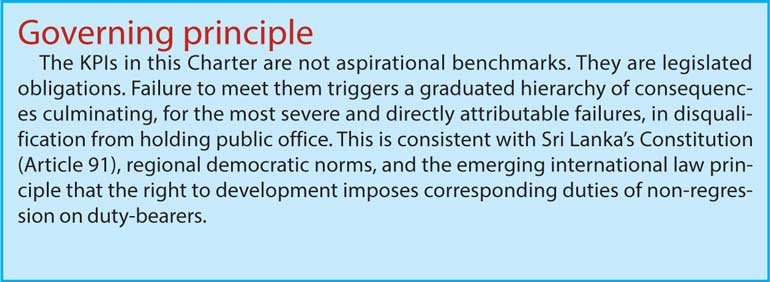
This framework draws simultaneously on four bodies of law. Sri Lanka’s Constitution — Articles 12 (equality before the law) and 27 (directive principles including the duty to ensure an adequate standard of living) — provides the domestic constitutional foundation, alongside the nascent Supreme Court jurisprudence on socio-economic rights as justiciable entitlements. The UN Sustainable Development Goals, adopted by Sri Lanka in 2015, are incorporated here as legislated targets through the proposed Sri Lanka Sustainable Development and Accountability Act. The UN Declaration on the Right to Development (1986) establishes that development is an inalienable human right and that states have a duty to formulate national development policies ensuring the fair distribution of development benefits. The Paris Agreement (2015) anchors the climate KPIs to Sri Lanka’s Nationally Determined Contributions.
The Charter assumes enactment of a Sri Lanka Sustainable Development and Accountability Act, which would codify these KPI targets in a Schedule to primary legislation amendable only by a two-thirds parliamentary majority with mandatory public consultation. It would establish an Independent National Accountability Commission (INAC) — a statutory body with powers of investigation, subpoena and referral to the Attorney-General — and define accountable officeholders as Cabinet Ministers, Secretaries to Ministries, Governors of the Central Bank and Heads of relevant State institutions. The INAC would publish an annual State of Rights Report tabled in Parliament and submitted to the UN Human Rights Council under the Universal Periodic Review mechanism.
Part II: The six KPI domains
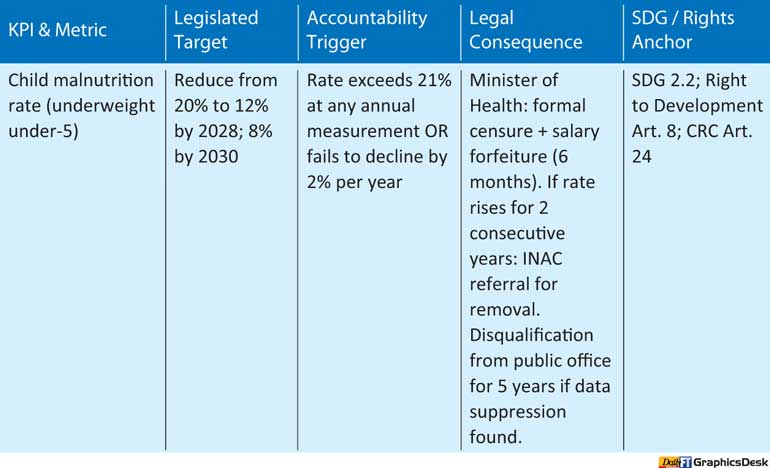
The following domains correspond to the structural vulnerabilities and immediate crisis pressures identified in the June 2026 analyses. Each domain carries legislated targets and mandatory consequence triggers. The full KPI schedule is set out in the Act’s Schedule; illustrative examples from each domain are presented below, with Domain 1 shown in full as a model.
Domain 1: Food security, nutrition and agricultural resilience
One in five Sri Lankan children is malnourished. The Yala 2026 paddy season faces a 60% probability of El Niño-induced rainfall deficit. Cyclone Ditwah destroyed 20% of the Maha harvest and left 32% of surveyed households food-insecure — double the pre-cyclone figure. A 30% food cost increase is arithmetically catastrophic for the 55–70% of households in Tiers 1–3. Fertiliser shortfall stands at 65,000 tonnes — 30% of seasonal need — and the Government’s input voucher of Rs. 15,000–20,000 per hectare has not been revised despite a 50–100% urea price increase.
Illustrative KPI — shown in full as a model for all six domains:
Domain 2: Income adequacy, wages and social protection
The effective median household income (Rs. 60,000–80,000 per month) stands 35–48% below the Anker living wage of Rs. 115,291. The minimum wage covers less than one-third of living costs, and 26% of the workforce falls outside wage protection entirely. Aswesuma welfare transfers miss 40% of food-insecure households. IMF conditionality constrains public wage increases while VAT at 18% on 97 essential goods systematically erodes real incomes at the bottom. Legislated targets include: minimum wage indexed annually toward 60% of the Anker living wage (Rs. 70,000 per month by 2028); Aswesuma coverage of 80% of food-insecure households by December 2026; and a Digital VAT Rebate pilot crediting back 50% of VAT on essentials to households earning below Rs. 100,000 per month. Failure to index the minimum wage triggers Tier 2 financial sanctions against the Minister of Labour; politically motivated welfare targeting triggers criminal prosecution.
Domain 3: Climate resilience and environmental rights
Sri Lanka is among the ten countries globally most vulnerable to climate change. Cyclone Ditwah caused USD 814 million in agricultural losses — 4% of 2024 GDP. The IMF program contains no explicit climate resilience provisions. This domain legislates what the program omits: a minimum 0.5% of GDP ring-fenced for climate adaptation by 2027, rising to 2% by 2032; a renewable energy share of 40% in the national grid by 2027; and 85% of drought-risk district households with climate-resilient water access by 2030. Diversion of ring-fenced adaptation funds triggers criminal prosecution for misappropriation. Failure to meet water access targets in any district triggers removal from post for the Provincial Governor and National Water Supply Board Chair.
Domain 4: Fiscal justice, IMF conditions and rights compliance
The cumulative incidence of IMF program conditions — primary surplus targets, VAT at 18%, cost-recovery energy pricing, public sector wage restraint — falls disproportionately on the bottom 70–80% of households. The program does not prohibit compensatory transfers; the Government has simply not used available fiscal space for this purpose. This domain legislates that obligation. Social protection expenditure must reach a minimum 8% of the Government Budget by 2027. Every fiscal measure above Rs. 5 billion must carry a published Distributional Impact Assessment before implementation; any measure implemented without a DIA is automatically suspended. Debt service exceeding 100% of Government revenue without a declared emergency triggers a mandatory joint parliamentary appearance by the Finance Minister and CBSL Governor, with potential criminal liability for concealment of contingent liabilities.
Domain 5: Data, governance and the right to truth
Policy is being designed for a 2026 compound crisis using data from 2019 — before the 81% rupee depreciation, the near-doubling of the poverty rate, and Cyclone Ditwah. Aswesuma’s 40% exclusion error is a direct consequence of this data deficit. This domain requires: provisional HIES 2025 microdata published within 90 days of the Charter’s enactment; a Statistics Independence Act insulating the DCS from political interference and criminalising suppression of official statistics; and a Mobile Pulse Census — a partnership with telecom providers using anonymised economic stress indicators to create a living poverty map updated monthly. Delay of the HIES beyond 12 months of its scheduled date triggers removal of the DCS Director-General. Politically ordered delay triggers ministerial censure, salary forfeiture and a five-year ban from oversight of statistical agencies.
Domain 6: Human capital, brain drain and the Diaspora compact
About 300,162 people departed for foreign employment in 2024. A further 144,379 left in the first half of 2025. This includes doctors, engineers, teachers and IT professionals — the skills required to engineer the recovery. The right to development includes the right not to be compelled by economic deprivation to emigrate. This domain targets: annual departures of tertiary-educated workers reduced from 150,000 to below 80,000 by 2028; a minimum doctor-to-population ratio of 10 per 10,000 in all districts by 2028; and a secondary education completion rate above 90% nationally. A Diaspora Knowledge Remittance Program— a tax-incentivised framework for diaspora professionals to fund remote mentorships for Sri Lankan SMEs and agricultural startups — is the 90-day activation measure. Persistent failure to meet retention targets, directly attributable to available incentives not deployed, triggers ministerial censure.
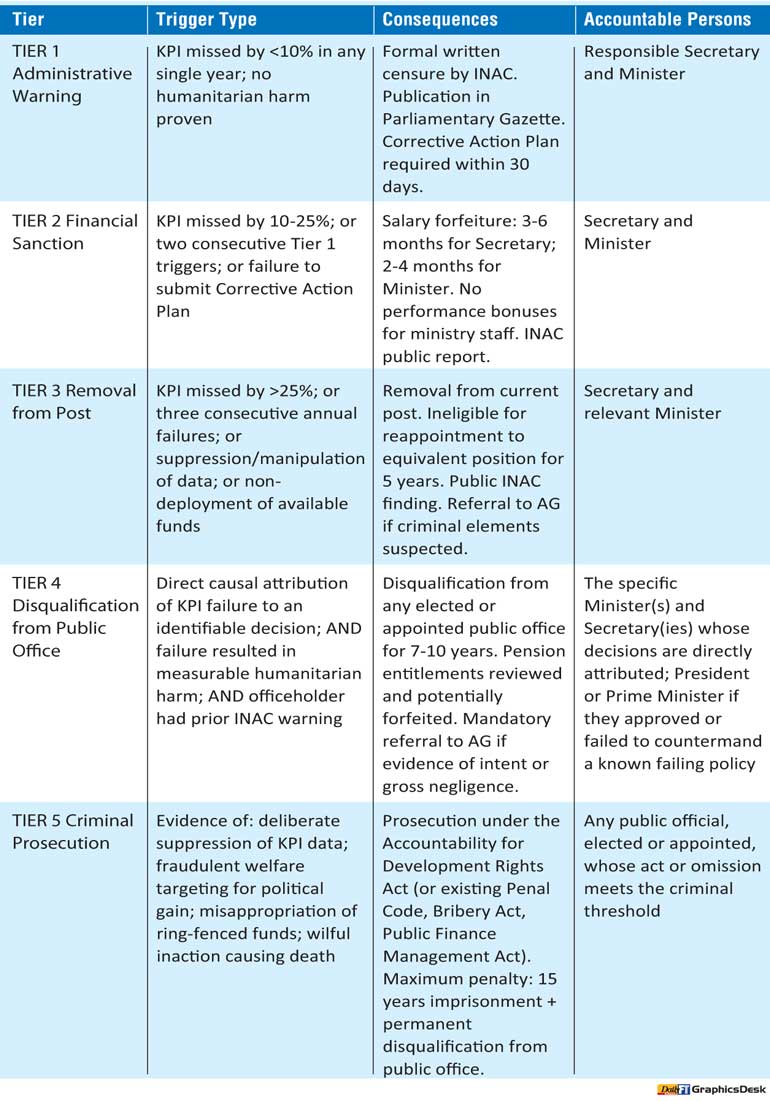
Part III: The hierarchy of mandatory legal consequences
This is the operative architecture that distinguishes this Charter from aspirational policy frameworks. Consequences are calibrated to the severity of failure, the foreseeability of harm, and the degree of direct attribution to an identifiable decision or omission by an identifiable officeholder.
Safeguards and due process
The accountability mechanism is designed to be robust against political weaponisation. INAC Commissioners are appointed by a three-fifths parliamentary majority, not the Executive, on fixed six-year non-renewable terms, removable only by impeachment. For Tiers 4 and 5, causation must be established to the balance of probabilities for disqualification and beyond reasonable doubt for criminal prosecution. An ‘Act of God’ or documented force majeure is a complete defence — but failure to prepare for foreseeable events (such as El Niño events with a 60% probability) does not qualify. All Tier 3–5 findings are appealable to the Court of Appeal within 60 days. This Charter applies prospectively from the date of enactment. Any public servant providing evidence to INAC is protected under a Whistleblower Protection Act, with criminal penalties for retaliation.
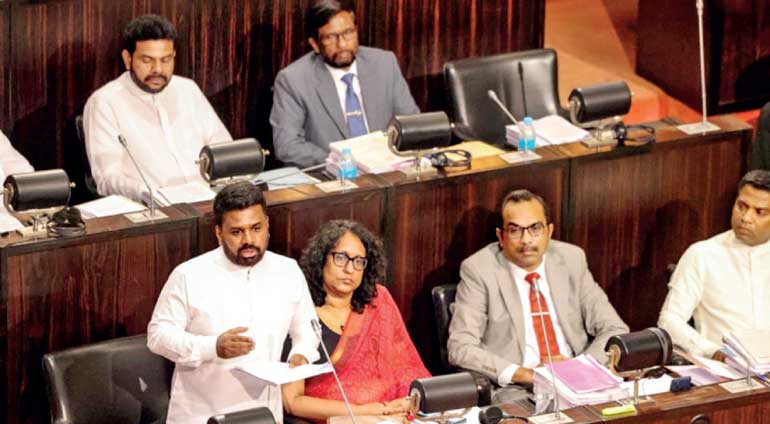
President and Finance Minister Anura Kumara Dissanayake presenting the 2026 Budget
Part IV: IMF compatibility and climate justice
IMF compatibility and the social floor
This Charter is designed to operate within, not in conflict with, the IMF Extended Fund Facility program. The proposed Social Floor Protocol is not a program deviation — it is a supplementary commitment within existing fiscal space. The distributional analysis demonstrates that fiscal consolidation and social protection are not mutually exclusive: the current Aswesuma budget carries 15–20% administrative leakage that, if eliminated, would fund the expanded coverage required by this Charter’s targets. The framework explicitly invites the IMF to incorporate these KPIs into its program monitoring as social conditionality — consistent with the IMF’s own Integrated Policy Framework and its increasing attention to inequality in program design.
Climate justice as an integral dimension
The Paris Agreement and Sri Lanka’s NDCs create international obligations. This Charter converts those obligations into domestic legislative targets with domestic enforcement. It goes further: it establishes that climate-vulnerable households — farmers in the Dry Zone, coastal fisherfolk, estate workers at altitude — have a justiciable right to climate adaptation that is directly funded, measurable and attributable to specific officeholders. Climate inaction is not a policy choice. It is a rights violation.
Part V: The 2028 repayment test and long-term resilience
Can Sri Lanka meet the 2028 debt repayment schedule? The answer is conditional. GDP growth of 5% is real. But growth built on the labour of a workforce 55–65% of whom live below a living wage, sustained by an agricultural base one El Niño season away from crisis, and measured by data that is seven years old, is not a foundation. It is a facade.
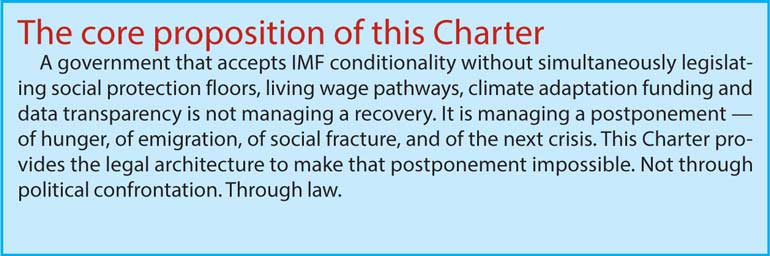
This Charter does not oppose the IMF program. It insists that fiscal consolidation be accompanied by a rights-compliant social architecture that prevents the gains of stabilisation from being captured entirely by the top two income deciles. That is not a radical demand. It is what the Right to Development, the SDGs and Sri Lanka’s own Constitution require.
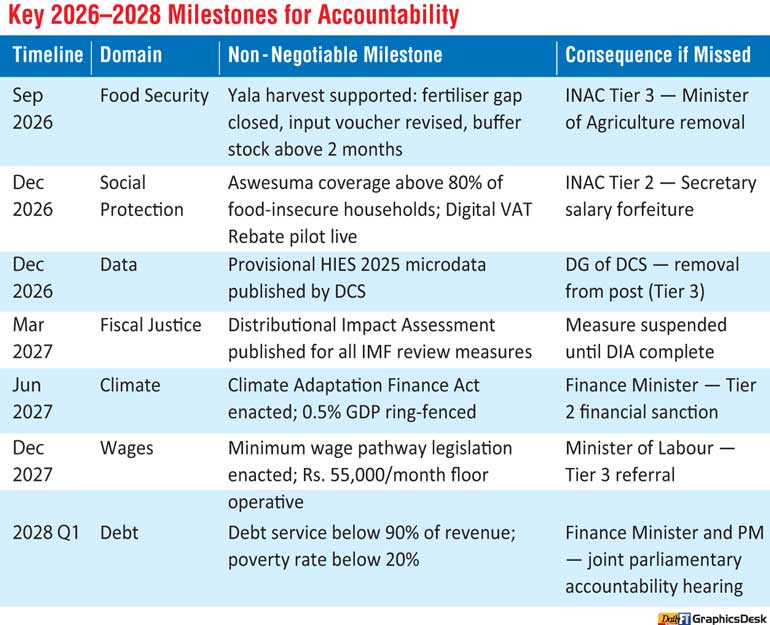
Key 2026–2028 Milestones for Accountability
Concluding note
This Charter is addressed to any Government of Sri Lanka — present or future, of any political colour. Its KPIs are grounded in international human rights law, in the SDGs, in the Paris Agreement, and in the lived reality of the 55–65% of Sri Lankan households currently below a living wage. Its consequences are grounded in the principle that the right to hold public power entails the obligation to exercise it in service of those who granted it.
The question asked by the June 2026 analyses — whether Sri Lanka can meet the 2028 repayment schedule — will be answered by events. The question this Charter asks is different: when the answer is known, who was responsible for the outcome? This document exists so that answer can never again be: no one.
Primary Sources
Sri Lanka: Food Security, Price Pressures & Household Coping Capacity (June 2026) │ Sri Lanka: Independent Household Income Analysis (June 2026) │ WFP Post-Cyclone Ditwah Household Survey (2025) │ World Bank Sri Lanka Development Update 2024 │ UNDP Human Development Report 2023 │ CGIAR/BRIGHT Survey 2024–2025 │ Anker Research Institute Living Wage: Urban Sri Lanka, June 2025 │ DCS HIES 2019 │ IMF EFF Programme Documentation 2023–2027 │ UN Declaration on the Right to Development (1986) │ UN SDGs (2015) │ Paris Agreement (2015) │ Sri Lanka Constitution 1978 (as amended) │ ICESCR │ ICCPR │ CEDAW │ CRC │ UNCAC



