Thursday Oct 22, 2026
Thursday Oct 22, 2026
Friday, 9 January 2026 00:20 - - {{hitsCtrl.values.hits}}
 1. Geopolitical neutrality: The”Strategic Autonomy”
Sri Lanka occupies a critical location in the Indian Ocean, sitting directly on the Sea Lines of Communication (SLOCs) that connect the East and West.
2. A destination for international diplomacy and business
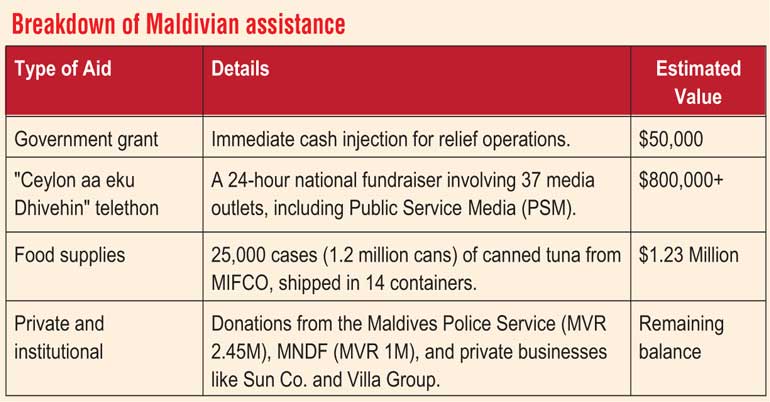
Sri Lanka is increasingly marketing itself as a neutral ground for regional and international dialogue:
In the wake of Cyclone Ditwah (late November 2025), described as one of the most challenging natural disasters in Sri Lanka’s history, several neighbouring countries and regional partners mobilised significant aid. The cyclone caused over 600 deaths and an estimated $4 billion in damage. Sri Lanka’s position as a neutral destination was reaffirmed when the island nation saw aid and relief efforts from not only immediate neighbours such as India, Pakistan and Maldives but global powers such as the USA, China and UAE.
Key contributions by country
 India
India
India’s assistance has been the most extensive, focusing on both immediate life-saving aid and infrastructure recovery.
Operation Sagar Bandhu: First responder. Under this operation India sent 1,100 tonnes of relief material, deployed 80 NDRF personnel, and set up a field hospital near Kandy. India also gave $ 350 million
in concessional loans and $ 100 million
in grants.
 package is aimed at restoring roads, railways, and agricultural livelihoods.
Pakistan
Despite logistical challenges regarding airspace, Pakistan sent significant maritime and aerial aid.
Sri Lanka received 200 tonnes of relief supplies via sea and an additional 14 tonnes via air. Pakistan deployed a 47-member Urban Search and Rescue (USAR) team and tasked a nearby Navy ship for evacuations.
Maldives
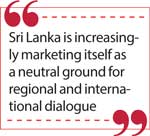
Maldives emerged as one of Sri Lanka’s most significant and immediate donors. Despite being a much smaller nation, the Maldives contributed a total value of approximately $2.4 million, making it the largest single sovereign donor in the initial weeks following the disaster.
The aid from the Maldives was a combination of Government grants, a massive public telethon, and essential food supplies.
UAE
The United Arab Emirates (UAE) established one of the most comprehensive and rapid humanitarian responses, providing both physical search-and-rescue teams and massive quantities of relief supplies.
The UAE’s support was
coordinated through the Joint Operations Command, the UAE International Aid Agency, and the Emirates Red Crescent, following direct orders from President Sheikh Mohamed bin Zayed Al Nahyan.
1. The humanitarian “Air Bridge”
 The UAE maintained a continuous flow of aid through a dedicated air bridge from Abu Dhabi and Dubai to Colombo.
China
China’s total contribution is estimated to be over $2.5 million in direct aid, with additional commitments for technical reconstruction.
1. Financial and material aid
China’s initial response focused on immediate liquidity and survival supplies for the millions of people affected by flooding and landslides.
USA
The United States provided a significant multi-faceted aid package. This support has been characterised by immediate financial grants and the high-profile deployment of military logistical capabilities to reach isolated regions.
1. Financial assistance
Within 72 hours of the cyclone’s landfall, the U.S. Government announced an initial $2 million emergency assistance package.
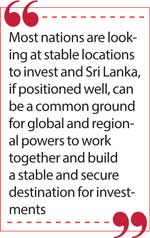
Sri Lanka now has a great opportunity to build on the ties established with countries that provided much needed aid, to promote itself as a true neutral destination and work towards attracting much needed FDI into the country. Most nations are looking at stable locations to invest and Sri Lanka, if positioned well, can be a common ground for global and regional powers to work together and build a stable and secure destination for investments. Sri Lanka could well be the Dubai or Singapore of South Asia.
(The author is a Consultant and Visiting Lecturer at University of Sri Jayewardenepura.)




