Monday Oct 12, 2026
Monday Oct 12, 2026
Monday, 13 July 2026 01:36 - - {{hitsCtrl.values.hits}}
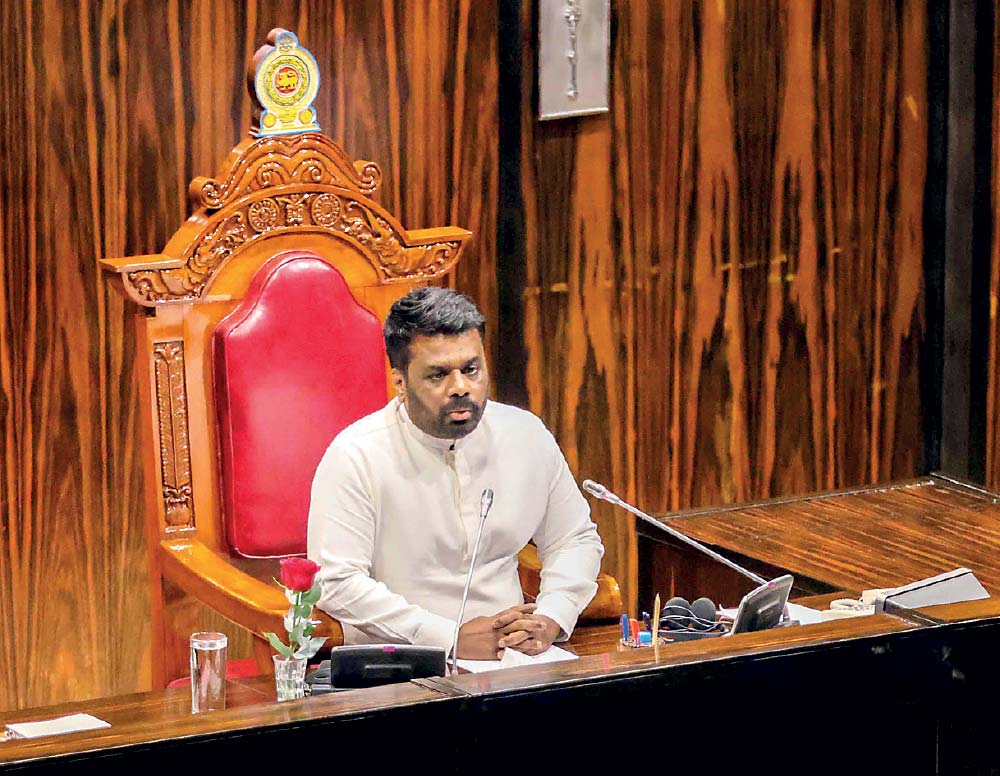
President Anura Kumara Dissanayake
 The Government's planned proposal is one of the most dangerous constitutional adventures proposed to be embarked upon in recent times. If the amendment is carried into effect, it will spell the doom of democratic institutions as well as individual and group rights, as we know and cherish them. Most calamitous of all, it will shake the foundations of public confidence in the integrity and objectivity of the Judiciary
 Government, it would seem, plans to amend Article 107(5) of the Constitution to extend the age of retirement of judges of the Supreme Court from 65 to 67 years, and judges of the Court of Appeal from 63 to 65 years.
A flawed policy rationale
An attempt is made to justify this measure by resorting to a simple argument: life expectancy has greatly increased as a result of improved medical facilities, with consequent extension of the productive segment of life; and the community will therefore benefit from the accumulated knowledge and experience of judges who still have much to offer, as they approach the age of retirement currently stipulated.
This contention is spurious and entirely unsustainable.
Prospective and retroactive reform
The age of retirement of judges is, of course, not an immutable norm. There is lively discussion the world over regarding the age to be fixed by law as the point of compulsory retirement.
Significant variation in approach is seen in different jurisdictions. In the United States, judges of the Supreme Court are appointed for life, and the age at which they relinquish office is a matter of personal decision. When a mandatory threshold is laid down, it may vary from 65 and 70 to 75. An inflexible determination is contrary to practice, and is not consistent with sound policy.
This, however, is not the issue. It is a red herring across the trail, intended to distract attention from the central issue. What is important is that the age of retirement, at whatever level it is decided upon, should be determined prior to appointment of the judge, so that when he embarks upon his judicial duties, he knows the span of his judicial career. Its duration should not be changed while he is in office. The constitutional instrument or other definitive text should stipulate, in advance, the point at which the appointment ceases, and the enacted principle should apply across the board to all judges, with no discrimination from case to case.
The effects of departure from this principle are gravely prejudicial to the prestige and stature of the Judiciary. This is well illustrated by the sequence of events in our own country.
During the first half of this year, 2026, three judges of the Supreme Court retired. If the proposed extension of tenure had been effected at the beginning of the year, these judges would have been entitled to its benefit, and would have continued in office for an additional two years.
The precise moment at which the change is brought into operation is the decisive factor in deciding who, among the judges of the court in question, will be beneficiaries of the innovation, and who would be left outside its scope.
The decision as to timing is entirely in the hands of the Executive, with the support of a majority of the Legislature at its disposal. The seriously disquieting result is that the Government of the day, by having recourse to ad hoc amendment of the Constitution for this purpose, becomes fully empowered to decide which judges will be recipients of its largesse, and which will not.
This amounts to picking and choosing among the judges of the court, the overriding consideration being the goodwill and discrimination of the Government in power.
Whatever the actual intention may be, this inevitably gives rise in the public mind to a doubt whether the decision by the Executive is predicated on acknowledgment of past empathy, or an incentive to future understanding. The arising of this doubt is, by itself, fatal to public perceptions of the objectivity and impartiality of the Judiciary.
The answer lies in prospective, rather than retroactive, prescription of the age of retirement. Nothing is cast in stone, and changing social circumstances certainly call for accommodation in the substance of the law. But the principle to be insisted on is that the changes contemplated should apply to judges to be appointed after the amendment is made, and should not be available as a lever for use to confer on some sitting judges advantages which are tactically withheld from others.
Classification and discrimination
By their very nature, arguments which appeal to longevity, productivity, and waste of talent in human resources, apply universally across the public service. Any limitation to one section, arbitrarily chosen, erodes the very foundation of the suggested rationale.
University professors and other academics in our tertiary education system retire compulsorily at 65 years. The age of retirement of medical consultants is currently fixed in our country at 63. Heads of Department throughout our public service relinquish their functions at 60.
In each of these categories, the accumulated experience is considerable. Is it only judges who remain capable of adding value to the public wellbeing at 65? On what rational ground is similar reasoning withheld from other categories of specialised personnel, such as cancer, kidney, and heart specialists, whose contribution in their respective spheres is noteworthy, and should continue to be available to the public?
The Minister of Justice, on the floor of Parliament, tried to justify the Government plan by pointing out that judges in developed countries serve beyond the age of 65. He cited as examples several jurisdictions, including the United Kingdom, Germany and Brazil.
What he did not mention is that judges in all these countries are not treated as an isolated exception. On the contrary, the enhanced age of retirement finds its place in an overall culture which lengthens the working lives of all public service personnel in keeping with transformed social conditions and expectations.
The attempt to distinguish judicial officers from all other public officers is capricious, invidious and insincere, and altogether lacks the ring of conviction.
Mandate and legitimacy
An interesting feature of the Government plan is the identification of this particular issue as being worthy of high priority and immediate legislative action. No one, to our knowledge, has agitated for urgent legislative intervention in this area, nor has it received even passing mention in the manifesto of National People's Power. By contrast, when it went before the people almost two years ago, it committed itself to decisive action in other fields, including in particular the abolition of the Executive Presidency.
Current political experience in the country highlights the importance of many other constitutional issues, in particular, anomalies besetting the electoral system. This has been repeatedly invoked as a reason for delaying the conduct of Provincial Council elections.
There are other issues which call for very early responses in light of current developments -- such as the recent ruling by the Vavuniya High Court suspending operation of the Gazette issued by the Governor of the Northern Province, removing from office the Mayor of the Vavuniya Municipal Council. This situation vividly exposes the ambiguities in the constitutional provisions governing the competence of a Governor to exercise the powers of a Provincial Council which is defunct in the absence of elections.
It seems strange, to say the least, that all these crucial issues are going by default, while the obsessive focus of the Government is on a matter which is peripheral and divisive. Furthermore, this issue is sought to be taken up on a stand-alone basis, rather than as an integral aspect of a comprehensive constitutional reform initiative.
Impact on the subordinate judiciary
The question arises in stark form regarding the impact of the proposed change on the ranks of High Court and District Court judges, as well as Magistrates. These are public officers who have devoted their entire working lives to the administration of justice in our country. Given their dedication and commitment, upward mobility in their chosen profession is no less than their due. And yet, their legitimate expectation of promotion to higher levels of the judiciary is stultified by the unexpected extension of the tenure of judges of superior courts. This will unavoidably result in demotivating these judges, with consequent loss of enthusiasm.
The Government, in pursuing its current initiative, has repeatedly stressed the need to retain the services of judicial officers of high calibre. This requires, at the very minimum, the provision of a conducive working environment in which conscientious application is recognised and rewarded. This can hardly be done by depriving judges of access to proper avenues of promotion on which they had relied with every justification.
The problem is certainly not solved by offering to extend the tenure of all judges (not only judges of the Supreme Court and the Court of Appeal) by two years. If implemented, the effect of this is that serving judges of subordinate courts will stagnate in the positions they hold at present, since natural rotation and promotion is interfered with, by the higher judiciary retaining their positions beyond the time span contemplated prior to the proposed innovation.
Equal protection of the law
If the Government proceeds with its plan to carve out one section of the public service, which is organically an integrated whole, and to confer on it substantial advantages which are deliberately withheld from other strata, the resulting problem has more than a moral or ethical dimension: it produces justiciable legal consequences. This arises from the operation of Article 12(1) of the Constitution, which provides that "all persons are equal before the law and are entitled to the equal protection of the law".
Trade unions and professional bodies representing services prejudicially affected will thus acquire the right to approach the courts with grievances of constitutionally impermissible discrimination. The glaring anomaly then arises that it is none other than the Supreme Court, in the exercise of its jurisdiction in terms of Chapter XVI of the Constitution, that would have the non-delegable duty to adjudicate upon the matter.
This is a flagrant violation of the essential elements of natural justice, in so far as the direct and exclusive beneficiaries of the impugned measure function as judges in their own cause -- a situation which would scarcely invite public confidence in the institution.
Absence of consultation
A measure so far-reaching in its impact must necessarily be preceded by extensive public consultation. This is amply borne out by international practice. In the United Kingdom, for instance, when extension of judicial tenure was considered in earnest for more than a whole year in 2021, the Government proposal was opened up for public debate, eliciting no fewer than 1,200 responses expressing a wide range of points of view.
The striking contrast in our own country is that the proposed amendment is being hatched in secrecy, unbeknown even to members of the Government, let alone the community at large. When the Bar Association communicated with the Minister of Justice, the non-committal and evasive reply was that the matter had not been discussed at Cabinet. A furtive and clandestine approach, indicative of singular lack of confidence, is hardly the right approach to constitutional reform in so critical an area.
Conclusion
The Government's planned proposal is one of the most dangerous constitutional adventures proposed to be embarked upon in recent times. If the amendment is carried into effect, it will spell the doom of democratic institutions as well as individual and group rights, as we know and cherish them. Most calamitous of all, it will shake the foundations of public confidence in the integrity and objectivity of the Judiciary. What is quite remarkable is that the Government initiative is not a response to overtures by the legal community, civil society, or informed and interested groups. It is a self-serving, partisan political initiative by the Government in power.
(The author is former Minister of Justice, Constitutional Affairs and National Integration; Quondam Visiting Fellow of the Universities of Oxford, Cambridge and London; and Former Vice-Chancellor and Emeritus Professor of Law of the University of Colombo)




