Saturday Oct 03, 2026
Saturday Oct 03, 2026
Monday, 12 January 2026 00:00 - - {{hitsCtrl.values.hits}}
 The industry faces significant challenges such as higher initial cost, grid integration, infrastructure, and inconsistency in policies. By introducing favourable conditions and promoting this sector, the Government can achieve multiple benefits while ensuring energy independence and security for Sri Lanka
 Introduction
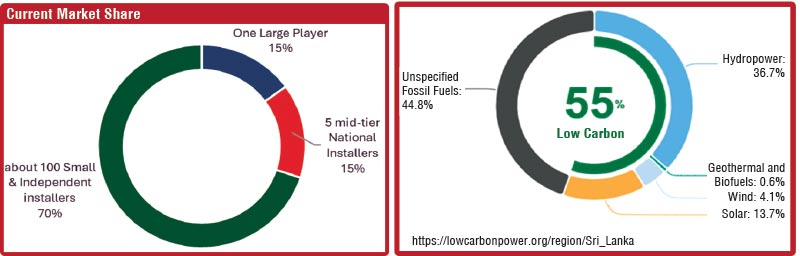
The average electricity generation was 16,802 GWh in 2024. The demand for electricity is expected to increase approximately by 5 to 6% every year. Therefore, there would be about 40% total increase in electricity demand by 2030. The contribution of fossil fuel sources was 44.8% of the total generation as of 2024. Sri Lanka still heavily depends on fossil fuels for generating electricity. The fossil fuel is costly, high-risk, and less sustainable from both the economic and environmental concervation points of view. The other major contributor was hydropower, which is 36.7% in 2024. There are limitations and challenges that hinder increasing the capacity of hydropower too. The wind power contribution was less than 5%, and the recent protest against the wind farm project in Mannar District highlights implementation challenges. Solar contribution was 13.7% in 2024. There are ongoing discussions on establishing nuclear plants and further expanding wind power, etc. to fulfill the increasing demand, but there are considerable challenges in implementing such projects. With rapid development of solar technology and a country having an abundance of sunshine, Sri Lanka has huge potential for expanding solar energy. Sri Lanka’s annual solar irradiation ranges from 1,642 to 2,190 kWh per square meter (Bandara and Amarasena, 2020; Chen et al., 2018). Therefore, it is more lucrative and practical for Sri Lanka to increase solar usage to meet increasing demand. The transition from mainly fossil fuels to renewable energy like solar would ensure energy independence, economic sustainability, and environmental conservation.
Global outlook of solar energy and technology
Growing concern over climate change and depletion of fossil fuels means there is a continuous increase in demand for green energy such as solar energy. On the other hand, rapid innovation in solar technology pushes costs lower and increases effectiveness, boosting the solar industry. In 2024, photovoltaic capacity (PV) was 2.2 TWp, which doubled in less than three years. Innovation in cell designs such as multi-junction solar cells and PERC (Passivated Emitter and Rear Cell) and bifacial modules that capture sunlight from both sides have contributed to greatly increasing the efficiency of the systems. (Badran and Dhimish, 2024; Ogundipe et al., 2024). Furthermore, there has been substantial improvement in energy storage technology, use of new materials, and efficient grid integration in the recent past, and continuous efforts are under way to innovate the technology. For example, in 2024 the investment in solar PV technology was around $ 500 billion globally, and it has been estimated that there will be a total installation of 600 GWp of new systems (Jäger‐Waldau, 2025). There is a considerable growth in cumulative installations in Asia as well (Feldman et al., 2021). Due to an increase in the production capacity and efficiency of solar cell production and improvements in PV technology and material, etc., there has been a rapid decrease in solar module prices, and now solar is highly competitive in comparison with fossil fuels (Ahmed et al., 2019; Nadarajah and Vakeesan, 2016). China plays a pivotal role in driving the growth of the solar industry (Bang-Møller et al., 2011; Yu, 2016). These trends will hopefully further improve the effectiveness of solar systems, making them accessible to all levels of consumers.
Solar energy market in Sri Lanka
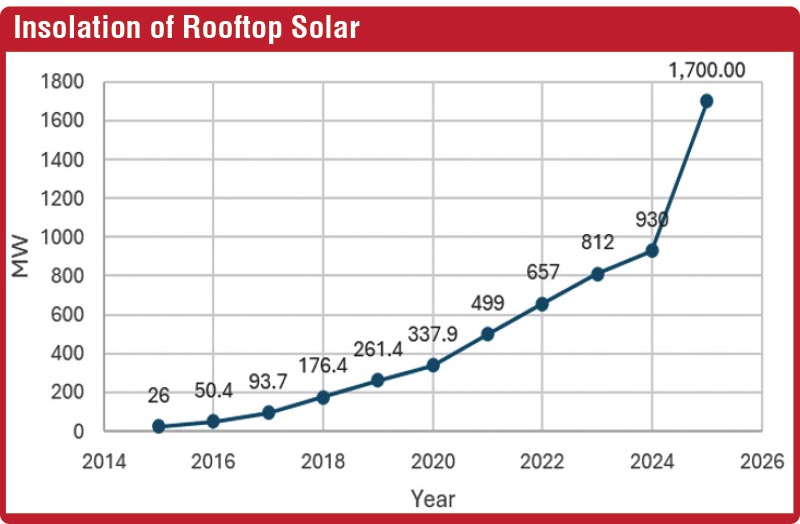
The rooftop solar capacity has increased rapidly, particularly from 2024 (930 MW) to mid-2025 (1,700 MW); this is an increase of 82% compared to 2024. This rapid increase takes place within a period where the country is recovering from an economic downturn. There are three market segments: industrial rooftop, commercial rooftop, and residential rooftop. Out of three market segments, the residential segment is leading, which is about 50% of the total installation capacity, while the commercial segment is the smallest, which would be around 14%. There is a growing interest in investing in rooftop solar among the general public as their second income source. Given the low interest rates for deposits, the public could see that investing in rooftop solar is a much better option than keeping money in the bank.
There are about 350 registered suppliers/installers in Sri Lanka; the vast majority are small players that are mainly operating in the Western Province. Approximately 15% of the market share is in the hands of one large player; another 15% is distributed among 5 mid-tier suppliers who are operating around the country. Balance 70% of the market share has been distributed among around 100 small players. Therefore, the solar market is a bit crowded and getting more and more competitive. The solar market is becoming price competitive, as there are many numbers of suppliers, mainly small and medium suppliers who are mainly competing in the residential market segment.
Nevertheless, there is still a huge untapped market. It is said that Sri Lanka has approximately 7 million buildings. It said that only about 1% of rooftops had solar by early 2024. Of course all the buildings are not potential for installation due to various reasons, but a vast number of rooftops are still available. This information indicates the size of the potential market. By mid-2025 the value of rooftop assets is about Rs. 100 –120 billion. If we expect moderate growth year-on-year, this installation capacity is going to be doubled by 2030, and the value would exceed 200 billion easily. With the support of the Government to promote this sector, we can expect much higher growth.
Benefits and challenges
Sri Lanka has a higher level of irritation and sunshine throughout the year. This ensures consistency and sustainability. Increasing the contribution of solar energy could save billions of dollars and can effectively contribute to the achievement of sustainable goals. This move would reduce dependency on fossil fuels and increase energy independence as a nation. This sector development can generate new job opportunities through enhancement of manufacturing, installation, and maintenance. This is a lower-risk investment opportunity for the general public. They can diversify their income source while contributing to the national economy and environmental conservation.
Still, higher initial costs in Sri Lanka create significant barriers for the general public to invest in this sector. Another issue that could advisedly affect it is inconsistency in policy and regulations. When regulations or policies change frequently, that creates uncertainty. On the other hand, technical issues with regard to grid integration and infrastructure are a formidable challenge. Furthermore, heavy reliance on imports could also create issues; hence, establishing manufacturing plants with partnerships could further improve this sector. Developing technical expertise and encouraging innovation within the country would greatly benefit the industry and the county.
Conclusion
There is huge potential for increasing solar energy capacity in Sri Lanka in order to meet the increasing demand for electricity. This will be beneficial to the Government and entrepreneurs as well as the public. The general public can use this opportunity as a second income source while supporting national economic and environmental conservation. The Government can achieve its sustainable goals by further promoting and supporting the solar sector. Entrepreneurs can achieve their goals while contributing to the employment generation and supporting both the Government and individuals who are seeking second income sources. However, the industry faces significant challenges such as higher initial cost, grid integration, infrastructure, and inconsistency in policies. By introducing favorable conditions and promoting this sector, the Government can achieve multiple benefits while ensuring energy independence and security for Sri Lanka.
(Rozan Jameel (MBA, FCA, ACMA, BSc (physical Science) has over 25 years’ experience in the sectors of construction and engineering, retail supermarket chain, and hospitality industries. He has held positions such as Director Finance, CEO and Group CEO.
Dr. Susil Kumara Silva a senior lecturer, researcher, management consultant and a Charted Member CIPM. Counts 26 years of managerial experience in construction and engineering, trading, apparel and education sectors. Held positions such as CEO, Senior Executive Vice President and Group Head HR and Administration in large organisations.)



