Saturday Oct 17, 2026
Saturday Oct 17, 2026
Saturday, 17 October 2026 00:00 - - {{hitsCtrl.values.hits}}
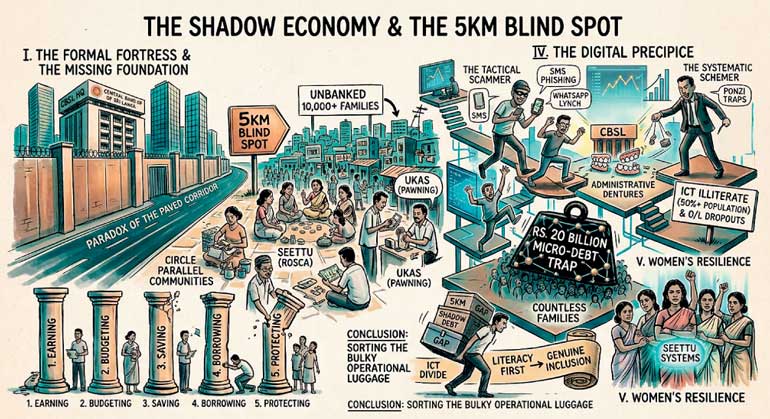
Until financial literacy precedes financial inclusion—and until the State provides robust legal shields against predatory asset-stripping—the gates of the formal financial system will remain a fortress that excludes the needy while facilitating the schemer
 Introduction: Paradox of the paved corridor
In the opening framing of Dr. W.A. Wijewardena’s Daily FT column, “Alarming case of financial illiteracy amidst drive for financial inclusiveness and literacy,” a stark reality is laid before policymakers: bringing uneducated, unprepared consumers into the formal financial system without equipping them with the intellectual shield of financial literacy is the exact equivalent of handing a high-powered vehicle to an untrained driver.
Yet, when we trace this dilemma from macroeconomic theory down to the asphalt of Sri Lanka’s commercial hubs, the plot thickens. The crisis is not merely that formal financial institutions are thrusting complex credit instruments onto unprepared citizens; the deeper crisis is that a massive, breathing, functioning parallel economy operates entirely outside the perimeter of formal banking—even within literal sight of Central Bank headquarters.
To fully grasp the anatomy of this financial disconnect, we must examine five critical structural observations. Together, these insights expose why financial inclusion without structural literacy and grassroots institutional reform remains an elusive illusion.
I. Five core pillars of financial literacy: Missing foundation
At the genesis of any sound economic policy lies an assumption: that the average citizen understands the basic mechanics of money. The framework we must uphold dismantles this comforting fiction. It defines financial literacy not as an innate trait, but as “the possession of the knowledge, skills, and confidence to make responsible financial decisions and manage personal money effectively.”
In this assessment, true financial literacy rests on five interdependent pillars that are systematically neglected in both standard school curricula and public awareness campaigns. Interestingly, 1. Earning (tracking gross vs. net pay and negotiating compensation), 2. Budgeting (living within means and separating needs from wants), 3. Saving and Investing (building reserves and leveraging compound interest), 4. Borrowing and Debt (managing credit, interest rates, and credit scores) 5. Protecting Assets (guarding against fraud, predatory loans, and risk).
When these pillars are absent, individuals cannot evaluate the true cost of credit. They see only nominal amounts of immediate cash, remaining entirely blind to compounding interest, hidden fees, and collateral traps. Without this foundational instruction, every push for financial inclusion simply expands the hunting ground for predatory lenders.
II. 5km paradox: Colombo’s unbanked thousands
The prevailing myth among urban planners and monetary authorities is that geographical proximity equals financial integration. If a bank branch sits down the street, the population surrounding it is assumed to be banked.
A startling revelation uncovered during a 2024 urban development initiative shattered this assumption: more than 10,000 families in the City of Colombo, who have benefited from all of our country’s financial systems, do not possess a single bank account (DN, 23.04.24).
Consider the gravity of this paradox. Within a five-kilometer radius of major bank headquarters in central Colombo—surrounded by glass-fronted commercial towers, digital payment gateways, and international trade desks—over 10,000 families operate entirely outside the formal banking system.
Similarly, across the rest of the island, commercial banks mirror real estate “Ribbon Development,” clustering rigidly along main arterial highways to chase high-yield, low-risk commercial transactions. Meanwhile, interior settlements, urban housing schemes, and marginalised communities remain untouched by genuine institutional outreach. The banks are present; the access is absent.
III. Shadow economy: Seettu, Ukas, and Rs. 20 billion micro-debt trap
Because formal institutions erect towering bureaucratic walls, rigid documentation rules, and steep collateral demands, everyday citizens have constructed a vibrant, highly efficient shadow economy. A significant share of national economic activity is driven by women operating through traditional micro-finance mechanisms through Seettu and Ukas.
Seettu (ROSCAs), is Rotating Savings and Credit Associations, where peer trust replaces legal contracts, enabling members to pool capital and access lump sums instantly without interest or paperwork.
Ukas (Pawning), is short-term collateralised borrowing against jewellery and family gold. However, a massive share of pawning transactions occurs entirely outside formal oversight, recorded only if and when desperation pushes borrowers into licensed centres.
Beneath this informal resilience lies an unmonitored debt crisis. A report in 2024 by a Standing Committee of Parliament pointed to a staggering statistic: around 200,000 families are burdened by an estimated Rs. 20 billion in micro-debt, predominantly held with informal micro-creditors and unregulated grassroots networks.
Despite legal safeguards like Article 4 and 5 of the People’s Bank Act tasking State-backed institutions with supervising rural and community credit expansion, these massive liabilities remain unrecorded in macroeconomic ledgers—operating as a breeding ground for systemic default and asset dispossession.
IV. Digital precipice: Scammers, schemers, and ICT illiterate
Compounding traditional financial exclusion is the modern digital revolution. We must recognise that financial illiteracy is no longer confined to the traditional urban and rural poor; it has metastasised across the digital divide.
Financial illiteracy is sparse among both urban and rural poor, but is now expanding rapidly among the ICT-illiterate, who make up easily over 50% of the population. This strangely includes well-qualified senior citizens. Furthermore, school dropouts around Ordinary Levels (O/Ls) account for nearly half the student population; they too find financial literacy difficult if they are not ICT-literate. Standing above them all are “scammers and schemers” operating across both digital and analog mediums.
This creates a two-pronged threat matrix that existing regulatory bodies are ill-equipped to handle:
The Tactical Scammer, relies on direct deceit, fake identities, and false promises via low-friction digital vectors (SMS phishing, WhatsApp links, spoofed phone calls) to trick citizens into voluntarily transferring funds or handing over account access.
The Systematic Schemer, architects broader institutional-scale operations—such as multi-level marketing traps, speculative timber investment rings, and sophisticated Ponzi schemes—that extract capital across entire communities before regulators notice.
When regulatory bodies freeze like “deer caught in headlights”—failing to implement the provided administrative “dentures” to enforce swift consumer protection—vulnerable citizens fall prey. For decades, the Central Bank of Sri Lanka operated without the robust legislative teeth required to regulate monetary responsibilities across the informal fringe. Even when new statutes pass, enforcement lags woefully behind the velocity of cyber fraud.
V. Women’s resilience vs. institutional failure
Perhaps the most profound takeaway is the gendered dichotomy of economic survival.
While formal commercial banks routinely reject low-income women due to a lack of formal pay slips or titled land deeds, these exact women prove to be far more advanced and effective within their own community banking systems. Through Seettu, modern Installment-based or Cooperative models, women maintain disciplined repayment schedules and capital allocation based entirely on social cohesion and mutual accountability.
When formal credit fails them during catastrophic shocks—such as medical emergencies or structural home repairs—they are forced into the shadows. Unregulated moneylenders step into the information vacuum, offering seemingly rapid cash infusions backed by hidden compound interest and predatory land-mortgage clauses.
As illustrated in Dr. Wijewardena’s article, cases like Alice’s—where a modest Rs. 400,000 emergency loan was weaponised through legal technicalities to threaten generational land valued at Rs. 10,000,000—the absence of grassroots financial literacy transforms emergency borrowing into a mechanism of permanent class subjugation.
Conclusion: Sorting bulky operational luggage
Dr. Wijewardena’s column in the Daily FT rightly challenges us to question the stubbornness of numerical financial inclusion. But to solve the crisis, we must heed ground-level truths.
The path forward requires sorting through decades of bulky operational luggage:
Closing the 5km Gap and forcing commercial banks to extend genuine, low-barrier outreach into unbanked pockets rather than chasing safe ribbon-development corridors. Expand a shared ATM/CDM network with modern capabilities.
Taming the Shadow Debt and enforcing rigorous regulatory oversight over the Rs. 20 billion micro-debt ecosystem and protecting vulnerable families from predatory lenders. CBSL must take leadership and step into action with stakeholders.
Bridging the ICT Divide and deploying grassroots, accessible digital literacy and anti-scam awareness campaigns that protect both dropouts and qualified senior citizens alike. Open School Banking Units and Finance Society forums across the board including Senior Citizens.
Until financial literacy precedes financial inclusion—and until the State provides robust legal shields against predatory asset-stripping—the gates of the formal financial system will remain a fortress that excludes the needy while facilitating the schemer.
(The author’s academic background includes computer science and business economics in the USA. He is formerly an engineer, and Ex-MP in Sri Lanka, and could be reached at [email protected])
Notes;
FT 12.10.26
https://www.ft.lk/columns/Alarming-case-of-financial-illiteracy-amidst-drive-for-financial-inclusiveness-and-literacy/4-798523
DN.23.04.24 https://dailynews.lk/2024/04/23/breaking-news/506575/national-program-of-rice-distribution-for-low-income-families-in-colombo-divisional-secretariat-division-held/




