Tuesday Nov 17, 2026
Tuesday Nov 17, 2026
Tuesday, 17 November 2026 04:26 - - {{hitsCtrl.values.hits}}
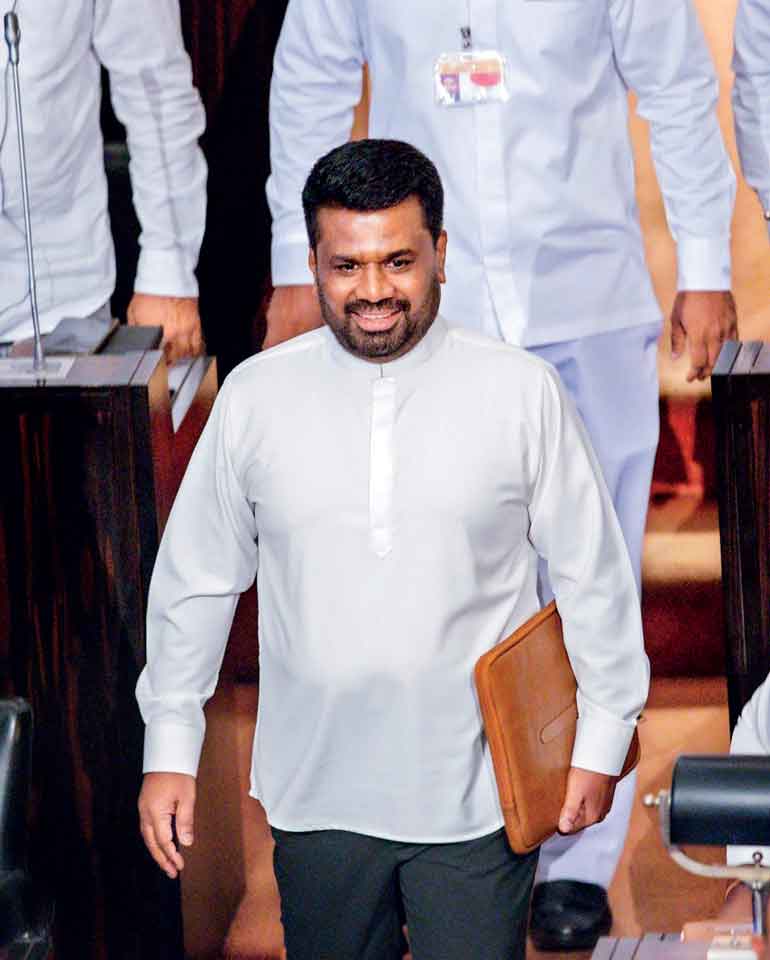
 From Bandaranaike’s State-led economy to Jayewardene’s liberalisation, Rajapaksa’s infrastructure ambitions and Dissanayake’s fiscal discipline, successive Governments have promised prosperity through competing economic models. Sri Lanka’s 2027 Budget proposes an ambitious transition from stabilisation to development. But does it address the institutional failures that have repeatedly prevented economic recovery from becoming lasting prosperity?
Sri Lanka’s 2027 Budget arrives at an extraordinary moment in the country’s economic history. Four years after sovereign default, foreign reserves have recovered, Government revenue has strengthened and economic growth has returned. President Anura Kumara Dissanayake can reasonably point to an economy considerably more stable than the one that collapsed in 2022. Yet stability, however necessary, is not transformation. The consequential question is whether this Budget represents a fundamental restructuring of Sri Lanka’s economy or another restoration of financial order within a system whose underlying weaknesses remain unresolved. For a country that has repeatedly mistaken economic recovery for lasting development, the distinction is neither academic nor insignificant.
For nearly seven decades, Sri Lanka’s budgets have reflected competing economic philosophies, each promising to overcome the limitations of its predecessor. Yet beneath those ideological differences lies a remarkable continuity: successive administrations have struggled to convert public expenditure, economic reform and periods of growth into sustainable productive capacity. Governments have repeatedly changed the relationship between the State and the market without sufficiently strengthening the institutions responsible for directing investment, enforcing accountability and delivering results. This recurring institutional weakness, rather than the failure of any single ideology, provides the historical context against which the 2027 Budget must be judged.
Seven decades of economic promises and recurring structural weaknesses
The Bandaranaike era marked an expansion of State intervention, reflecting postcolonial ambitions to strengthen domestic ownership and reduce dependence on foreign commercial interests. Sirimavo Bandaranaike’s administrations subsequently deepened nationalisation, import substitution and State-led industrial development. These policies emerged from legitimate concerns about sovereignty and inequality, while Sri Lanka’s broader welfare commitments contributed to important achievements in education and healthcare. Nevertheless, extensive protection, foreign exchange restrictions and administrative controls constrained investment and competition. The World Bank subsequently cited estimates suggesting that economic distortions during 1971–77 reduced annual growth by approximately two percentage points. The lesson was not that public intervention was inherently misguided, but that ownership and protection alone could not guarantee productive efficiency.
Sri Lanka has learned how to survive an economic crisis. The greater challenge is proving that it has learned how not to create another
J.R. Jayewardene’s 1977 liberalisation represented an ideological reversal. Trade restrictions were relaxed, foreign investment encouraged and export manufacturing expanded, with the garment industry demonstrating the possibilities of international integration. Yet liberalisation did not establish sufficiently diversified industrial capabilities, while civil war imposed enormous fiscal costs. The post-war period under Mahinda Rajapaksa subsequently promoted infrastructure-led growth, financed partly through external borrowing. Roads, ports and energy facilities improved connectivity, but the commercial returns and financing of individual projects raised questions about sustainability. Following Gotabaya Rajapaksa’s 2019 tax reductions, which the IMF estimated cost more than 2% of GDP in revenue, existing vulnerabilities intensified. Combined with pandemic disruptions, debt pressures and serious policy failures, the consequences culminated in the 2022 collapse. Across these competing models, Sri Lanka repeatedly failed to establish the institutional discipline necessary for sustainable development.
Fiscal recovery is measurable. But whatW does the 2027 Budget actually change?
Against this history, Dissanayake’s fiscal achievements deserve recognition. According to the Budget Speech, Government revenue increased from 8.2% of GDP in 2022 to 16.6% in 2025, while the overall deficit narrowed to 2.3% of GDP in 2025. Economic growth reached 5%. Nevertheless, stabilisation began under the IMF-supported program negotiated during Ranil Wickremesinghe’s presidency. The NPP Government deserves credit for maintaining fiscal continuity despite its earlier opposition to aspects of the prevailing economic framework. Pragmatism need not indicate ideological weakness, but it raises an important question: what distinguishes the administration’s promised transformation from the recovery program it inherited?
The 2027 estimates project revenue of Rs 6.15 trillion against expenditure of Rs 7.673 trillion, rising to Rs 7.933 trillion with supplementary expenditure. Interest payments alone amount to Rs 2.643 trillion, exceeding the underlying public-investment allocation of Rs 1.75 trillion. The Government projects a primary surplus of Rs 1.15 trillion before supplementary expenditure, demonstrating fiscal restraint but also the limited resources available for development after financing existing obligations. The proposed Rs 2 trillion public-investment program includes supplementary reconstruction funding associated with Cyclone Ditwah. Reconstruction is necessary, but restoring damaged assets must not be confused with creating entirely new productive capacity.
The more revealing concern is implementation. The IMF reported that capital expenditure was under-executed by approximately 1% of GDP annually during 2023–25. This suggests that stronger fiscal balances have partly coincided with the State’s inability to execute planned development expenditure. The Government’s new investment commitments therefore require independently evaluated feasibility studies, transparent procurement, published implementation schedules and measurable economic returns. Without these safeguards, Sri Lanka risks repeating a familiar pattern in which announcements acquire greater political importance than completed projects.
The transport proposals illustrate both opportunities and difficult choices. The Budget allocates Rs 80 billion towards the first phase of suburban railway electrification, including the Kelani Valley, Main and Coastal lines, while proposing Rs 30 billion for the Kurunegala–Galewela Expressway section and Rs 27 billion for the Ruwanpura Expressway. Railway electrification could reduce dependence on imported fuel, improve commuting efficiency and increase productivity if accompanied by reliable services and affordable fares. Expressways may improve freight movement and regional connectivity, but their benefits depend upon traffic demand, maintenance costs and integration with productive economic activity. The relevant question is not whether infrastructure generates visible development, but whether each rupee invested produces greater economic value than alternative uses of limited public funds.
The real achievement of this Budget will not be determined by the size of its allocations, the elegance of its projections or the confidence of its parliamentary presentation. It will be determined by whether the economy emerging from recovery is fundamentally stronger than the one that failed
Taxation, agriculture and the distribution of economic opportunity
The Budget proposes increasing the monthly personal income tax-free threshold from Rs 150,000 to Rs 162,500 and revising progressive tax brackets. These changes provide relief to sections of the formal workforce, while the proposed VAT exemption for printed books and exercise books recognises educational affordability. However, the projected Rs 3.592 trillion in taxes on goods and services, compared with Rs 1.341 trillion from income taxes, demonstrates continued reliance on consumption taxation. This raises substantial distributional concerns because lower-income households spend larger proportions of their incomes on necessities, while personal income tax concessions primarily benefit those above the tax threshold. A credible progressive fiscal framework must assess not merely revenue collection but who ultimately finances recovery.
The World Bank estimates that poverty remained at 16.9% in 2025, compared with 11.5% in 2019. Against this backdrop, the Rs 230 billion allocation for social protection allowances, including Aswesuma, and increases in monthly allowances for people with disabilities and kidney disease from Rs 10,000 to Rs 12,500 address genuine hardship. The additional Rs 25 billion for the Praja Shakthi rural development program could strengthen local economic opportunity. Yet welfare must be connected to employment, education and productive capital. Otherwise, transfers may alleviate immediate deprivation without addressing the conditions that reproduce poverty.
Agriculture offers a particularly revealing example of the structural challenge. The Budget acknowledges that the sector employs approximately 23.9% of the workforce while contributing only around 8.4% of economic output. Its Rs 44 billion fertiliser subsidy, supporting payments of Rs 30,000 per hectare, may reduce production costs, but subsidies alone cannot resolve low productivity, fragmented cultivation or weaknesses in marketing. The proposed collective Yaya production system, improved agricultural service centres and greater flexibility in cultivating underutilised paddy lands could improve efficiency. Their success, however, depends upon farmer participation, market access, water management and fair pricing. Sri Lanka must move beyond measuring agricultural policy through subsidies distributed and begin evaluating productivity, farmer incomes and value added per hectare.
The Rs 67.687 billion allocated for enterprise lending subsidies and refinancing, intended to support approximately Rs 174 billion in concessionary loans, represents another potentially significant intervention. Affordable credit could help small enterprises recover from the crisis, acquire machinery and expand employment. Yet lending is not synonymous with productive investment. Banks must distinguish viable enterprises from businesses unable to repay, while policymakers should assess whether subsidised finance generates sustained income rather than temporary liquidity. Credit schemes will have limited transformational value without market access, business development services and reliable infrastructure.
For decades, Sri Lanka’s political establishment has treated economic recovery as evidence of national progress. The events of 2022 demonstrated how misleading that assumption can become
Building productive capacity: The real test of transformation
Foreign direct investment remains central to the Government’s development ambitions. The proposed 200% enhanced capital allowance for qualifying Board of Investment-approved export manufacturing and tourism investments, subject to a minimum investment of $3 million, could encourage capital formation. However, tax concessions cannot indefinitely compensate for unpredictable regulations, administrative delays, expensive energy or weak contract enforcement. Sri Lanka must examine whether investment incentives generate additional economic activity that would otherwise not occur, rather than simply reducing taxation on investments already commercially attractive.
India offers opportunities for integration into regional manufacturing, logistics, pharmaceuticals and professional services, while Vietnam demonstrates how investment policy, infrastructure and export integration can support industrial expansion. Sri Lanka cannot mechanically reproduce another country’s economic model, but it can recognise that sustainable foreign investment requires an entire ecosystem of productive capabilities. Its objective should be to generate skilled employment, domestic supplier networks and technological learning rather than merely celebrate announced investment commitments.
Energy policy is equally consequential. The Budget outlines plans to increase battery energy-storage capacity from 160 MW in 2026 to 560 MW in 2027, alongside a proposed subsidy of up to Rs 250,000 for eligible domestic rooftop solar battery systems. These measures could improve renewable-energy integration and reduce vulnerability to imported fuel, although their benefits depend upon grid reliability, competitive procurement and transparent subsidy targeting. Energy security is not simply an environmental objective: reliable and competitively priced electricity is essential for industrial competitiveness, household welfare and investor confidence.
The Government’s digitalisation agenda, including the proposed National Artificial Intelligence Centre of Excellence, expanded Government cloud infrastructure and digital public services, could similarly improve administrative efficiency. Yet digital transformation must mean more than converting inefficient procedures into electronic formats. It should reduce discretionary approvals, improve transparency and establish measurable service standards. The same principle applies to healthcare and education, where proposed investments in medical equipment, ambulances, teacher development and digital learning could strengthen human capital. Their long-term value depends upon equitable access, maintenance, professional capacity and measurable improvements in public services.
The Budget also proposes increased allowances for medical officers, nurses, university academics and other public employees, partly phased across 2027 and 2028. Such measures may help retain skilled personnel and recognise rising living costs, particularly in essential services. Nevertheless, recurrent commitments create continuing fiscal obligations. They should therefore be integrated with transparent workforce planning, performance standards and broader institutional improvements rather than treated as substitutes for reform.
The ultimate test: Has Sri Lanka changed the economy or merely its management?
External vulnerabilities remain substantial. The Budget projects foreign debt-service obligations of approximately $2.99 billion in 2027 and $3.57 billion in 2028. With the existing IMF program approaching its scheduled conclusion in March 2027, the Government must determine how stability can be sustained without recurring emergency assistance. International support may remain valuable, particularly amid geopolitical instability and climate shocks, but the ultimate measure of recovery cannot be the successful negotiation of successive rescue arrangements. It must be the development of institutions and industries capable of reducing the likelihood that another rescue becomes necessary.
The NPP’s electoral mandate makes this challenge especially consequential. Its political appeal rested substantially upon dissatisfaction with corruption, entrenched privilege and established political practices. A mandate for systemic change demands more than competent management of existing economic arrangements. It requires transparent public investment, predictable regulation, effective procurement oversight and accountability for expenditure that fails to produce intended results. These reforms may lack the visibility of major budget announcements, but their cumulative economic consequences could prove substantially greater.
The 2027 Budget contains credible proposals across infrastructure, agriculture, enterprise development, social protection, energy and human capital. Its ambitions address genuine structural weaknesses, yet the proposals remain promises until their economic effects can be demonstrated. Sri Lanka’s history offers no simple ideological solution: State-led development struggled with efficiency, liberalisation expanded opportunity without eliminating vulnerability, infrastructure investment created assets alongside financing risks, and fiscal stabilisation restored confidence without guaranteeing productive transformation.
Dissanayake now confronts the challenge that successive administrations have approached through competing economic philosophies: converting public policy into durable institutional capability and sustained prosperity. Sri Lanka has demonstrated that it can collect taxes, restrain expenditure and rebuild reserves. It has not yet demonstrated that it can consistently attract productive investment, generate sophisticated exports, create high-quality employment and distribute the gains of growth fairly.
For decades, Sri Lanka’s political establishment has treated economic recovery as evidence of national progress. The events of 2022 demonstrated how misleading that assumption can become. The real achievement of this Budget will not be determined by the size of its allocations, the elegance of its projections or the confidence of its parliamentary presentation. It will be determined by whether the economy emerging from recovery is fundamentally stronger than the one that failed.
Sri Lanka has learned how to survive an economic crisis. The greater challenge is proving that it has learned how not to create another.
(The author is an International Relations student at Monash University whose writing explores politics, governance, and international affairs)