Sunday Oct 04, 2026
Sunday Oct 04, 2026
Monday, 20 April 2026 03:21 - - {{hitsCtrl.values.hits}}
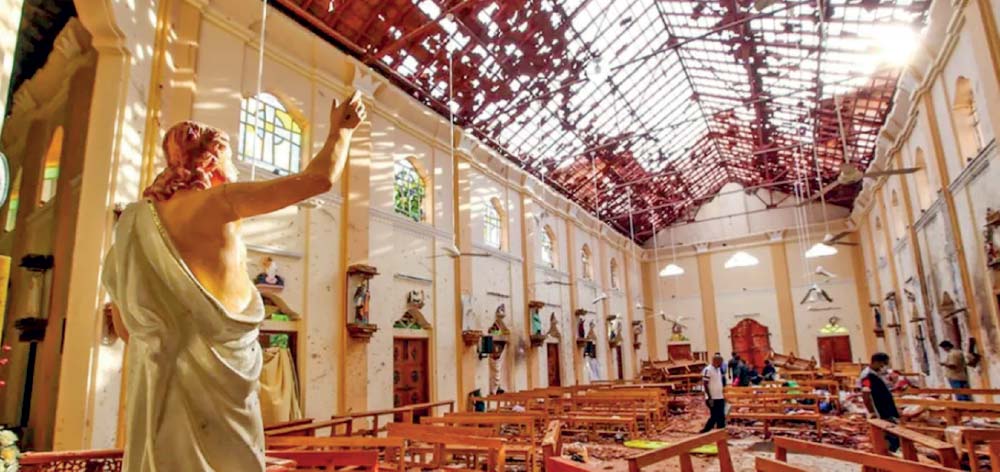
 Seven years on from that black Easter Sunday of 2019, the toll of grief has not let up its death grip. Nor have the traumatic memories of the dark day which unshrouded terror diminished. The wound has merely deepened into something more corrosive and even cancerous – since it has been left untreated.
Dare we say, some 2,555 days (or 83 months) later, it has deepened into a silent national crisis that no one dares name. It is an issue that goes by no formal title. Yet, sometimes someone somewhere senses that – as we often think and feel – that ‘justice delayed is justice denied’.
The dead of April 2019 – some 269 souls lost, in churches and hotels, and scores more maimed for life – have long been buried; but not now or ever forgotten by those who still grieve.
What remains unburied is the rotting corpse of corruptive unaccountability. And what festers, like a mortal (or moral?) wound untreated, is the lingering and unshakeable suspicion that the full story is known – somewhere, somehow, by someone, or more than one, still in power, or on the periphery. Yet, it is withheld, held secret, kept on the tantalising edge of a conspiracy theory.
If the Christian calendar followed by our former European colony’s Roman Catholic community invites reflection on sin, repentance, and redemption, then Sri Lanka’s erstwhile Easter tragedy demands its own liturgy. Not a litany of abstract vices, but a list of concrete failures, and blatant, lying unrepentance. Let us call them (for your sake and mine, today) the ‘Seven Deadly Sins’ of the once and future State.
Sloth – the sin of knowing without action
Intelligence warnings were not vague whispers in the wind... rather, they were repeated, specific and actionable gen or info. Yet, the machinery of the State as it was then lay inert. Worse, some arms may have collaborated in or coordinated the attacks, while sentries against intrusion slept supine.
This was not mere bureaucratic delay or bumbling. It was a farcical paralysis in the face of preventable catastrophe. And that is sloth in its most lethal form. In theology, sloth is not mere laziness, but the stubborn, sluggish, selfish refusal to do what one knows can and must be done. By that measure, the State – whatever successive regimes may say or do or not – stands condemned.
Pride – the sin of division, weaponised
At the time, our country was governed not by unity of purpose but by rivalry at the apex. Institutional fragmentation – by and between President, Prime Minister and security apparatus – meant that information did not flow, decisions did not cohere, and Cabinet responsibility was corroded by the acid of ego.
Pride, in its classical theological sense, is the elevation of self over the common good. That pride – taken to the nth by indifference, negligence and ignorance – cost lives, livelihoods, peace, justice, and eventually the nation’s security; which later became ironic as it was a regime hell-bent on security that ushered itself into power.
Avarice – the sin of negligence when power dismisses duty
Judicial findings have since confirmed what the public once intuited: there was culpable negligence at the highest levels. Power was held, but not exercised in the service of protection. This was not merely failure in terms of dereliction of duty... it was the hoarding of authority without the due discharge of its obligations – a most lamentable type of avarice for those in the highest offices in the land.
The sin of silent complicity
In the seven years since 21 April 2019, investigations have proliferated, commissions have reported, and the culpable have been charged and fined. And yet, the full truth of the case seems to remain elusive. Files moved, testimonies have emerged but not been properly pursued, bloodhound detectives have been transferred or kicked upstairs, but clarity has receded and closure evaded.
Silence now is not the absence of speech. It is the management of narrative. And the Government of today, when it was the Opposition of yesterday, managed that narrative in the national interest – and no doubt with prejudice against its political opponents, and in favour of its impending electoral prospects.
And from today’s vantage point, although hindsight has 20/20 vision, it seems the voter as well as the seeker of justice were gulled once again into trusting ‘promising’ Governments and Governments-in-waiting.
And in the present lacunae of silence, where thunderous rhetoric once held sway, suspicion thrives – that some knew more, far more, and much earlier at that... and chose discretion over disclosure – and still choose inaction.
The sin of collusive proximity
Allegations – troubling, persistent and never fully extinguished – have suggested links between the security establishment and those who would later become perpetrators. The shadow of unholy alliances hovers over those who have never been named, except to be tried in the court of public opinion.
Even when unproven, the very plausibility of such proximity indicts a system that allowed extremist networks to intersect with State intelligence. In moral theology this is scandal: the blurring of lines between guardian and the unguarded explosive threat.
The sin of exploitation
What followed the blasts was not only mourning but mobilisation: of fear, of anger, of a national security narrative that reshaped the political landscape. It took the shape or form of a wraith: the wrath of a new regime thinly disguised as policy. That the tragedy became a catalyst for hardline governance is irrefutable fact... the fallout from which doesn’t bear rehearsing. The wrath I mentioned above was so cynically harnessed that it became an instrument, a weapon, a winning strategy.
Whether by odious design or diabolical opportunism, the suffering of innocents was transmuted into the base metal of cheap (in one sense) but also expensive (in another) political capital.
Its cheapness was the low view it took of trust, human life, decency. Its expense came at a high cost to nation, State, country: hunger, a thirst for justice, long fuel queues, the pitting of State power against people on the street protesting arrogant incompetence, an Aragalaya that only served – in the end – to retrench the corrupt political establishment.
Need I mention bringing Mother Lanka to her knees, clutching the begging-bowl of bankruptcy?
The sin of delay
Must we rehearse the axiom that justice delayed is thereby justice denied? Seven years is a long time in the life of a grieving Republic. Long enough for memories to fade, for evidence to cool, for narratives to calcify. Investigations supposedly continue; fresh arrests are made; the shock value makes the naive gasp and the sceptical nod their heads. Yet, closure remains out of reach. Delay, in this context, is not procedural – it is moral. Justice deferred becomes justice diluted.
And to add insult to injury, the vociferous Opposition then – sitting silent of late in Government ranks now – stirred up national indignation at the spectre of a criminal mastermind behind the dastardly bombings who had gone free.
Is it too much to ask – beyond the pale of lamentable excuses about trails run cold and an incriminating silence on promises made to bring the culprits to book no sooner they assumed power – what happened?
These seven sins do not point neatly to a single mastermind. Instead they sketch a darker possibility: that the tragedy was not the work of one hidden hand, but the convergence of many visible failures. A network of extremists may have executed the attacks, but a larger culture of rivalries, omissions, silences, and ambitions created the conditions in which those attacks could succeed.
For a nation that is almost a tenth Catholic, which commemorates Easter as a story of resurrection, the question is unavoidable: can there be renewal – let alone forgiveness – without confession? Can there be reconciliation without truth? Can there be peace without justice?
The dead cannot be raised to life and liberty again. But the truth – however inconvenient, however politically costly – can still be brought to light. Until then, Sri Lanka remains suspended between the twilight of Good Friday and the hopeful dawn of another more promising Easter Sunday.
We are – whatever our faith or philosophy – a people who have suffered, together, in our own crucifixion – but are yet to witness, experience and testify to the resurrection of justice. And with it peace.
(The writer is Editor-at-large of LMD with Degrees in Biblical Studies and Theology, including a Master’s, as well as a Post-graduate Diploma in Politics and Governance)



