Monday Sep 14, 2026
Monday Sep 14, 2026
Monday, 14 September 2026 03:44 - - {{hitsCtrl.values.hits}}
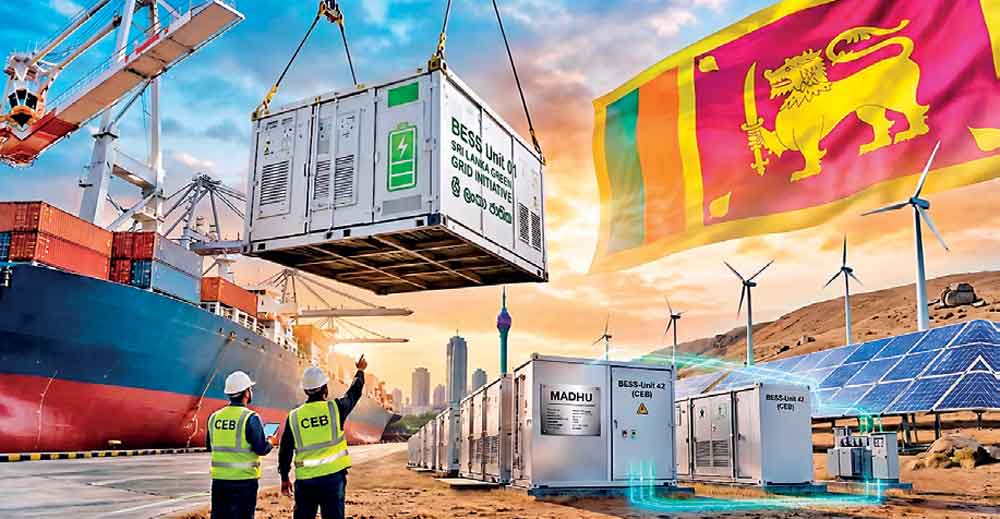
 The current economic situation in Sri Lanka makes the Public Utilities Commission of Sri Lanka (PUCSL) consultation on investment related to power generation important. The country is emerging from a deep economic crisis at a time when it is vulnerable to a range of external shocks, including due to the war in Iran and climate related disasters. Sri Lanka is particularly vulnerable in terms of energy. At the same time, the possibility of a food crisis, affected not only by climate change but also by shortages of fuel and fertilisers is a clear and present danger.
It is therefore necessary to consider the importance of self-sufficiency, particularly in the energy sector, within this crisis-prone global situation. A country that is dependent on imported energy remains vulnerable to external shocks that can quickly affect every part of its economy. Therefore, dependence of power generation on external inputs, particularly imported fossil fuels is a concern. Furthermore, electric power generation is important for all other forms of production, including food.
Timely consultation
The PUCSL is generating recommendations on the Interim Report (2027-2029) of Long-Term Power System Development Plan 2027-2046 prepared and submitted by the National System Operator. The Report has both near-term and long-term implications with respect to the nature and timing of power systems investments.
As per the Report, there are a number of challenges and bottlenecks to electric power generation transmission, and the use of electricity by a range of actors during different times of the day. The Report states that amidst increasing night time demand, rooftop solar has exceeded planned targets and “wind power development has experienced delays due to environmental, land, transmission and financing constraints.” In this context, aggressive installation of Battery Energy Storage System (BESS), and transmission development is a must. The Interim Report seeks to particularly increase BESS installations and increase power generation by 2029 with renewable energy contribution to about 68% of total annual power generation; this is in line with the target of PUCSL to go from 50% to 70% renewable energy from 2025 to 2030. However, much more is necessary to avoid dependence on thermal generation of electric power, where Sri Lanka spent about Rs. 150 billion in coal and oil for power generation in 2025 (Finance Ministry Annual Report, 2025). That cost is likely to be higher this year with the ballooning fuel costs with the war in Iran.
 Return on investment should not be the mode of assessment when it comes to the expansion of an essential service such as electricity. Energy infrastructure must instead be treated as a national priority with the necessary State investment. Such investment should also be frontloaded, recognising the multiple shocks awaiting to confront the country in the near future
Return on investment should not be the mode of assessment when it comes to the expansion of an essential service such as electricity. Energy infrastructure must instead be treated as a national priority with the necessary State investment. Such investment should also be frontloaded, recognising the multiple shocks awaiting to confront the country in the near future.
Off the IMF path
The 17th IMF program (2023-2027) has curtailed State investment. The IMF conditionality of prioritising external debt repayment through austerity measures has undermined national economic growth. One such austerity measure includes “cost-recovery pricing” of energy that has dampened the demand for
electric power in the country.
The Government should fundamentally shift its policies towards ensuring self-sufficiency in energy. For example, prioritising public transport fuelled by renewable energy sources could be one
This IMF program concludes in March 2027, providing an opportunity for the Government to change the course of its economic trajectory. While eroding national production, the IMF has also tremendously dispossessed the working people, whose utility costs have drastically increased. Therefore, a fundamental shift in direction away from market dominant profit orientation is necessary as Sri Lanka ends the IMF Program.
Affordable energy is important to sustain rural livelihoods, for example irrigation of farms using off-grid solar power systems
The Government should fundamentally shift its policies towards ensuring self-sufficiency in energy. For example, prioritising public transport fuelled by renewable energy sources could be one. This will drastically reduce the import costs of both private vehicles and fuel. For such a transformation, investment in power generation and transmission should be prioritised, and accelerated for the development of our energy infrastructure and to stabilise the country's balance of payments. Shocks and fluctuations in global fuel supplies and prices, as witnessed this year, are likely to remain the scenario over the coming years, and we have to be prepared for these uncertainties affecting our economy.
Investments and subsidies
The global shocks including climate uncertainties call for prioritisation of policies and investments relating to essential goods and services. Self-sufficient national energy infrastructure should be one of them with sufficient budgetary allocations. Such State-led investment is also extremely important for the marginalised sections of our society, which continue to bear the brunt of the economic depression. Affordable energy is important to sustain rural livelihoods, for example irrigation of farms using off-grid solar power systems. Electricity is important for the education of the younger generation, so that children can study at night. It is also crucial to strengthen small enterprises and industries. In this way, the energy sector needs to be approached with a holistic vision.
 The 17th IMF program (2023-2027) has curtailed State investment. The IMF conditionality of prioritising external debt repayment through austerity measures has undermined national economic growth. One such austerity measure includes “cost-recovery pricing” of energy that has dampened the demand for electric power in the country. This IMF program concludes in March 2027, providing an opportunity for the Government to change the course of its economic trajectory
Finally, investment in energy infrastructure should not be assessed solely on the basis of return on investment, or for that matter the profitability of the Ceylon Electricity Board (CEB). The IMF program conflates subsidies with the “profit and loss” of State enterprises. Essential services such as electricity should be provided at stable prices and not left to the whims of the fluctuations in the global energy markets. The additional costs of stabilising the prices should be subsidies in the form of public expenditure from the Treasury rather than being considered losses of State enterprise. Similarly, subsidised interest cost of long-term investment in energy infrastructure should be a national priority; national development banks in many developing countries finance such infrastructure in the national interest. Therefore, subsidies and State-led investments are necessary to serve broader economic and social objectives. The taboo on subsidies constructed by the market fundamentalist international institutions such as the IMF and World Bank needs to be rejected.
The PUCSL needs to lead the energy sector away from a skewed idea of a profitable energy sector and provide a clear national vision of self-sufficiency with respect to energy investment and development
The PUCSL needs to lead the energy sector away from a skewed idea of a profitable energy sector and provide a clear national vision of self-sufficiency with respect to energy investment and development. Energy is central to national production, food security and livelihoods. The energy sector has to come under a democratic vision and place the concerns of our citizenry before that of the market.
(This article is based on an oral submission made by the author, PhD in Anthropology from City University of New York, MA in Economics from New School for Social Research and BS in Electrical Engineering from Georgia Institute of Technology, at the Public Utilities Commission of Sri Lanka (PUCSL) consultation at BMICH on 7 September 2026)




