Monday Sep 14, 2026
Monday Sep 14, 2026
Monday, 14 September 2026 01:24 - - {{hitsCtrl.values.hits}}
 As the 8th Colombo International Maritime and Logistics Conference (CIMC 2026) draws to a close, the most consequential takeaway for policymakers came not from regional cheerleading, but from a candid message delivered by the leadership of the US Federal Maritime Commission (FMC).
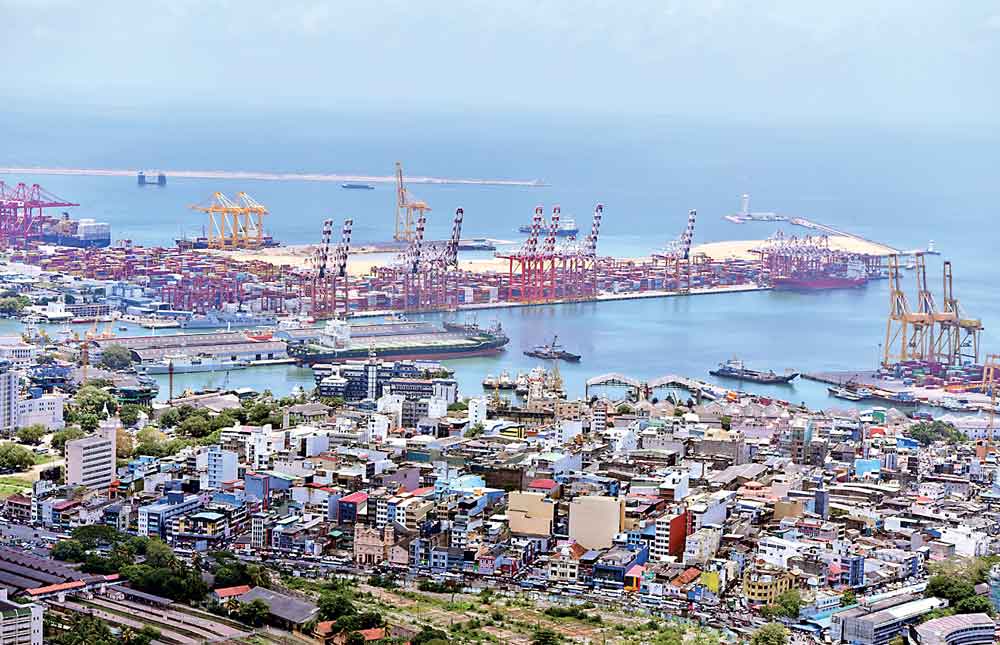
Chairman Laura DiBella’s visit—the first by a sitting FMC head to South Asia—laid bare a crucial reality: Colombo is no longer merely a regional feeder outpost; it has evolved into a vital node for American supply chains, processing roughly 500,000 containers worth an estimated $ 30 billion in cargo value bound for or originating from U.S. markets. Yet, as the FMC leadership explicitly warned, Sri Lanka’s strategic window to permanently institutionalise this advantage is rapidly closing.
With massive capacity expansions coming online across the East Container Terminal (ECT) and Colombo West International Terminal (CWIT)—poised to double handling capacity toward late 2027—Sri Lanka faces a critical choice. Will these berths become high-yield conduits anchoring global commerce, or will they become underutilised monuments of concrete and debt?
Securing the American cargo business and defending against emerging subcontinental alternatives requires looking beyond engineering works to pursue targeted regulatory, legislative, and institutional reforms.
The imperative of US trade lanes
For global mega-alliances transporting goods to North American consumers, reliability, transparency, and geopolitical neutrality are non-negotiable. Amid protracted disruptions in traditional choke points like the Red Sea and Bab el-Mandeb, Sri Lanka’s location on the primary East-West shipping channel provides an open-ocean, choke-point-neutral bypass.
 The strategic interest demonstrated by the US Federal Maritime Commission is a clear recognition of Sri Lanka’s economic potential. Yet this validation comes accompanied by an urgent call to action. Physical capacity expansion must be matched by structural modernisation
However, geography alone is no longer an adequate economic moat. With India aggressively developing deep-water transhipment capacity at Vizhinjam and modernising its direct gateway ports, mainline ocean carriers are continually scrutinising port costs, terminal turnaround velocity, and anti-competitive practices. If Colombo fails to offer predictable governance, vessel allocations will shift.
The structural barrier: The hybrid operator-regulator trap
The primary obstacle to securing foreign direct investment and deeper liner commitments is Sri Lanka’s outdated institutional architecture.
Government must step back from trying to run commercial logistics and focus entirely on being a facilitation
The Sri Lanka Ports Authority (SLPA) remains caught in an inherent conflict of interest under the SLPA Act No. 51 of 1979. The Authority acts simultaneously as the port’s master landlord, its administrative regulator, and a direct commercial competitor operating terminals (JCT and ECT) against private consortia (SAGT, CICT, and CWIT).
Global capital and international regulators look warily upon environments where the entity setting common-user tariffs, allocating berthing windows, and managing marine services is also competing for the same transhipment boxes. As the FMC noted, private capital actively avoids environments governed by arbitrary constraints or perceived regulatory bias.
To extract real value from American trade corridors, Sri Lankamust aggressively operationalise its Commercial Hub regulations
The policy blueprint: What the State must execute
1. Enact an independent Maritime Regulatory Commission
Sri Lanka must decouple commercial operations from sector regulation. Establishing an autonomous maritime commission—mirroring independent oversight bodies like the FMC —is essential. Such an authority would oversee tariff structures, monitor carrier alliances, enforce anti-cartel safeguards, and provide transparent dispute resolution mechanisms. A credible, independent referee provides the certainty international shipping lines require to sign multi-year volume commitments.
2. Complete the transition to a pure landlord model
The State must formally transition the SLPA into a dedicated Landlord Authority. Under this model:
 The public authority retains permanent freehold ownership of core maritime assets —the water basins, dredged fairways, and breakwaters.
Commercial cargo-handling operations (including JCT and ECT) are unbundled into corporatised special-purpose vehicles and concessioned to private consortia under transparent Build-Operate-Transfer (BOT) agreements.
Public finances are freed from procuring expensive gantry cranes and mobile equipment, transferring operational and market risks entirely to the private sector.
3.Pivot from low-margin “Box shifting” to high-value logistics
Pure transhipment yields slender economic margins and exposes the national treasury to global rate volatility. To extract real value from American trade corridors, Sri Lanka must aggressively operationalise its Commercial Hub regulations around Colombo, Hambantota, and Katunayake. Enabling seamless, paperless Multi-Country Consolidation (MCC), buyer’s consolidation, and green-channel air-sea corridors will allow Sri Lanka to capture higher downstream revenue per container while embedding local industries directly into global retail networks.
4. Let business lead through digital modernisation
Government must step back from trying to run commercial logistics and focus entirely on being a facilitator. Fully operationalising a mandatory Port Community System (PCS) that digitally integrates Customs, terminal operators, and border agencies will eliminate the manual documentation and clearance friction that currently inflates vessel dwell times.
The State must formally transition the SLPA into a dedicated Landlord Authority. Sri Lanka must decouple commercial operations from sector regulation. Establishing an autonomous maritime commission—mirroring independent oversight bodies like the FMC —is essential
The moment for decisive action
The strategic interest demonstrated by the US Federal Maritime Commission is a clear recognition of Sri Lanka’s economic potential. Yet this validation comes accompanied by an urgent call to action. Physical capacity expansion must be matched by structural modernisation. By enacting the legislative reforms necessary to create an independent regulator, transitioning to a pure landlord port, and establishing an open commercial environment, Sri Lanka can secure its place as the primary maritime hub of the Indian Ocean for decades to come.
(The author is a Chartered Engineer and researches global trade and shipping developments. Views expressed are personal. He can be contacted at [email protected])




