Friday Oct 16, 2026
Friday Oct 16, 2026
Wednesday, 18 March 2026 00:20 - - {{hitsCtrl.values.hits}}
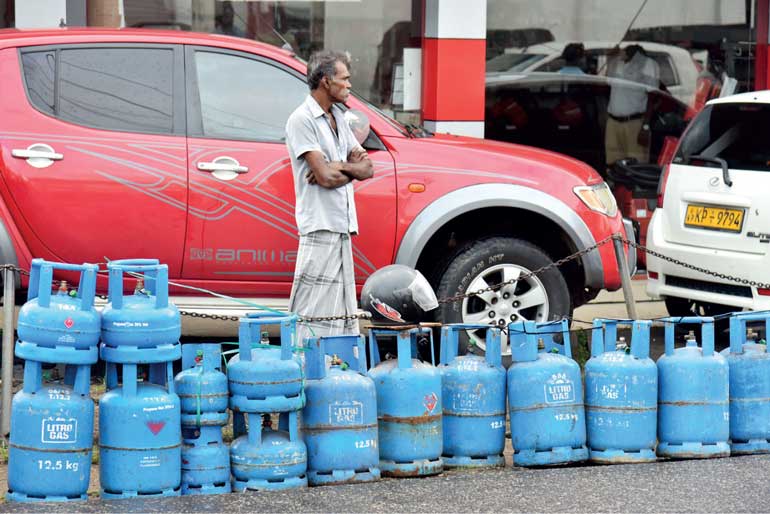
 Sri Lanka’s latest tender for importing liquefied petroleum gas (LPG) in 2026 has delivered a timely lesson in energy security. The contract ultimately secured supplies from the United States, helping the country avoid a looming shortage at a moment of heightened geopolitical tension.
Yet the outcome owed less to careful planning than to circumstance: the winning bid came from Geo Gas of Switzerland, a firm sourcing LPG from American refineries, which simply offered the lowest price.
In effect, Sri Lanka stumbled into diversification by accident. That should worry policymakers. The episode exposed a conspicuous gap in the country’s energy procurement strategy, the absence of robust contingency provisions in critical tender documents. For a commodity so central to everyday life, relying on luck is hardly a strategy.
Sri Lanka’s two main operators, Litro and Laugfs, import roughly $500 million worth of LPG each year. In recent years, most of that supply has come from Oman. The sudden need to pivot away from this source revealed the risks of depending on a single or geographically concentrated supply chain.
That Sri Lanka managed to secure alternative supply from America was fortunate. But the fact that diversification occurred because the cheapest bid happened to originate elsewhere, rather than as part of a deliberate backup plan, underscores how thin the country’s safeguards remain.
More than a commodity
LPG occupies a critical role in Sri Lanka’s energy mix. It fuels millions of household kitchens while serving as an essential input for industries ranging from food processing to ceramics. A disruption to supply would quickly ripple through both domestic life and industrial production.
 Recent geopolitical tensions, including the shadow cast by conflict involving Iran, illustrate the risks. Events far beyond Sri Lanka’s control, an armed conflict, sanctions, shipping disruptions or extreme weather due to El Nino can rapidly constrict global energy flows. For a small island economy, such shocks can translate into sudden shortages, price spikes and social discontent.
Compounding the vulnerability was turbulence in the industrial LPG market. Laugfs, a major supplier to industrial users, encountered financial and global supply chain difficulties. The industrial segment together with consumer LPG (yellow cylinder) accounts for roughly 20% of Sri Lanka’s daily LPG consumption. As that supply faltered, state owned Litro was forced to fill the gap.
The resulting diversion of resources strained the overall system. Industries such as tile and sanitaryware manufacturing, which rely on LPG fired kilns continued to demand fuel, even as household supplies tightened. The episode demonstrated how fragility in one segment of the market can quickly destabilise another.
Building resilience into tenders
If Sri Lanka is to avoid similar near-misses, its procurement framework must evolve. Tender documents for LPG imports should move beyond narrow considerations of price and capacity. Instead, they ought to embed mandatory and enforceable contingency provisions designed to guarantee continuity of supply.
Several measures would strengthen the system
 First, bidders should be required to demonstrate a credible global logistics network. Suppliers that already deliver LPG to multiple destinations, say, at least ten markets worldwide are more likely to possess the infrastructure and flexibility needed to reroute shipments in a crisis.
Second, tenders should require geographical diversification. If a supplier’s primary source lies in the Middle East, for example, it should also demonstrate access to cargoes from a different region, such as the Americas or Southeast Asia.
Third, bidding structures could incorporate a second tier of supply. Under clearly defined force majeure conditions, the government could activate pre-priced backup volumes without the need for an emergency procurement process.
Fourth, authorities should consider establishing a pool of pre-qualified secondary suppliers. These firms would undergo prior vetting and could step in swiftly should the primary contract fail.
Finally, strategic reserves deserve serious attention. Maintaining a national stockpile sufficient to cover several weeks of consumption would provide a crucial buffer against sudden disruptions.
From luck to policy
Sri Lanka’s 2026 LPG tender ultimately secured supply. But it should not be regarded as a model of success. Rather, it is a reminder of how exposed the country remains to shocks in global energy markets.
 Performance bonds and competitive bidding provide useful safeguards, but they are not substitutes for a comprehensive resilience strategy. If the main supply route is disrupted whether by war, shipping bottlenecks or supplier failure, the consequences for households and industry alike would be immediate.
By embedding robust contingency provisions and insisting on diversified global supply networks, Sri Lanka could shift from reactive crisis management to proactive risk mitigation. In doing so, it would ensure that the country’s kitchens and factories remain running, even when the world beyond its shores becomes less predictable.




