Saturday Oct 03, 2026
Saturday Oct 03, 2026
Wednesday, 3 June 2026 00:45 - - {{hitsCtrl.values.hits}}
 “Oh Bhikku! Censure yourself (for your misdeeds). Control yourself. The self-controlled wise bhikku will experience happiness” - The Buddha (Dhammapada – Bhikku Vagga)
By Tisaranee Gunasekara
The child was nine and came from a broken family. When his mother developed a health complication, he was sent to his maternal aunt’s house to continue schooling. A monk from a nearby temple suggested he become ordained. The family agreed. Given their poverty, it must have seemed like a kind of a solution.
The child was handed over to the temple to be trained for ordination. According to the Appeal Court judgement, within the course of about four days he was sexually abused twice by the chief incumbent of the temple. The first time, he stayed silent out of shame. The second time, he fled to his aunt’s house.
The family, despite their socio-economic vulnerability, complained to the police. The alleged perpetrator, Uduwila Sujatha thera, was a monk of some substance (by 2019, he was the chief monk-leader of North and East - pradhana sangha nayaka - and ran a dhamma school for children, according to Facebook). While the child-victim was giving his statement to the police, the monk walked in, according to the Appeal Court judgement, an obvious display of power-play. When the investigating official was asked by the high court judge whether there was pressure on him, he admitted that there was pressure by the monk to settle the case out of court.
So, though the crime was committed in August 2009, the case did not begin till 2022, when the child-victim of 9 was a young man of 22. Fortunately, the police, despite pressure, had completed the investigation, so key pieces of evidence such as the statement of the judicial medical officer, who examined the victim within weeks of the crime, was available. He testified that “there was a severe injury to the child’s anal region and that the physical findings, together with the medical history, were consistent with recent anal penetration” ((https://courtofappeal.lk/wp-content/uploads/judgements/HCC-210-23-new.pdf).
How that child dealt with his trauma, his broken childhood, what mental agony and social opprobrium he had to experience as he waited for justice would remain unknown. Though justice was delayed, it was not denied. The High Court found the monk guilty and sentenced him to 10 years in 2023. In May 2026, the Appeal Court upheld the decision.
Now that Uduwila Sujatha is a convicted paedophile, what will his nikaya (Siam Nikaya) do? Will the chief prelates follow the example of the Buddha and de-robe him? Or will they continue with their Chinese Monkey act of See no child-abuse, hear no child-abuse, speak no child-abuse?
Now that Uduwila Sujatha is a convicted paedophile, what will the authorities do? Paedophilia is not a natural expression of passion/lust but a psychiatric disorder. Will the authorities issue  an order banning the convicted-monk from working with children? Or will the Government, too, do a Chinese Monkey, enabling the convicted paedophile to return to his temple and his religious school for children once he is out of prison, age permitting?
A distinct possibility. After all, last month, while the Pallegama Hemaratana child rape drama was at its zenith, President Anura Kumara Dissanayake and Prime Minister Harini Amarasuriya sent felicitation messages for the 80th birthday celebrations of Pahalagama Somaratana, a convicted child rapist who spent several years in a British jail for his crime and is now lording it over a pirivena (a school for novice monks) in Gampaha.
According to the police, also in the month of May, a monk was arrested for sexually abusing a 15-year-old child (who was also the daughter of his brother) and a Mawlawi (a Muslim cleric) was arrested for raping a 14-year-old child.
Minister of Justice Harshana Nanayakkara, during a recent television interview, claimed that child abuse is a bigger crime in Sri Lanka than murder or theft.
The question is what are he and his Government going to do about it?
Many, if not most, child abuse cases go unreported. This is true for clerical child abuse cases as well. While clerical child abuse is a scourge that affects all religions, it is particularly rife in religions with a celibate clergy, like Buddhism and Catholicism. In Sri Lanka, the matter is further complicated by the now-established practice of child ordination.
Subhadda’s disciples
In December 2022, the Buddhist and Pāli University was closed over a case of brutal ragging, senior monk-students torturing junior monk-students as they themselves were tortured earlier. In January 2023, Kandy police arrested six young men for drunken and disorderly conduct. They turned out to be monks in civvies from nearby temples having a night out.
All of them would have been ordained as children.
The practice of child ordination has become entrenched today for three main reasons. For the Sangha, it is the predominant source for new recruits. For poverty-stricken families, it is a path from rags-to-riches for a son. For the state, it is an unofficial poverty alleviation programme. (There is a fourth, less prevalent, reason: property; a chief incumbent would ordain a relative to step into his shoes someday. The accused in the Anuradhapura child rape case, Pallegama Hemaratana thera was ordained while a child of 14 obviously for that reason).
In his autobiography, Irish writer Fintan O’Toole points out that paedophile priests in Ireland knew who they could abuse with impunity: “the vulnerable boy, the kid who got into trouble, the kid whose father had died” (We don’t know ourselves: A personal history of modern Ireland). In Sri Lanka, most child-monks are fair game for any paedophilic monk because of their disadvantaged socio-economic origins and relative lack of familial protection.
Ordained long before they know their own minds, long before they have had experience of life’s many joys and sorrows, these boys are caught in a trap devised by the state, the sangha, society, family, and tradition. Many would leave the robes upon the completion of education. Of those who remain, some would strive to practice what the Buddha taught, staying within the path and showing the path to others. The rest would try to live the lay-life early ordination deprived them of. They’d dabble in politics, start businesses, organise excessive rituals, seek fame and fortune. Some would do unto child-monks what was once done unto them by senior monks; others will have female companions, beget children, abuse children. And the quality of the Sangha will erode until the difference between a monk and a layperson is reduced to a robe.
In 2023, a comedian was jailed wrongfully under the ICCRP for making a joke about Prince Siddhartha’s father. W A Wijewardena wrote of how he heard a female devotee saying the police was right in arresting the comedian because she had “defamed the Buddha” and “undermined the rich Buddhist tradition.” She “would have obviously been paid by foreign elements to destroy Buddhism…” (https://www.colombotelegraph.com/index.php/stories-true-buddha-dhamma-what-do-scholars-advise/).
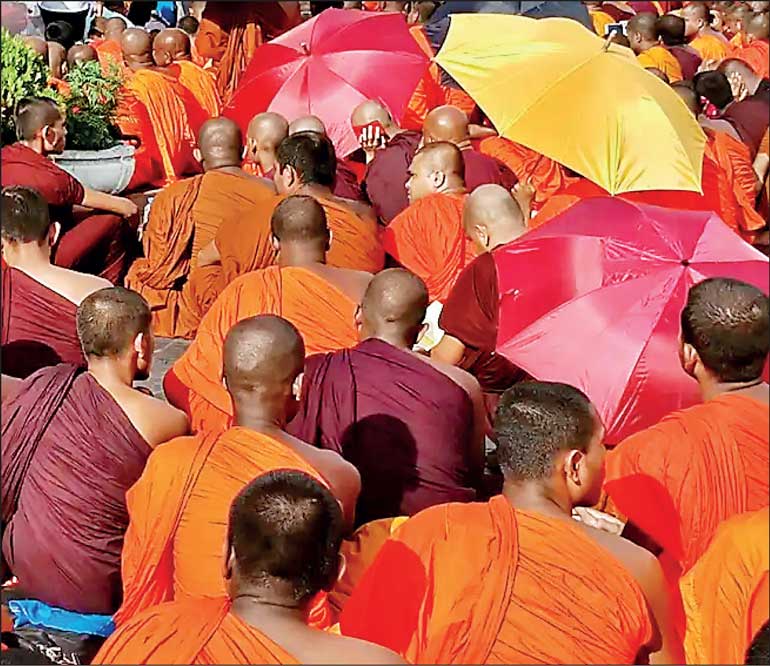
The dominant Sangha reaction to the Pallegama Hemaratana case is silence. Of the handful who have spoken out, a minority condemned the deed and emphasised the need for justice for all parties. The others, as usual, talked about conspiracies. An excellent case in point was Agalakada Sirisumana thera: “When we look at Lankan history, this country was built through a partnership between pious people and monks. Cholas tried to break up this relationship for 1000s of years; they couldn’t. The western nations tried for 500 years; they couldn’t do it. Prabhakaran tried for 30 years he; couldn’t (Obviously the Eelam demand was a red-herring!). Now the descendants of Vasawarthi Maraya (God of death) are using social media to attack the robe. To attack monks. If the Sasana falls, it won’t be monks who are destroyed but the majority culture of this country… We will become like Afghanistan” (https://www.youtube.com/watch?v=KjNaVHIlFXQ).
The question is simple. If all this is a Muslim conspiracy (as the reference to Afghanistan implies), why didn’t the accused monk stand tall and insist that investigations are completed pronto and a case filed pronto, so that he can prove his innocence in a court of law? Why did he flee like a man with a guilty conscience, hide like a criminal? Or is Agalakada monk implying that irrespective of what a monk does (including child rape), lay society should see, hear, speak no evil of him, because that is the way to protect the Sasana? If so, why did the Buddha institute Vinaya rules for monks instead of telling lay followers to worship the robe, shut up, and put up?
Soon after the Buddha’s passing, a monk named Subhadda is said to have told his grieving fellow monks, “We are well rid of that great ascetic. Too long, friends, have we been oppressed by him saying: ‘This is fitting for you; that is not fitting for you.’ Now, we shall be able to do as we wish, and what we do not wish, we shall not do” (https://www.accesstoinsight.org/tipitaka/dn/dn.16.1-6.vaji.html).
Subhadda is winning. Hands down.
Lessons of history
The former head of Atamasthana, Pallegama Sirinivasa, passed away in 2022.
In 2023, the Anuradhapura court heard two unusual and related cases. One, filed by a city businessman, claimed that the late monk had purchased several luxury vehicles with his personal funds and transferred their ownership to the said businessman legally during his final illness (https://srilankamirror.com/news/atamasthanadhipathi-asked-to-appear-in-court-over- vehicle-dispute/?noamp=mobile). The other, filed by the businessman’s wife, claimed that the same monk gave to her, via a deed of gift, a piece of land in the New Town which also was his private property, worth 100million rupees (https://srilankamirror.com/news/land-registrar-summoned-to-court-over-land-given-away-by-atamasthanadhipathi/).
How did a monk subsisting on state patronage and public donations amass so much of wealth? Didn’t such accumulation of wealth violate the Buddha’s teaching and his Vinaya? Why did he make gave such generous gifts to this particular couple?
Child abuse is not the only way many a Lankan monk violate Vinaya in plain sight. Sangha is the only Lankan institution which openly practices caste, in direct violation of the Buddha’s teaching. It is also, arguably, the most economically unequal entity in Sri Lanka. Some temples and monks are as rich as Croesus; others struggle to find daily meals.
Author Piyadasa Sirisena is famed as a Sinhala-Buddhist nationalist. He was, but not a blind one. He used at least one of his novels to warn about the un-Buddhist practices rooted within the Sasana. In Wimalatissa Hamuduruwange Mudal Pettiya (The Money Box of Monk Wimalatissa), the eponymous monk seeks the services of private detective Kongoda Wickramapala to find his lost money box (Mr Sirisena was probably the country’s first detective novelist). The money box was stolen by the junior monk in the temple, (and, if memory serves me right, the senior monk’s nephew) who wanted the cash to marry the girl he had fallen in love with. The moralising parts in the book are critical of burghers, western cultural practices and those Sinhalese who follow them. But the author is even more critical about Buddhist monks who act in violation of the Vinaya, and collect riches.
The novel was written in early 1900’s (possibly 1904) which means monks accumulating private property (as distinct from Sanghika property) was already well established. Today wealth and its inevitable corollary financial corruption are as common among Sangha as they are in lay society.
History of the Catholic church provide a dire warning of the dangers of this path. Before Martin Luther unleashed his tumultuous (and, in the end, violent) Reformation, many Catholics spoke about the need for top-down and comprehensive reform of the Church. Foremost among them was the great Humanist and philosopher Desiderius Erasmus. His diagnosis of the problem carries a familiar ring: “Almost all Christians being wretchedly enslaved to blindness and ignorance, which the priests are so far from preventing or removing…wisely foreseeing that the people (like cows, which never give down their milk so well as when they were gently stroked), would part with less if they knew more” (In Praise of Folly).
But the church would not reform. The rest is history: Luther’s Reformation, the bifurcation of the Church, religious wars, surge of anti-clericalism and religious scepticism, the secularisation of Europe, the reduction of the once mighty Vatican into a statelet - many of this may not have happened if the Church leaders didn’t do a Chinese Monkey, if they instituted timely, transparent, and through reforms before the dam broke.
A temporally nearer example comes from Ireland of the 20th Century. Independent Ireland was a Catholic island ruled not by elected politicians but by the Irish church. Absolute power and absolute impunity bred absolute corruption. For decades, the corruption of the church and the depredations of its priests existed in plain sight, elephants in the room everyone saw but pretended not to see, from politicians and media to ordinary men and women. But, behind the veneer of unassailability, church was haemorrhaging support, as the younger generation, disgusted by the abyss between preaching and practice, turned away from the church. The breaking point came when the powerful bishop Eamon Casey was forced to resign from his positions and flee the country because his long-time girlfriend, Annie Murphy, exposed their relationship (including the existence of their child, Peter). The church’s inability to respond to the Murphy crisis with a thoroughgoing reform led to its eventual political and social, and societal marginalisation.
Most Lankans knew that clerical child sex abuse was a reality. Knew, and looked away. The brutally sordid nature of the fate that befell the 11-year-old child in Anuradhapura made wilful ignorance, wilful indifference, and wilful silence non-optional. If such a horror did happen within yards of the Sri Maha Bodhi, if its perpetrator was that holy place’s custodian, then the question cannot but arise whether he - and all other monks who stay silent about the scourge of child abuse in temples – are followers of the Buddha? Do they believe what they preach: good and bad karma, merit and de-merit, heaven, hell, and rebirth? If they do, how can they commit/condone such acts? If they don’t, aren’t they the true followers of the Buddha’s contemporary, Ajita Kesakambalin, who is said to have taught that there is ‘no fruit or result of good or bad actions’. What matters is not the deed but whether its hidden or exposed.
Buddhism, both within and outside Sri Lanka, has a history of instituting internal reforms to face internal crises. These were undertaken by monks and/or kings. We are living in a time which cries for such reforms. If the many monks who follow the Buddha’s teaching and observe the Vinaya rules fail to voice the need for such reforms, terminal decay might not be that far a fate.



