Sunday Sep 27, 2026
Sunday Sep 27, 2026
Monday, 10 August 2026 00:22 - - {{hitsCtrl.values.hits}}
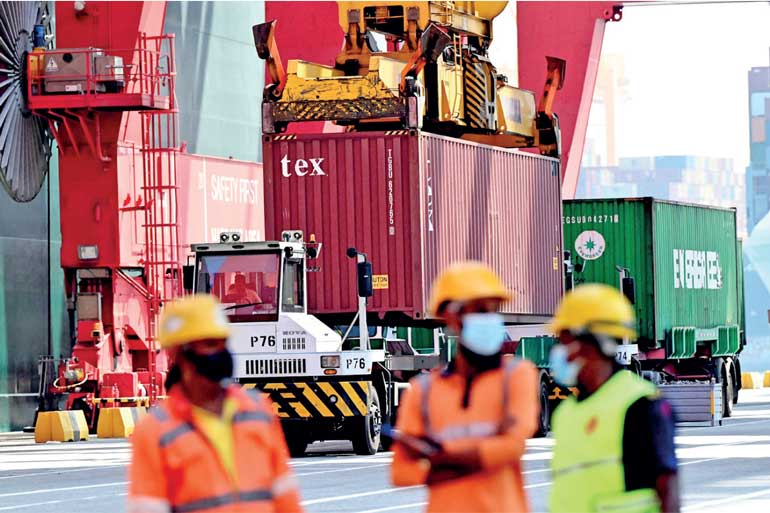

When a shipment of Sri Lankan tea, apparel, or value-added spices arrives at a port in Europe, North America, or neighboring Asia, customs officers at the port of entry look beyond the commercial invoice, the bill of lading, or the physical containers. They examine a single critical document that dictates the legal and financial fate of that cargo: the Certificate of Origin (CoO).
In an era defined by geopolitical re-alignments, heightened tariff friction, unilateral trade sanctions, anti-dumping actions, and rigorous environmental and labour enforcement, the Certificate of Origin has evolved from a routine administrative paper into a high-stakes trade security document.
For a developing maritime nation like Sri Lanka, strategically positioned along Indian Ocean shipping lanes the integrity of our trade documentation is paramount. As global powers impose trade embargoes, punitive countervailing duties, and strict environmental mandates on various foreign entities, the risk of transshipment fraud and origin circumvention has surged.
If third-country goods under embargo or subject to anti-dumping duties are illegally transshipped through Sri Lanka and falsely passed off as local origin, the international backlash will not merely hit the fraudulent exporter-it will devastate the credibility of Sri Lanka's entire export apparatus.
This column serves as a comprehensive operational guide and strategic warning for exporters, trade chambers, customs brokers, and policymakers across Sri Lanka. It breaks down the mechanics of Rules of Origin (RoO), contrasts preferential and non-preferential certificates, outlines World Customs Organisation (WCO) and World Trade Organisation (WTO) standards, and highlights the urgent necessity for trade chambers to exercise meticulous due diligence.
Explaining Rules of Origin: The DNA of commercial goods
At its core, Rules of Origin (RoO) are the technical criteria used to determine where a product was made. In international commerce, establishing origin is not as simple as noting where a container was loaded onto a vessel. Modern supply chains involve raw materials sourced from Country A, processed in Country B, assembled in Country C, and packaged in Country D.
To navigate this complexity, global customs frameworks categorise Rules of Origin into two primary regimes:
1.Wholly Obtained Criteria: Goods that are entirely grown, harvested, extracted, or born in a single country without any imported components (e.g., pure Ceylon Tea grown in Nuwara Eliya, raw cinnamon harvested in Matara, or fish caught by Sri Lankan flagged vessels in territorial waters).
2.Substantial Transformation Criteria: Goods produced using imported raw materials or intermediate inputs. To qualify as originating from the exporting country, these materials must undergo a substantial, economically justified transformation that yields a new and distinct product.
Primary tests for substantial transformation
Competent authorities globally, guided by WCO standards, utilise three main methodologies to evaluate whether substantial transformation has occurred:
Preferential vs. Non-Preferential Certificates of Origin
Understanding the legal distinction between Preferential and Non-Preferential Certificates of Origin is essential for every trade stakeholder in Sri Lanka.
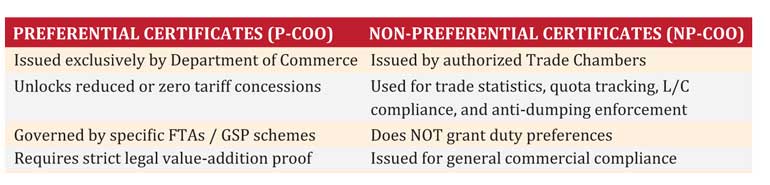
A. Preferential Certificates of Origin (P-COO)
A Preferential Certificate of Origin is a legal instrument issued under specific bilateral, regional, or multilateral trade agreements, as well as unilateral trade preference schemes. Its primary purpose is to enable the importer in the destination country to claim reduced or zero customs duties (tariff concessions).
In Sri Lanka, the Department of Commerce (DoC) is the sole designated National Authority competent to issue and validate Preferential Certificates of Origin.
Key examples of Preferential Trade Frameworks:
B. Non-Preferential Certificates of Origin (NP-COO)
Non-Preferential Certificates of Origin are used for standard commercial exports that do not claim preferential duty reductions. They are routinely requested by foreign customs agencies, banks (for Letter of Credit compliance), and trade authorities to verify the commercial source of goods, administer import quotas, apply trade statistics, or enforce trade defence measures.
In Sri Lanka, designated Trade Chambers (such as the Ceylon Chamber of Commerce, the National Chamber of Commerce of Sri Lanka, the Federation of Chambers of Commerce and Industry of Sri Lanka, and the National Chamber of Exporters) are authorised to issue Non-Preferential CoOs to exporters.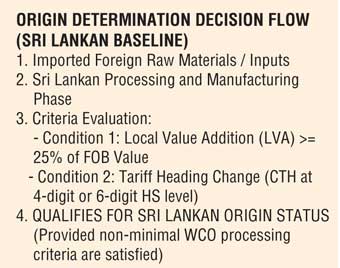
Practice vs. global realities: The 25% rule and anti-dumping protection
Sri Lanka has already enacted domestic Anti-Dumping, Countervailing, and Safeguard legislations to protect its local manufacturers from unfair foreign trade practices. However, establishing clear domestic Non-Preferential Rules of Origin (NP-RoO) criteria is just as crucial.
The pragmatic 25% benchmark
Practically, Sri Lanka has been using the administrative guideline issued by the Department of Commerce requiring at least 25% Local Value Addition (LVA) or a Change of Tariff Heading (CTH) to declare Sri Lankan origin for processed imports.
It is also noteworthy that BOI agreements themselves recognise the importance of meaningful domestic value creation. Most BOI agreements require BOI-approved enterprises to maintain a minimum Domestic Value Addition (DVA) of at least 25%, reinforcing Sri Lanka's long-standing administrative benchmark applied in origin determination. Nevertheless, satisfying this value-addition requirement alone is insufficient. The processing undertaken must also constitute substantial transformation under internationally accepted Rules of Origin and must not fall within the WCO's list of minimal operations.
Why formal non-preferential Rules of Origin are essential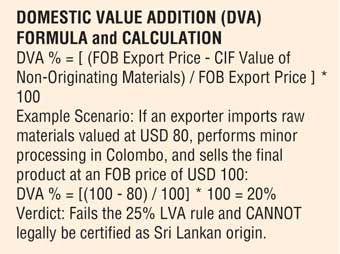
While Sri Lanka currently relies on this practical 25% guideline, the nation has not yet formally legislated its own product-specific Non-Preferential Rules of Origin Framework.
This is a key regulatory gap. When an international anti-dumping or countervailing investigation is launched-or when Sri Lanka initiates its own trade defence measures the availability of established, legally binding Non-Preferential Rules of Origin criteria is absolutely necessary.
Major trade blocs like the European Union have already established legally binding Non-Preferential Rules of Origin (e.g., Article 60 of the EU Union Customs Code, supplemented by Annex 22-01 UCC-DA). The EU's rules explicitly define 'last substantial transformation' for specific goods and dictate which exact processes confer or deny origin when trade defence duties (like anti-dumping) are triggered.
Furthermore, Sri Lanka's 25% value-addition practice must strictly align with WCO Minimal Processing Criteria. Even if a local exporter claims that a 25% value addition was reached due to local markup, labour, or expensive packaging, if the physical process falls under WCO-defined minimal operations, it can NEVER confer origin.
International standards
WCO minimal processing criteria with real-world examples
Under the World Customs Organisation (WCO) Revised Kyoto Convention (RKC) specifically Specific Annex K-the core objective of determining origin is establishing where a product underwent substantial transformation.
To prevent origin circumvention, the RKC lays down the Minimal Operations Rule. These are operations that do not confer origin, regardless of whether the product achieves a 25% local cost addition, changes tariff lines on paper, or incurs local labour hours.
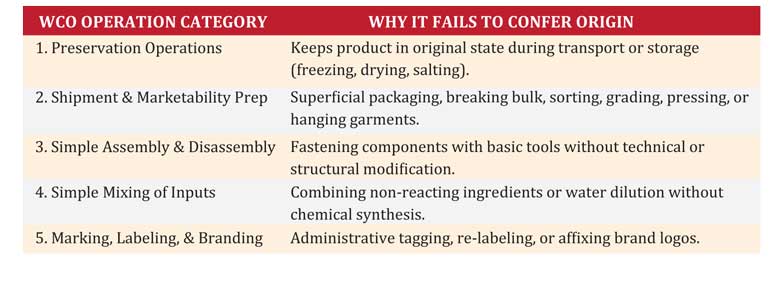
Specific manufacturing examples of WCO minimal processing
Preservation operations:
Raw shrimp harvested in Foreign Country A is shipped frozen to a processing warehouse in Sri Lanka. In Sri Lanka, the shrimp is defrosted, rinsed, re-frozen, and vacuum-packed.
Origin Verdict: Country A. Washing, chilling, and re-freezing are minimal preservation operations that do not confer Sri Lankan origin.
Packaging and sorting operations:
Fully manufactured garments made in Foreign Country A arrive in bulk cartons at a bonded zone in Colombo. Workers unbox the items, steam-press them, put them on plastic hangers, add price tags, and repack them.
Origin Verdict: Country A. Pressing, hanging, and repacking are minor logistical operations that leave the origin unchanged.
Simple assembly operations:
Completely knocked down (CKD) components for solar panels or electronic tablets manufactured in Foreign Country A are imported to Sri Lanka. Workers snap the plastic casings together and insert four screws using handheld screwdrivers.
Origin Verdict: Country A. Simple assembly without technical transformation, surface-mounting, or high-tech manufacturing fails to confer origin under WCO standards.
Simple mixing of products:
Fruit juice concentrate imported from Country A is mixed with water and imported sugar in Sri Lanka and poured into consumer bottles.
Origin Verdict: Country A. Dilution with water or simple ingredient mixing without chemical synthesis or fermentation is a minimal process.
Affixing labels and branding:
Unbranded footwear made entirely in Country A is imported to Sri Lanka, where a local factory sews a 'Ceylon Design' cloth tag onto the shoe tongue.
Origin Verdict: Country A. Relabeling carries zero legal weight in origin determination.
The WTO perspective on non-preferential Rules of Origin
The World Trade Organisation (WTO), through the Agreement on Rules of Origin (1995), recognised that inconsistent and divergent Non-Preferential Rules of Origin (NP-RoO) applied by different countries could create uncertainty, increase compliance costs, and act as unnecessary obstacles to international trade. 
To address this, WTO Members launched the Harmonisation Work Program (HWP), entrusting the World Customs Organisation (WCO) with the development of harmonised product-specific Non-Preferential Rules of Origin based on objective criteria such as substantial transformation. Although significant technical progress has been achieved, WTO Members have yet to adopt a universally binding harmonised system. Consequently, each Member continues to apply its own domestic Non-Preferential Rules of Origin, provided they are transparent, predictable, impartial, consistently administered, and do not create restrictive or trade-distorting effects.
For Sri Lanka, this presents both the opportunity and the responsibility to establish a comprehensive domestic Non-Preferential Rules of Origin framework aligned with WTO principles and international best practices, thereby strengthening the credibility of origin certification and safeguarding the country's reputation in global trade.
The escalating risk: Anti-Dumping, countervailing duties, and circumvention fraud
The global trading environment is navigating unprecedented administrative friction. Major markets (including the US, EU, and India) aggressively enforce:
The mechanism of Origin circumvention
When Country A is hit with a 100% Anti-Dumping duty by Country C, bad actors in Country A seek workaround routes. They ship the restricted goods to Sri Lanka (Country B) into a free zone or bonded warehouse. There, the goods undergo superficial repackaging or labeling. The exporter then applies to a Sri Lankan Trade Chamber for a Non-Preferential Certificate of Origin claiming 'Sri Lankan Origin' to evade Country C's anti-dumping duties.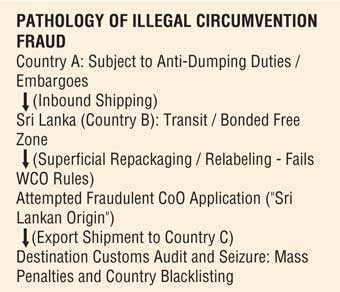
If Sri Lankan documentation is implicated in circumvention, foreign customs authorities will flag all Sri Lankan shipments as 'High Risk,' triggering 100% physical container inspections and damaging the entire export economy.
A direct call to Sri Lankan trade chambers: Exercise meticulous due diligence
This brings us to a crucial operational point for our national economy. Trade Chambers issuing Non-Preferential Certificates of Origin cannot act as passive rubber-stamping bodies.
While the Department of Commerce rigorously scrutinises every Preferential CoO application using detailed cost statements, factory audits, and bill-of-material verifications, Trade Chambers issuing Non-Preferential CoOs must elevate their verification procedures to the exact same high standard.
Mandatory action plan for Sri Lankan trade chambers:
1.Stop 'Mere Export' Reliance: Never issue a CoO simply because cargo leaves a Sri Lankan port or the exporter has a local business registration.
2.Apply WCO Minimal Processing Rules First: Verify that processing exceeds basic minimal operations before calculating value addition.
3.Mandate Complete Input Traceability: Demand Customs Import Declarations (CUSDEC), raw material invoices, and detailed cost breakdowns proving at least 25% LVA or genuine CTH.
4.Conduct Unannounced Factory Audits: Perform spot-checks to confirm production capacity, machinery, and physical labour match declared export volumes.
5.Strictly Control Free Zone Cargo: Demand foreign original CoOs for transshipment cargo and issue 'Certificates of Re-Export/Non-Manipulation' clearly stating original foreign origin-NEVER declaring Sri Lanka as the origin.
6.Exercise Special Care for BOI Entrepôt Operations: Where exports originate from BOI-approved entrepôt trading entities, verify whether the processing undertaken exceeds the WCO minimum processing criteria. If the goods have not undergone substantial transformation, the Non-Preferential Certificate of Origin should clearly indicate the actual foreign country of origin rather than Sri Lanka.
Evolving global demands: Labour integrity and environmental standards
To remain competitive internationally, Sri Lanka must align its export verification framework with newly emerging non-tariff regulatory demands most notably regarding labour practices and environmental sustainability.
A. Forced labour regulation and US tariff concessions
The United States strictly enforces prohibition on goods produced wholly or in part by forced labour, debt bondage, or child labour from certain countries and regions. Sri Lanka's apparel and manufacturing sectors have long maintained an ethical edge under the slogan 'Garments Without Guilt.' By maintaining high labour standards, enforcing freedom of association, and ensuring fair wages, Sri Lanka has earned preferential consideration, lower risk-rating metrics, and duty reductions in Western markets compared to regional competitors.
However, to protect this advantage, trade documentation must verify not only manufacturing processes, but supply chain compliance. Exporters sourcing foreign raw yarns or components from regions implicated in forced labour risk total seizure of their exports upon arrival in the US.
B. EU Green regulations: CBAM and deforestation mandates
The European Union has introduced groundbreaking environmental regulations that directly impact international trade documentation:
For Sri Lankan exporters of rubber products, tea, and agricultural goods, proving 'Sri Lankan Origin' now requires proving environmental compliance. Customs authorities in Europe increasingly require origin certifications to be backed by geolocated plot data, environmental impact statements, and deforestation-free supply chain tracking.
Entrepôt ( Transshipment) trade and origin determination
Sri Lanka's Board of Investment (BOI) framework provides for the establishment of enterprises engaged in entrepôt trade, recognising the country's strategic position as a regional logistics and maritime hub. Under these BOI-approved operations, companies are permitted to import goods, undertake limited or simple processing, and subsequently re-export them to third-country markets.
However, the mere existence of a BOI approval does not automatically confer Sri Lankan origin on such goods. In many entrepôt operations, the processing carried out is intentionally limited to activities such as sorting, grading, repacking, relabelling, simple assembly, or other minor operations that fall below the threshold of substantial transformation. Where such activities do not satisfy the internationally accepted Rules of Origin or exceed the World Customs Organisation (WCO) minimum processing criteria, the country of origin of the goods remains the country where the goods were originally manufactured or where the last substantial transformation occurred.
Consequently, when issuing a Non-Preferential Certificate of Origin for such exports, Trade Chambers should accurately state the true country of origin rather than declaring Sri Lanka as the origin. Where appropriate, the certificate should clearly indicate the actual originating country—normally the country contributing the highest proportion ( Back to back Certification) of originating materials or where the substantial transformation took place—thereby ensuring transparency and preventing any allegation of origin circumvention or anti-dumping evasion.
Conclusion: Securing Sri Lanka's export future
In international commerce, trust is a nation's most valuable economic currency. A single compromised Certificate of Origin can tarnish an entire country's export brand, leading to retaliatory tariffs, port delays, and lost market access. Therefore, following take home message should strictly be followed by the concerned stakeholders in safeguarding Sri Lankan brand name as a trustworthy, reliable trading partner.
1.Rules of Origin are non-negotiable legal benchmarks: Achieving the 25% local value addition or a Change of Tariff Heading is a strict requirement, and it must be paired with compliance under WCO minimal processing rules.
2.Formalise Non-Preferential Rules of Origin: Sri Lanka must establish legally binding Non-Preferential Rules of Origin criteria to safeguard domestic industries during anti-dumping and countervailing investigations.
3.Trade Chambers must serve as rigorous guardians: Non-preferential CoOs carry immense international weight. Chambers must conduct thorough due diligence, verify raw material trails, reject superficial processing claims, and strictly report third-country re-exports accurately.
4.Compliance is our greatest competitive edge: By honoring WCO and WTO standards, maintaining zero tolerance for forced labour, and upholding environmental compliance, Sri Lanka will solidify its reputation as a reliable, ethical, and world-class trading partner.
The Department of Commerce remains fully committed to supporting Sri Lankan businesses, guiding trade chambers, and technical experts in navigating the complexities of international trade rules. Together, through compliance, transparency, and operational integrity, we will safeguard Sri Lanka's global trade standing and drive sustainable, export-led economic growth.
(The author is Director of Commerce, Department of Commerce of Sri Lanka and Consul General of Sri Lanka in Karachi, Pakistan)




