Saturday Oct 03, 2026
Saturday Oct 03, 2026
Thursday, 26 February 2026 00:01 - - {{hitsCtrl.values.hits}}
 In the high-stakes theater of Sri Lankan politics, with the National People’s Power (NPP) Government holding a commanding 159-seats and currently riding high on the wave of solid public affirmation of its performance, the belief of the Opposition comprising of the Samagi Jana Balawegaya (SJB) led by Sajith Premadasa, the Sri Lanka Podujana Peramuna (SLPP), led by Mahinda Rajapaksa, the United National Party (UNP), led by Ranil Wickremesinghe, and various other parties, that it can topple the Government, individually or collectively, by democratic means, exceeds reasonable imagination. Toppling a Government through actions and rhetoric that lack real meaning are relics of old-school political playbooks that no longer resonate with an electorate exhausted by years of instability. It is, therefore, time for the Opposition, particularly the SJB, to accept that, to survive and eventually lead, it must transform from a roadblock to a guardrail.
Power is a potent intoxicant, warping perspective, and eroding empathy. Like a chemical high, it creates a feedback loop in which the thrill of control demands ever-greater doses to sustain. Ultimately, it blinds leaders to their own fallibility, transforming a tool of influence into a destructive, addictive obsession. It is this obsession that blocks the Opposition from displaying common sense. In political theatre, ‘power’ is the difference between being the lead actor and a heckler in the nosebleed seats.
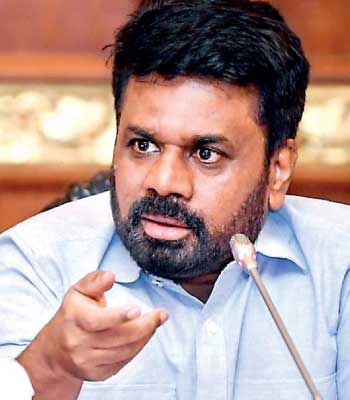 |
| President Anura Kumara Dissanayake |
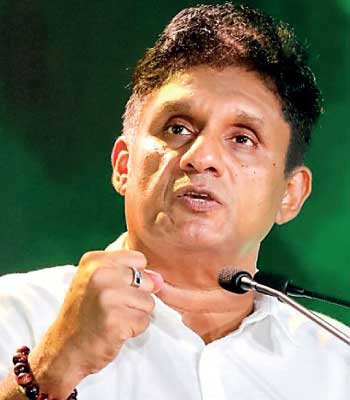 |
| Opposition Leader Sajith Premadasa |
 |
| NPP MP Namal Rajapaksa |
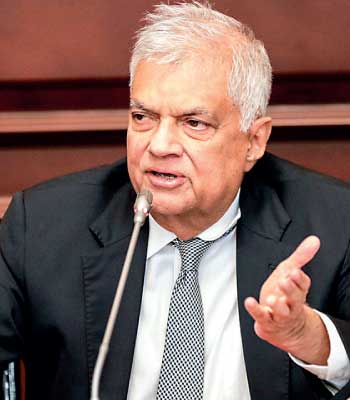 |
| Former President Ranil Wickremesinghe |
Country first approach rather than a party first approach
The Opposition must resign itself to the fact that the current Government's plans will become policy. Unlike in the past, it is very unlikely that the NPP members of parliament can be lured with money to vote against Government policy; unless such policies are blatantly and grossly unfair to the constituents they represent. It must also realise that while the Government gets to build the mountain, it has the opportunity of owning the moral high ground. Respect can be earned by converting this moral high ground into actions that meet the public’s requirements. In principle, it must support the Government in endeavours that benefit the common man and the country, and it must, where relevant and necessary, debate the ‘iffy’ aspects and assist in fine-tuning the accompanying legislation. This will portray collaboration rather than blind, senseless, ‘knee-jerk’ opposition that lacks logic and merit. The Opposition must acknowledge that the NPP, despite the tainted history of its main party, the Janatha Vimukthi Peramuna (JVP), was elected to power by the people because they had had enough of the questionable governance practices of past regimes. The monotonous and machine-like opposition to everything that the NPP proposes or does is tantamount to defying the will of the people. Against this backdrop, the Opposition must cultivate voter goodwill by showing a ‘country first’ approach rather than a ‘party first’ approach. SJB, the lead party in the Opposition, with forty seats, must play its cards right if it is to remain on the positive side of the memory of the voters at the next round of elections. It can take a cue from the Ilankai Tamil Arasu Kachchi (ITAK) on how to be objective in supporting or opposing Government policy.
The "collaboration over conflict" strategy is a sophisticated pivot from the zero-sum politics that have historically crippled Sri Lanka. The SJB must realise that relentless obstructionism will be perceived by the electorate as "sabotage" against national recovery. By contrast, a strategy of selective collaboration will signal a brand of stability and maturity. By supporting the Government on critical issues, such as the Rule of Law, Anti-Corruption, or IMF Mandated Fiscal Discipline, the SJB can record three psychological positives with voters, these being, > De-politicising Progress: Showing it cares more about the country’s success than the NPP’s failure, > Technocratic Credibility: Positioning itself as a "partner in governance," making the transition to power, if it does happen, a natural evolution rather than a volatile regime change. The SJB has many battle-hardened experts in its ranks. They can display their skills as ‘frontliners’ rather than as ‘backbenchers,’ > The "Guardrail" Approach: By agreeing, in principle, on the “Why” (the purpose), collaborating on the "What" (the goal), the SJB gains the moral authority to critique the "How" (the implementation). Today’s voters are exhausted by uncertainty and chaos. Sajith Premadasa can, as leader of the opposition, function as a moderator rather than a ‘protestor’ and capture the vital "swing vote" of the middle-class professional and the pragmatic youth who yearn for a functioning state over partisan warfare.
The role of SJB must go beyond an un-analysed, spontaneous “no” to “let us have a look at it” response. Historically, the role of the Opposition has been viewed through a binary lens: either wait for the Government to fail or actively accelerate that failure. However, in a post-crisis Sri Lanka, the public’s expectation of a "strong" Opposition has evolved from the volume of the protest to the value of the alternative. The SJB must pay heed to it.
With a two-thirds majority, the NPP possesses the power to rewrite the supreme law of the land. In this context, the SJB can project itself as the ‘Constitution’s Guardian.’ When a Government has no mathematical check in parliament, the opposition can become the moral and legal check. This means scrutinising every clause of the proposed new Constitution. It is not to obstruct for the sake of it, but to ensure that the changes do not inadvertently lead to executive overreach and/or the erosion of minority rights.
Policy laboratory
The SJB can also position itself as a’ Policy Laboratory.’ The NPP’s mandate was built on the promise of "clean Sri Lanka" and anti-corruption. However, as we all know, governing is more complex than campaigning. In showcasing its prowess as a policy formulator, the SJB must, instead of merely shouting that the IMF-mandated reforms are painful, present to the Government and the public a "shadow strategy" that offers alternatives. By offering data-driven alternatives such as more targeted social safety nets or specific export-incentive structures, the SJB can prove it is a "Government-in-waiting" rather than just a "party-in-protest."
SJB also has an opportunity to be “The Voice of the Unheard.” Majoritarian mandates often create blind spots. The NPP's sweeping victory across traditional ethnic divides was historic, but the specific grievances of the North, East, and the estate sectors still require focused advocacy. The SJB can be the first port of call and the amplifier for those whose expectations remain unmet, ensuring that the "Thriving Nation" includes those on the margins.
A ‘Mood of the Nation’ poll conducted by Verité Research and Vanguard Survey in February 2026, showed a significant rise in public optimism compared to that in February 2025. The overall approval of the Government has risen to 65%, an increase of 3%; the economic index has surged by fourteen points to thirty-six points; 64% of those surveyed believed the economy is getting better compared to 55% who thought so a year ago. For the first time in four years, those rating the economy as "good" or "excellent" outnumbered those saying "poor," and 59 percent said they are satisfied with the country's direction. This is brilliant for a Government that detractors were hoping will fail.
Rule of law and the anti-corruption drive
Given the above indicators and given the NPP’s super majority in parliament, the SJB’s notion that it can ‘unseat’ the Government in the period between elections is a far cry from reality. Attempts to do so are likely to backfire. The public, still traumatised by various events in the past decade, has little appetite for manufactured instability. In this light, the SJB is well advised to adopt a strategy of selective collaboration and shadow governance. It must, in principle, support the ‘good’ and scrutinise the ‘how’ by engaging with the Government in initiatives that are obviously, and objectively, good for the country, such as the equal application of the Rule of Law and the Anti-Corruption drive. It must support the arrest of corrupt figures from the past and present, provided the arrests are within the law. By doing this, the SJB can shed the "all-politicians-are-the-same" label and distance itself from those parties with checkered reputations.
The arrest of former President Ranil Wickremesinghe in August 2025 regarding the alleged misuse of state funds for a private visit, was a litmus test for the SJB. The SJB found itself at a critical decision crossroad between political solidarity and institutional principles. In projecting itself as a "party of principles," the SJB's response should have balanced two competing democratic interests: the Rule of Law and the Protection against Political Victimisation. The SJB should have avoided appearing as part of a "politicians' club" that protects its own. By labeling the arrest as petty vengeance, the SJB alienated, to some extent, a public that is demanding accountability from all leaders, regardless of status. A principled stance would have been to officially support the judicial process, insisting that no individual, former president or otherwise, is above the law. This would have reinforced the SJB's commitment to the anti-corruption mandate that voters signaled in the presidential and general elections. Conversely, the SJB had a duty to ensure the Rule of Law was not weaponised. The party should have focused its critique on procedural fairness rather than the person. By advocating for transparency in the Criminal Investigation Department's (CID) findings and demanding that the Government avoid "theatrics" in high-profile arrests, the SJB could have positioned itself as the guardian of a neutral justice system. The SJB’s actual response, joining other "old guard" parties to denounce the arrest, was seen by many as a defensive maneuver by culprits facing similar circumstances. A call for an independent commission to oversee such cases, given its political hues, may have been more effective in ensuring that while the law is applied equally, it is not used as a tool for executive intimidation.
NPP’s greatest challenge is "Delivery vs. Democracy" dilemma
The NPP’s greatest challenge is the "Delivery vs. Democracy" dilemma. They have the mandate to deliver, but global economic headwinds, shifting trade tariffs and IMF constraints et cetera make the management of them arduous. While the NPP navigates its internal Marxist-Leninist roots in a world where successful economies are pursuing free-market approaches, the SJB can consistently advocate for a "Social Democratic" model. The SJB must position itself as a party of open-minded benevolence. This means supporting fiscal discipline while being the loudest voice for protecting the lower and middle classes from burdensome taxation and high utility pricing, dictated, in the main, by operating and service models which are inefficient.
The SJB can also resort to Guardrail Diplomacy. With a supermajority, there is always a risk of "democratic backsliding." The SJB should focus its energy on consensus through committees. By chairing/leading Sectoral Oversight Committees with rigour, it can force transparency on Government spending. This is a "quiet" form of power that builds public trust far more effectively than shouting in the well of the House. It demonstrates that the SJB is working for the taxpayer, not for their own seats. In this vein, when the Government proposes a bill that aligns with national interest, the SJB should vote for it but suggest "precision amendments" as necessary. This will position the party not as an enemy of the state, but as a discerning moderator that makes good laws better.
The SJB must desist from forming "unholy alliances" with discredited remnants of the old guard. It must maintain its ideological purity. The recent decision to collaborate with the UNP under a joint program led by Sajith Premadasa is a step towards unifying the country’s fractured center- right and consolidating the "Liberal-Democratic" vote. However, it must be a union of ideas, not just a union of convenience. Their combined historical vote banks will be a formidable bloc. Further, Sajith’s grassroots popularity, though not matching AKD’s, and his ‘social democratic’ appeal, can blend synergistically with Ranil’s free market economics. The primary hurdle remains the uncertainty over who truly leads the alliance. An overdose of Ranil, risks alienating SJB members who broke away specifically to escape his style of leadership and his lack of empathy for the common man. Also, associating with Ranil, who showed his hunger for 'power at any cost’ by partnering with the SLPP, could damage the SJB’s "clean alternative" image, reinforcing the "all politicians are the same" narrative.
Capture the "disappointed NPP voter" of the future
As an overall strategy, the SJB must differentiate itself by pivoting from the NPP’s grassroots-heavy approach toward a Social Democratic model that leverages private-sector efficiency and global integration. For example, in key areas such as Agriculture, Health, Education, Labour and Public Transport, to name a few, the SJB can differentiate by focusing on, > Agriculture; Transition quickly to export-oriented agri-tech and global supply chain integration relative to NPP’s focus on food sovereignty and cooperatives. While the NPP emphasises self-sufficiency, the SJB can champion precision farming. By removing middle-man monopolies through digital marketplaces rather than state boards, the SJB can appeal to the "agri-entrepreneur", > Health; The SJB can establish digital health stacks and encourage public private partnerships for specialised care compared to NPP’s safe, conservative and broad-based strategy of strengthening the state delivery system, > Education; By aligning education with global job markets and accelerating english medium education in contrast to NPP’s standardisation of state education and curbing privatisation, the SJB can offer alternatives, > Labour; SJB can establish flexible labour laws paired with a ‘safety net’ for the ‘gig’ economy, different from NPP’s stronger protections and wage mandates, > Public Transport; Digitised multi-modal hubs and private-sector franchising of routes compared to NPP’s state-managed modernisation of rail/bus public transport.
In summary, in Agriculture, Health and Education, the SJB message must be on modernisation. Where the NPP focuses on strengthening the existing, the SJB should propose ‘smart farms,’ ‘smart schools’ and a universal digital health ID, framing technology as the equaliser for social mobility. In Labour, while the NPP leans toward worker rights, the SJB should lean toward worker empowerment. This means reforming labour laws to attract FDI while providing state-funded retraining. In transport, the SJB can differentiate by proposing a "unified payment system" across private and public sectors, focusing on efficiency over ownership. The SJB must position itself as the "managerially competent" alternative, offering progress through systemic reform rather than just systemic overhaul.
Toppling a Government with a 159-seat mandate is a fantasy; out-governing them from the Opposition benches is a winning strategy. By playing the role of a moderator, the SJB can capture the "disappointed NPP voter" of the future, the citizen who wants the corruption to end but also wants the lights to stay on and the economy to grow.
SJB’s legacy will not be defined by how hard it fought the NPP, but by how well it helped the NPP in steering the country through its recovery. In 2026, the most radical and "exciting" thing an Opposition party can do is to display its sense of patriotism and responsibility by collaborating with the NPP in fast-tracking the development of the country.
(The author is, currently, a Leadership Coach, Mentor and Consultant and boasts over 50 years of experience in very senior positions in the Corporate World – local and overseas. www.ronniepeiris.com)



