Friday Sep 25, 2026
Friday Sep 25, 2026
Thursday, 24 September 2026 00:25 - - {{hitsCtrl.values.hits}}
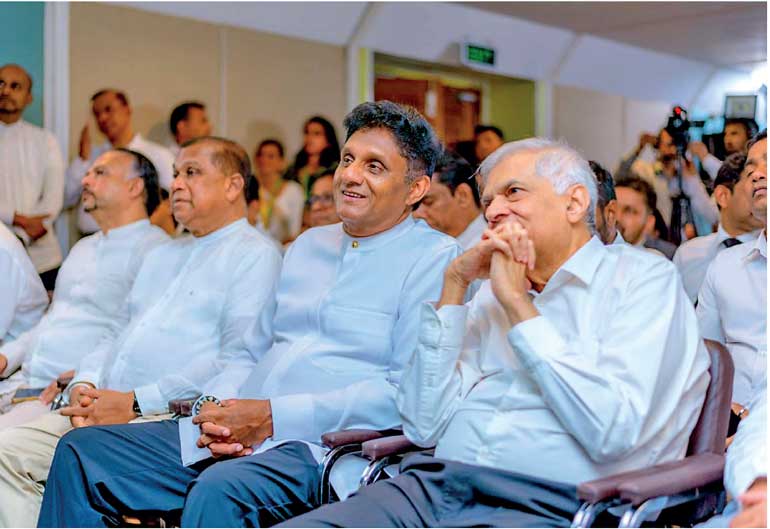
Better late than never: will the rapprochement produce an alliance?
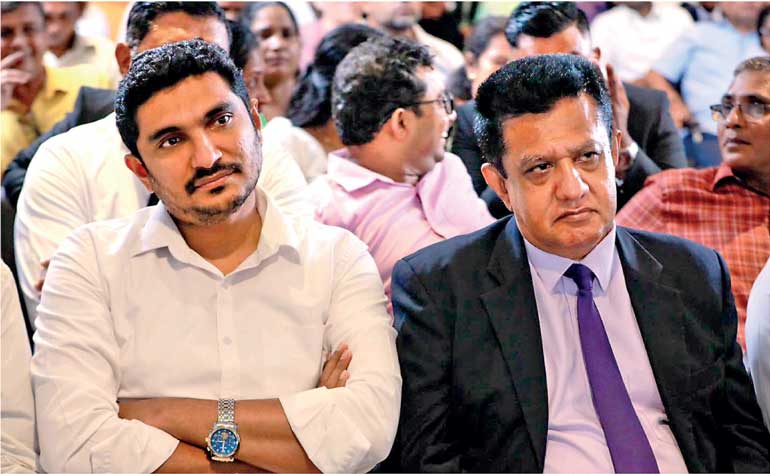
Two SJB top guns in any debate: Prasad Siriwardena and Prof. Charitha Herath
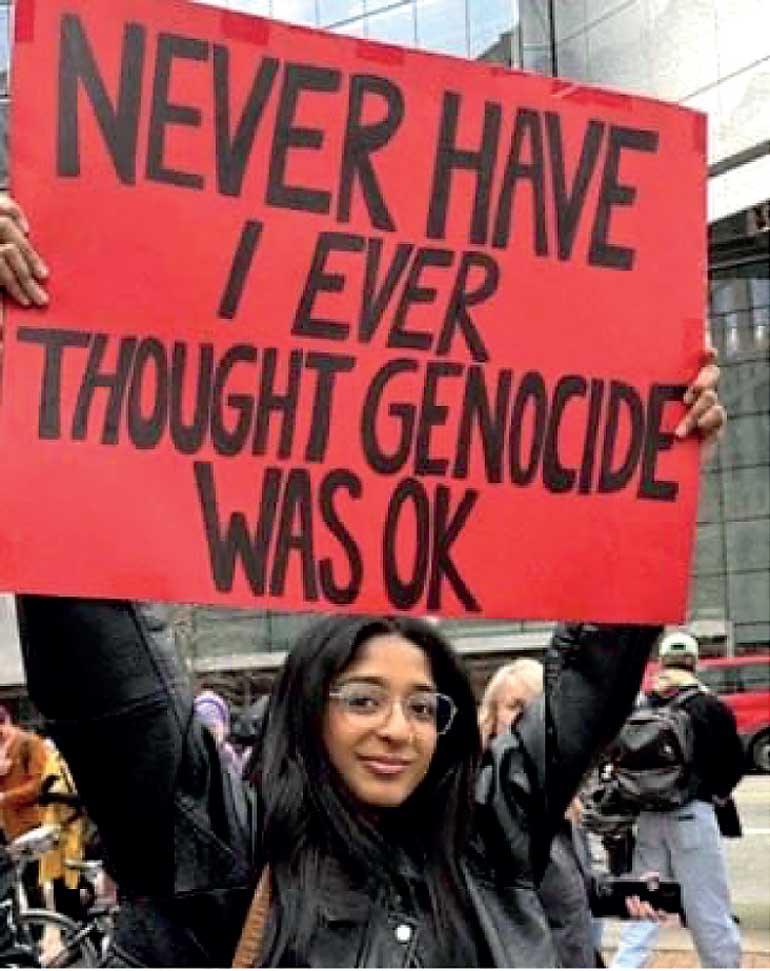
Netflix star from ‘Tamil Eelam’ Maitreyi Ramakrishnan at Vancouver demonstration 2025
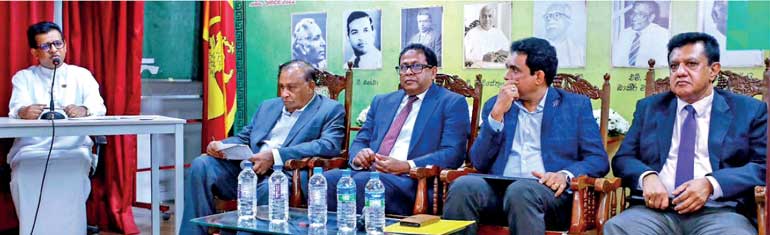
Buddhika Pathirana moderates panel of SJB and UNP academics
 An indoor event held last week has much greater potential importance than the numbers gathered there. It was the 120th Birth Anniversary of President J.R. Jayewardene and the event had been organised by the D.S. Senanayake Political Academy, an affiliate of the Samagi Jana Balavegaya (SJB). The leaders of the UNP and SJB, ex-President Ranil Wickremesinghe and Opposition Leader Sajith Premadasa delivered speeches. A panel discussion followed.
I followed it keenly in its entirety on FB live, as I had the Anuradhapura mobilisation of the SLPP plus some partners.
Though the Jayewardene commemoration has been hailed or sought to be spun as an in-gathering of the right, there was no such mention on the invitation/e-flyer, which did have ‘The Middle Path’ in its title (‘J.R., Governance and the Middle Path’).
Ranil Wickremesinghe didn’t mention the right in his speech. Instead, he focused on the ‘revolution’ of economic modernisation launched by J.R. Jayewardene and the social upliftment that preceded it on the UNP’s watch and was accelerated during the Jayewardene Presidency.
Cuffing “those in some corners declaring themselves on the right”, Sajith Premadasa went further, tracing the social programs that accompanied JR’s economic modernisation under various key Ministers including of course his father, Prime Minister Premadasa. The SJB and Opposition Leader made an explicit pitch for a middle path of “blending a market economy with social welfare and Social Democracy”. (https://www.ft.lk/front-page/SJB-UNP-alliance-to-counter-NPP-s-one-party-rule-Sajith/44-797391)
The panel ranging from Karunasena Kodituwakku to Prof. Charitha Herath argued for growth with social welfare and a role for the State.
Most significant was the key political, not ideological, takeaway—Sajith Premadasa’s statement that from here on in, the SJB and the UNP would work together, unite in action, ally with each other, especially in fighting against President Anura Dissanayake’s dictatorial drive as exemplified by the 22nd Amendment.
If the two parties don’t capitalise on the mood and momentum, and turn away from each other again, they will both suffer losses because they would be turning their backs on the indispensable human factor that Ernst Bloch named ‘The Principle of Hope’.
Positive, despite downside
I am hardly unaware of how it could go. Both the UNP and the SJB have been hooked on a feed of neoliberal right-wing ideology in the post-Premadasa decades—the very decades they failed to be elected to the country’s leadership—from the International Republican Institute, the Friedrick Neumann Stiftung and the Konrad Adenauer Stiftung. This has created a substratum of rightist consciousness.
Nor am I unaware of the possible foreign policy implications. While Sajith Premadasa is friend of both India and China, stands with Palestine and solidarises with the Global South, I have the surreal experience of being in a foreign policy (virtual) group in the early years of the SJB with two brilliant young intellects (one still with the party, fortunately) and two prominent SJB neoliberal MPs. 
The group was deadlocked and soon defunct because the neoliberal twins (of a troika) who were mentored in foreign policy by cosmopolitan-neoliberal globalist Mangala Samaraweera during Yahapalanaya, were hysterically allergic to my definition that the defence and furtherance of the national interest, the core of which is the defence of ‘national independence, sovereignty, territorial unity and integrity’, is the fundamental guiding principle and goal of foreign policy. They reportedly threatened to defect back to Ranil’s UNP if my perspective was reflected in the group consensus. One even opposed Sajith’s support for Palestine.
Furthermore, I have never once heard the SJB’s lead economist speak of China’s economic miracle. This Mangala-mentored UNP faction froze all Chinese projects including the Port City under Yahapalanaya, collapsing the growth-rate.
If the SJB and UNP converge, the centre of gravity ideologically could shift rightwards, with neoliberal-rightist elements reinforcing each other.
Sajith and Ranil must realise though that a rightist stand will be electorally counterproductive, even decisively so, because:
(I) There is no space (or barely any) to the right of AKD-JVP-NPP on economics or external relations.
(II) A rightist economic model precludes a compelling vision and program (e.g., Premadasa’s ‘New Vision, New Deal’ and Janasaviya in 1988) which can swing the increasingly impoverished socioeconomic majority—who may otherwise shift to ethnoreligious ultranationalism.
All that said, as a social-democratic realist, I support an SJB-UNP bloc or alliance, because shifting the balance of forces in the political arena and resisting, retarding and rolling-back the Government’s anti-democratic tendencies, constitute the most crucial considerations. 
An SJB-UNP equation will open a ‘second front’ against the Government. Namal Rajapaksa’s SLPP opened the first in Anuradhapura. Sajith’s strong showing in Hiriyala on 20 September (Sunday) with the unexpectedly sizeable crowd walking through the mud to attend after very heavy rain, was as significant as Anuradhapura in its own way and scale, since it was from a single electorate, not a provincial capital.
What Sri Lanka badly needs now is a strong ideological centre-space, preferably centre-left, but even with the centre-left and centre-right as two wings, held together and helmed by a social democratically inclined reformist. Even if the SJB-UNP bloc amounts to a centre-right rather than a centrist convergence, it will objectively strengthen the democratic Opposition as a whole.
It will drive into the AKD-NPP administration’s 2024 popular support along the centrist/centre-right front or flank, while the Namal-centric SLPP brings up the ‘centre-left’ or statist, populist-nationalist flank. Independently and competitively, the two formations will act as a pincer.
Tale of two princes
I worked closely with two history-making, heroic leaders, Presidents Ranasinghe Premadasa and Mahinda Rajapaksa during Sri Lanka’s high-intensity crisis and conflict. I regret neither experience.
Each of them has a son leading one of the two main camps of the democratic Opposition. Though hardly clones of their fathers—which they can’t, wouldn’t and shouldn’t be—Sajith and Namal are exceptional in that both have been influenced by and learned something directly from those visionary figures, which puts their potential contributions to this country above those of anyone else in Government or Opposition. Comparatively, their learning curve is much shorter.
A profile of two ‘princes’ (in Machiavelli’s sense):
Sajith is a serious, progressive-oriented, pragmatic-centrist; a modernising reformer with caring, humanistic, interventionist reflexes; a knowledgeable, clear-sighted macro-policy architect capable of repairing, renovating, and reconstructing the nation.
Namal has rock-star appeal; is very smart, speedy and strong; an instinctive political player and dashing young warrior who will lead from the front and stay in the battlefield till the finish.
Sri Lanka today, is mired in structural socioeconomic crisis and a process of povertisation. As an adherent of ‘the Social Doctrine of the Catholic Church’, with its focus on the poor and the labouring classes, I have a strong sense that Sajith Premadasa will do more than any other Sri Lankan politician available, to uplift the poor and the middle-classes currently being impoverished (comprising 65% of our citizens) through a practical program, while running a sound economy and balanced development strategy.
The flipside is that with the historic, heroic solitary exception of President Premadasa who removed a large foreign military force from this island, the Achilles Heel of the generic UNP including its derivative successor the SJB is the national-patriotic dimension.
If ‘the atoms swerve’, creating a ‘Black Swan event’ presenting the country with a different situational danger in 2029, not primarily structural and socioeconomic, but national, existential and latently kinetic, the needle of preference may shift of necessity to Namal Rajapaksa.
If he remains imprisoned, rendered unable to contribute to the national cause, voters might consider Champika Ranawaka, Dilith Jayaweera or Gen. Shavendra Silva, as they did ‘dark horse’ AKD in 2024.
Karma of overdrive
I’m now older than my father when he died; this week I’ve nosed past the exact age Mervyn de Silva was when he died at 69, two-and-a-half months from 70. When you’ve lived long enough, been around the block a few times, you can remember earlier versions of what you’re currently seeing and know how they will probably end.
Take the AKD administration’s punitive legalistic overdrive. I’ve seen this twice before, the first during the United Front Government of Prime Minister Sirimavo Bandaranaike; the second under the Jayewardene presidency. 
The UF Govt had on its agenda a spillover from the first time around, the brief coalition Government of the SLFP- LSSP (1964) which tried to move on Lake House—a move which backfired. It was renewed in 1970 with much fanfare about the violation of foreign exchange regulations by Lake House Directors. This was used to justify the State takeover of Lake House, which was overkill. Mervyn de Silva, Editor-in-Chief and sympathiser of the centre-left Government had argued for a ‘third way’: authentic ‘broad-basing’ i.e., pluralistic diversification of ownership instead of monopolistic State ownership and control. ‘Broad-basing’ was never implemented by respected Public Trustee Barnes Ratwatte, a relative of the PM.
‘State takeover’ didn’t help the SLFP at all because every time it was in Opposition, the State-owned Lake House, serving the interest of the ruling party, pounded it.
In parallel, many prominent businessmen were arrested on allegations of violation of foreign exchange laws, vilified as ‘racketeers’ and detained under a variant of the special legislation (the Criminal Justice Commission Act) aimed at the 1971 JVP insurrectionists.
Both target categories (Lake House and ‘racketeers’) were viewed by the centre-left coalition enjoying a Parliamentary two-thirds majority, as components of the rival UNP’s class constituency.
The engine of the punitive drive was Justice Minister Felix Dias Bandaranaike, his handpicked officials at the Ministry, and the hard-charging, pistol-packing, bell-bottomed Senior Solicitor-General and Bribery Commissioner Ian Wickramanayake who was a member of the Special Squad with Felix Dias Bandaranaike and the Director of Intelligence.
The AG’s Department was tampered with, over-politicised, causing several top lawyers to migrate. Raja Gunasekara, respected Principal of the Law College, was vilified.
When the economics-powered backlash came, securing JR’s UNP a 5/6ths majority in Parliament, the ‘racketeers’ and JVP rebels were released, Lake House remained in State hands, all those beginning with the PM who were responsible for the punitive legal overdrive found themselves hauled up before a Presidential Commission, pronounced guilty of ‘the abuse of power’ and deprived of their civic rights.
There is a lesson here about the virtue of prudence and practice of moderation instead of self-righteous excess.
The Jayewardene administration too learned the perils of excess. When Sirimavo Bandaranaike was deprived of her civic rights, the Ward Place grapevine had it that JR had never forgiven her for the ridiculous arrest of his son Ravi on the suspicion of having trained the JVP insurrectionists in the use of firearms in which he was expert. Ravi was kept overnight in a cell, and as JR complained to my father, “made to eat food served on a tin plate”.
The UNP Government and its supporters were delighted that their main opponent Mrs. Bandaranaike had been taken off the board and their main electoral competitor the SLFP, decapitated.
It was something of a shock to the Jayewardene administration that pressure for the restoration of Mrs. Bandaranaike’s civic rights came from the USA, in the person of Ambassador Howard Wriggins, a distinguished scholar whose first book had been on Ceylon (‘Dilemmas of a New Nation’) and was an expert on the island’s politics. Washington was easily persuaded that the removal of Mrs. Bandaranaike from the helm of Opposition politics had weakened the moderate forces and the democratic system, and would facilitate polarisation.
Having dragged his feet, JR eventually restored Mrs. Bandaranaike’s civic rights in 1986, but it was far too late. Ambassador Wriggins was proved right—irreversible polarisation and systemic disequilibrium had set in with her absence from the frontline of politics, and due to it. She too was in no mood to play ball with the Government by the time her civic rights had been restored, and her capacity to ensure moderate dominance of anti-Governmental dynamics had been severely impaired anyway.
There was nothing and nobody to stop the country’s corkscrewing plunge into the abyss of civil war and anarchy in the latter half of the 1980s.
When you deploy extra-electoral methods, even non-violent legal inquisitions, to secure a degree of political dominance or monopoly that the electorate didn’t grant you, you destabilise the very system in which you operate.
When you tamper with balance, you risk capsizing the boat you are in, or more conceptually, undermining the equilibrium of the sociopolitical and behavioural ‘eco-system’ within which you survive as Government and ruling party. You jeopardise your very conditions of existence.
These are lessons that President AKD and the JVP-NPP administration should ponder. Realism teaches the difference between the one-dimensionally legalistic and the perspicaciously holistic.
In 1971 and 1986-1989, the JVP’s illegal political adventurism made for crushing defeat. This time its legal political adventurism may yield approximately the same outcome, though in non-violent form.
The Temple of Apollo at Delphi (which housed the Delphic Oracle) in ancient Athens is said to have had injunctions of ultimate wisdom carved above its entrance: ‘Know Yourself’ and ‘Nothing in Excess’. For six decades, the JVP’s leaders have had an exaggerated—wildly delusional—notion of themselves, and resorted to excess far more often than not—with clear consequences that proved the accuracy of ancient Athenian wisdom.
Strategic folly
Sri Lanka’s external relations under the AKD administration veer between farcical failure and reckless folly but I disagree that missing BRICS and SCO (Sri Lanka is a Dialogue Partner of the latter) stems from incompetence.
President AKD having declined President Putin’s invitation to attend the BRICS summit in 2024, thereby sent an arrogant negative signal which has contributed to Sri Lanka not yet having the BRICS membership we’ve applied for—though in the intervening years, a new full-member (Indonesia) and several Partner Countries have been admitted. AKD didn’t attend the BRICS summit in Brazil either. We haven’t yet been admitted to the ‘BRICS bank’, the NDB. We weren’t at the Shanghai Cooperation Organisation (SCO) meeting this year.
AKD’s administration has reached out to NATO whose geographic/geostrategic zone we are way outside; invited India to expand its strategic economic footprint in the North and East; declined to disclose the contents of the defense-related MoUs signed by AKD in Delhi 2025; and entertained the visiting Indian Defense Minister’s insistent urging that Sri Lanka’s navy ‘integrate’ into a ‘maritime mechanism’ with India—whose strategic posture is aimed (understandably) at Pakistan and China, our staunch friends.
The total picture is not one of inadvertent foreign policy lapses but of conscious decisions, strategic choices by President Dissanayake, his comrades and his associates.
As Netflix star of “Tamil Eelam” Maitreyi Ramakrishnan’s discourse and actions epitomise, the next wave of ‘Tamil Eelamism’ is building up, driven by Western Tamil Diaspora millennials alleging ‘genocide’. Resonance in Tamil Nadu cannot be ruled out.
AKD’s choice of direction in external relations pivots us away from the broadest groupings of autonomous powers of the Global South and Eurasia, distancing us from the global counterweights which provide balance, and the friends who consistently shield us in the UN, especially the UNHRC. Such strategic irresponsibility makes Sri Lanka vulnerable, and gravely harms the national interest.
(https://dayanjayatilleka.webflow.io/)




