Tuesday Sep 29, 2026
Tuesday Sep 29, 2026
Tuesday, 29 September 2026 00:05 - - {{hitsCtrl.values.hits}}
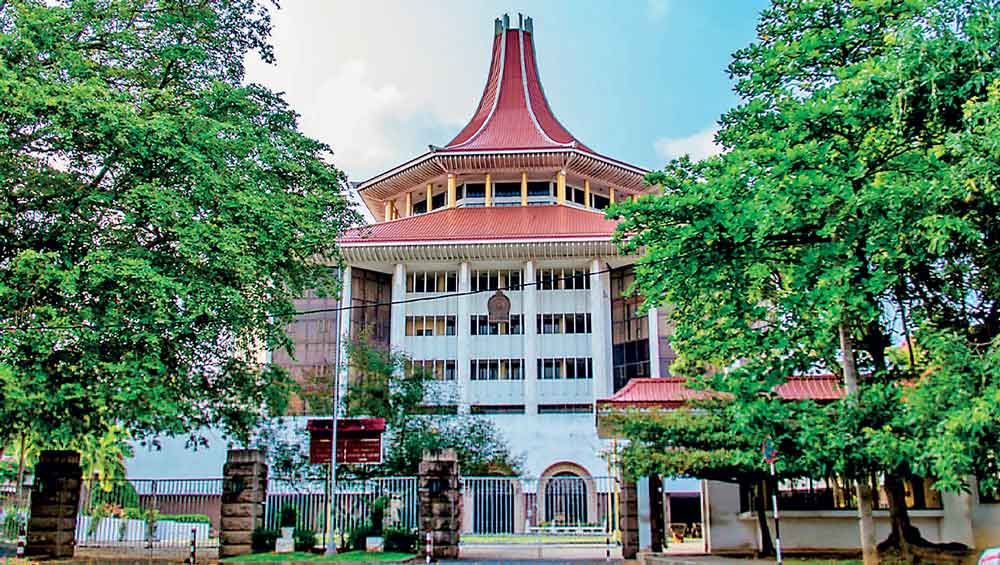
Supreme Court of Sri Lanka
 There is widespread interest in the 22nd Amendment to the Constitution of Sri Lanka in this country as well as abroad. This is especially so, after the widely disseminated comments by Ms Margaret Satterthwaite, the Special Rapporteur of the United Nations on the independence of the judiciary. The analysis contained in this article is being developed for publication in scholarly legal journals in the Commonwealth. The current version was written to cater to local interest.
Full Court
This was taken up as a threshold issue.
Given the importance of the matter, the majority of petitioners strenuously contended for the constitution of a Full Court consisting of all thirteen judges of the Supreme Court.
There is ample precedent for this in our country. In 1983, to adjudicate on an aspect of the Sixth Amendment, Neville Samarakoon CJ constituted a Bench which included the full strength of the Supreme Court, then consisting of nine judges. The same course of action was adopted by Sharvananda CJ in 1987 with regard to a challenge to the constitutionality of the Thirteenth Amendment and the Provincial Council Bills.
There are other situations in which Benches of seven judges have been constituted. Examples are provided by the orders by Nalin Perera CJ in 2018 in the premature dissolution of Parliament case and by Jayantha Jayasuriya CJ in the Easter Sunday bombing fundamental rights application in 2023.
The five judge Bench in the 22A case had no hesitation in rejecting the request for a Full Court.
This conclusion was founded on the premise that the hearing of the petitions “cannot be assigned a procedure outside the Constitution”. The governing provision is that “The Chief Justice may, if the question involved is in the opinion of the Chief Justice one of general or public importance, direct that such appeal, proceeding or matter be heard by a Bench comprising five or more judges of the Supreme Court”.
The substantial ground of rejection of the request for a Full Bench was that the Chief Justice had already exercised his discretion in appointing five judges, and that any variation of this would necessarily involve “an abdication by the Chief Justice of the constitutional role vested in him and usurpation of the discretion of the Chief Justice by the other judges of the Court”.
 The longevity of amendments to the Constitution of Sri Lanka during the last five decades has not been impressive. The future will decide the wisdom and viability of the 22nd Amendment
It was declared that, in the absence of provision conferring a right of appeal, revision or review, the application was misconceived. This, however, overlooks the reality that what was sought was not intervention by other judges to override an order of the Chief Justice, but a subsequent order by the Chief Justice himself to expand the composition of the Bench in light of cogent submissions by counsel representing the petitioners about the objective need for this initiative. This was not a situation in which, as a matter of strict procedure, the Chief Justice, having made an order, was finally and irrevocably functus and devoid of authority to take any further action in the matter at his own discretion. The invocation of a totally rigid constitutional fetter is fanciful and unrealistic, and defeats the ends of justice.
It was observed: “The Court cannot without any reasonable basis or justification give prominence to some selected cases and postpone other cases”. Nevertheless, the reasonable justification could readily be inferred from the circumstances, since the request by the petitioners was by no means self-centered or idiosyncratic but derived from the far-reaching implications of the matter at hand, evident even at a glance.
The Chief Justice nominated five judges to the adjudicating panel. Mr. Stephen Tiru, President of the Commonwealth Lawyers Association, who was an observer of the proceedings, as well as LawAsia, commented explicitly on the apparent absence of any explicable criterion governing the selection. Seniority on the Bench was clearly not the yardstick, since the judges selected occupied, from this perspective, slot numbers 6, 8, 11 and 13 out of a total complement of 13 judges of the Supreme Court.
Indisputably, the discretion is solely that of the Chief Justice. But, as my former teacher, Professor Sir William Wade of the University of Cambridge, never tired of pointing out, discretionary powers in the public domain, however amply conferred, must always be exercised so as to inspire public confidence. He insisted that nothing is more inimical to the values of public law than the concept of unfettered discretion. Indeed, the entire body of common law represents as strong a disincentive as possible against arbitrariness and caprice.
Consultation
The Court gave short shrift to the petitioners’ argument relating to the failure by the government to conduct a consultative process.
The singular absence of consultation was quite manifest. The Minister of Justice, in reply to explicit questions by the Opposition on the floor of Parliament, stated that no change relating to the retirement age of judges had been decided upon. Even two weeks before the Amendment was gazetted, the Secretary to the Ministry of Justice declared that she was unaware of any proposed change. The Bar Association, despite persevering efforts, was able to obtain an interview with the President only after a final decision by the Cabinet and subsequent to publication of the Bill in the Gazette. The Maha Sangha, the Catholic Bishops’ Conference, the Church of Ceylon, the Bar Association of Sri Lanka, 43 trade unions as well as a large number of academics and civil society organisations protested vehemently, but to no avail.
The Court, as the ground of dismissal, made the surprising statement that “the Parties failed to show any legal provision which has made it incumbent upon the government to ‘conduct a consultative process with the relevant stakeholders’ before it decides to gazette the Bill and place it in the Order Paper of Parliament”.
In 2022, when the United Kingdom embarked upon a comprehensive review of the retirement age of judges, and the government published proposals for public scrutiny and debate, there were no fewer than 1,200 responses from stakeholders during the span of over a year. And yet, there was no coercive statutory provision of any kind which made this consultative process compulsory. On the contrary, it was the cumulative thrust of comity, recognition of the value of consensus and the continuity of democratic tradition which impelled the deciding authority to regard the range and depth of public consultation as indispensable. Not even the most unrepentant Positivist would deny its necessity in the absence of statutory imperatives.
In any event, internationally acknowledged practice is unequivocal. The Venice Commission and Report on Constitutional Amendment has this to say: “Constitutional amendments should only be made after extensive, open and free public discussions involving the various political forces, non-governmental organisations, citizens’ associations, academia and the media, and with an adequate time frame for meaningful debate”.
In the specific context of judicial reforms, the Venice Commission has recently reaffirmed that “It is essential to continue to have proper public consultations before a Parliamentary vote”. Nothing could be more explicit.
Bias
One of the principal contentions on behalf of the petitioners was that, since the impugned measure has the effect of conferring on the decision makers an extension of judicial tenure, with accompanying advantages in terms of salary and all other perquisites of office, the public perception of probable lack of objectivity or bias would contravene the tenets of natural justice.
The Court adopted the approach that the disqualifying interest must necessarily take the form of “a direct pecuniary or personal interest in the specific outcome as between the litigants”. This limitation on the scope of bias as “a direct personal and case-specific interest”, excluding an “institutional stake”, is an unwarranted gloss on the law, clearly inconsistent with judicial authority of the highest standing.
In re Pinochet (No. 2), speaking in the House of Lords, Lord Browne-Wilkinson, commenting on the scope of the rule against bias, accepted its applicability in two distinct contexts: “first, where the judge has a financial or proprietary interest; and secondly where, although he has no such interest, his conduct or relationship may give rise to a suspicion that he is not impartial”.
In the 22A proceedings, the Court unhesitatingly opted for a subjective interpretation of the notion of bias, asking the question whether the decision-maker believed that he was receiving a benefit arising from a “legislative bribe”. This is reflected in the emphatic assertion: “We hold that there cannot be any such conflict in the mind of the judge”. It is respectfully submitted that this is the wrong question to ask. The issue is not whether the judge, in his own mind, considered himself the recipient of an advantage, but rather whether “a fair-minded and informed observer would conclude that there was a real possibility that the tribunal was biased” (Porter v Magill).
The operative criterion, then, is apparent or potential bias which extends beyond direct interest to the underlying purpose of sustaining public confidence in judicial impartiality.
An identifiable flaw in the Court’s reasoning derives from placing increase of salaries of judges and retrospective enhancement of the age of retirement of judges on the same level. The Court categorically asserted: “We have to apply one yardstick to both”. However, while salaries must obviously be increased over a period of thirty or so years during which a judge may hold office, the same considerations hardly apply to extension of duration of tenure, departing from constitutional postulates which determined the period of office at the time of commencement of the appointment.
This is vividly illustrated by the attitude of Chief Justice Geoffrey Ma, who held office in Hong Kong when, in 2019, the age of retirement of judges of the Supreme Court was extended from 60 to 65 years. Chief Justice Ma, in expressing the reasons for his decision, which continues to resonate as an inspiring precedent, said that although in terms of the law enacted midstream during his judicial tenure, he was entitled to serve for an additional five years, he would refrain from doing so and relinquish office at the previously designated age of retirement. He was doing so to give effect to his own settled expectation, and that of all others, that he would retire at the age which applied at the time he took office. He considered that this course of action was conducive to the health of the judicial system which he wished to transmit, in its full integrity, to his successors.
Another observation by the Sri Lankan Court gives rise to consternation. This relates to the Court’s attitude to a seminal statute, the Judicature Act,No.2 of 1978, which sets out, inter alia, the procedure to be followed in the event of a judge having an interest in the subject matter of a case before him. Their Lordships commented: “We regret to note a gradual increase in the number of vexatious petitions being filed in Courts. We think the time has come for Courts to give a purposive interpretation to section 49 of the Judicature Act rather than trying to blindly follow the said provision”.
The suggestion that a court may properly, at its own discretion, apply or disregard a binding provision of statute law is likely to occasion more than passing misgivings.
Role of the Constitutional Council
The effect of Article 41C, read with Article 107(1) of the Constitution, is that concurrence by the Constitutional Council is a condition precedent for appointment of Superior Court judges by the President.
One of the objections to 22A was that the Constitutional Council had approved the appointment of these judges only up to the time indicated in Article 107(5) of the Constitution and that any extension of tenure beyond this period would be without the concurrence of the Constitutional Council, and therefore in violation of a mandatory constitutional requirement.
This contention was disposed of by the Court on two grounds. First, the Court declared: “The incumbent judges of the Superior Courts whose age of retirement would be increased if the Bill is passed into law, are judges whose appointments have been approved by the Constitutional Council after due process”. This overlooks the consideration that the approval was time-bound and cannot plausibly be construed as open-ended, covering any period which a subsequent legislature might choose to prescribe.
The second reason was stated as follows: “We have already adverted to the fact that they have been serving in the Judiciary well before the present government came to power”. It is difficult to understand the rationale spelt out in these terms. Whatever government was in power, the issue is whether approval granted by the Constitutional Council in respect of a particular appointment envisages only the period during which the appointment was thought to be operative at the time concurrence was given, or whether approval is infinitely elastic in terms of time frame. There is obviously no particular sanctity attaching to judicial appointments made prior to, or after, a specific point in time.
Selectivity and “Court capture”
By way of refutation of this basic criticism of the constitutional innovation, the Court placed heavy reliance on the generality of application of the proposed reforms. Their Lordships declared: “It is important that we bear in mind two important distinctions that were referred to by the learned Solicitor-General, that being the extension is non-discriminatory in that it applies to all judges, and it is non-discretionary, in that the extension is not at the whim and fancy of the Executive”.
Empirical reality militates against the validity of this contention.
During the first half of this year, 2026, three judges of the Supreme Court retired. If the proposed extension of tenure had been effected at the beginning of the year, these judges would have been entitled to its benefit and would have continued in office for an additional two years.
In May 2026, just three months before the 22nd Amendment was presented to Parliament, the President of the Court of Appeal, after a distinguished career spanning 30 years, retired from service. He did so at a time when no fewer than four vacancies existed on the Bench of the Supreme Court. The President of the Bar Association, in his address at the ceremonial sitting to mark the retirement of the judge, publicly expressed regret that the country had been deprived of his service at the apex court, despite repeated interventions by the Bar to prevent this injustice. On 3 September 2026, just days before the vote in Parliament took place on 22A, another judge of the Court of Appeal retired, not having been promoted to fill one of the vacancies in the Supreme Court.
These circumstances, objectively viewed, detract substantially from the merit of the argument premised on the absence of discretion and discrimination.
An appeal to patriotic sentiment
In the face of attempts to convey to the Court, with a sense of urgency, the ill omens in other jurisdictions, Their Lordships were inclined to push back energetically by denigrating these apprehensions and regarding the circumstances of our country as special. The Court was strident in its assertion: “We can only reiterate that the judiciary of this country consists of men of courage and men of wisdom who have always and who will always maintain the independence of the judiciary under varying circumstances”. It was claimed: “This is clearly established by the fact that nobody, not even the Bar Association of Sri Lanka, has ever complained, nor has there been any allegation or an iota of suspicion that the judges of this country surrendered their much cherished independence”. The bedrock of this approach was an appeal to patriotism: “Disparaging our country to advance an argument at the expense of our national reputation is unfortunate and regrettable”.
Sadly, the state of the world we live in is far less sanguine. History is replete with examples which bear testimony to the truth that descent into autocracy does not generally happen by one fell swoop but takes place incrementally over time, for the most part by steps which are typically modest and even imperceptible. To persuade ourselves that we are insulated against the common experience of humankind and are, alone, invulnerable is fraught with the gravest danger. The dynamics of history do not admit of anomalous exceptions. This is why “the gritty resolve of this Court to uphold constitutional obligations” may not, by itself, provide entirely satisfying reassurance.
Conclusion
The longevity of amendments to the Constitution of Sri Lanka during the last five decades has not been impressive. The future will decide the wisdom and viability of the 22nd Amendment.
(The author is Justice, Constitutional Affairs and National Integration Minister; Quondam Visiting Fellow of the Universities of Oxford, Cambridge and London; and former Vice-Chancellor and Emeritus Professor of Law of the University of Colombo)




