Thursday Oct 22, 2026
Thursday Oct 22, 2026
Tuesday, 6 January 2026 00:30 - - {{hitsCtrl.values.hits}}
By Senehe Perera
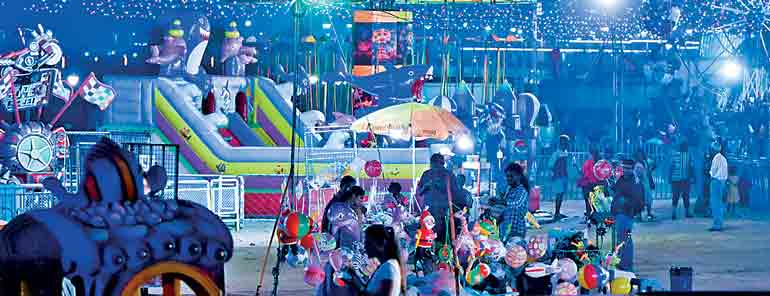
While watching television broadcasts on Christmas Day and New Year’s Eve, I could not help but reflect on whether even one per cent of the celebrants enjoying the festivities at the Galle Face Green, or the commercial enterprises that earned revenue through events and advertising, were aware of the extraordinary individual whose courage and intellect made such public enjoyment possible.
The unrestricted access of the general public to the Galle Face Green, the vibrant celebrations witnessed by television viewers, and the continuity of public events at this iconic location were not accidental developments. They were made possible through the dedicated, erudite, and fearless legal work of Ruana Rajepakse, Attorney-at-Law, who acted steadfastly in the interest of the public.
Galle Face Green: A people’s space
Her legal intervention, undertaken with courage and unwavering commitment, paved the way for the commencement and continuation of public activities at the Galle Face Green, safeguarding it as a space for the people.
Yet, her contribution remains largely unacknowledged, an example of the quiet dedication of a lawyer who placed public interest above personal recognition.
Even a cursory look at Ruana Rajapakse’s life and work reveals an extraordinarily ambitious and accomplished woman: a Supreme Court Attorney and a playwright, a newspaper columnist and an environmentalist, a novelist and a legal advocate.
Multi-skilled family
Ruana hailed from a family with strong ties to the legal profession, politics and foreign affairs, and the arts. Her great-grandfather was Sir Francis de Zoysa, an advocate of the Supreme Court of Ceylon who was later appointed King’s Counsel. Her grand uncles included Stanley de Zoysa, the former Finance Minister, A.C. ‘Bunty’ de Zoysa, a President’s Counsel and Lucien de Zoysa, a pioneer of English theatre in Colombo.
Her father, Jayanath Rajapakse, was a member of the foreign service and her childhood was spent in far-flung corners of the world, from Russia to Canada, where she was exposed to multiple languages, cultures and social systems.
Upon returning to Sri Lanka at the age of ten, she spent a good deal of time with her extended family, which included Richard de Zoysa, the renowned actor, playwright, poet and journalist who was found dead during the second JVP insurrection in 1990. They were no ordinary family gatherings. Under Richard’s guidance, assorted members of the de Zoysa clan staged numerous plays well before their teenage years. Many who were involved in these home grown yet highly elaborate productions remained involved in the theatre scene for years afterwards
A woman who wore many hats
Perhaps due to these varied and powerful influences, Ruana was not content to merely follow a mid-level career in her chosen profession. As a barrister, she served a Presidential Task Force on Child Abuse and wrote a weekly column for the Island Newspaper entitled Legal Watch. She authored two professional volumes on constitutional and legal issues in Sri Lanka.
Determined to seek new avenues of creative expression, she also wrote and produced two plays: a “Colombo” version of R. B. Sheridan’s School for Scandal and the one-act play ‘All In A Day’s Work’. A deep curiosity about Sri Lankan history later fueled her foray into novel-writing, and in 2008 she published her first and only work of fiction entitled Garland of Fate, inspired by a jataka story set in 510 BC.
A very private person, she did not often speak openly about herself. Anyone who interacted with her, whether in a personal or professional capacity, immediately recognised her tendency for hard work, her dedication to immaculate scholarship and her respect for learning. She was articulate and passionate about a number of issues and was a member of the Sri Lanka chapter of the IUCN Commission on Environmental Law. She was an outspoken critic of the Urban Development Authority’s attempts to hand over the Galle Face Green to a private company in the early 2000s for the purpose of building an amusement park on the waterfront. When a public-interest environmental organisation took up the case, she represented them in the Supreme Court, according to the Access Initiative. The Court annulled the agreement between the Urban Development Authority and the private company, ruling that the UDA did not have the power to hand over the Green, which had been “dedicated to the public by an order of the Colonial British Government in 1856.”
In a tragic turn of events, Ruana spent her last years on this earth in poor health. She died alone on 26 July, and her funeral was conducted without the knowledge of her extended family or colleagues. We hope this belated obituary offers a glimpse into her rich and full life. Though her final years were spent in isolation and obscurity, she will be remembered for her fine contributions to the fields of law and letters in Sri Lanka.
This article is a tribute to her great and brave work. It is written not only to honour her memory but also to acknowledge the unsung dedication she showed in service of the general public and the rule of law.
May her legacy continue to inspire the generations to come.




