Wednesday Sep 30, 2026
Wednesday Sep 30, 2026
Wednesday, 30 September 2026 00:20 - - {{hitsCtrl.values.hits}}
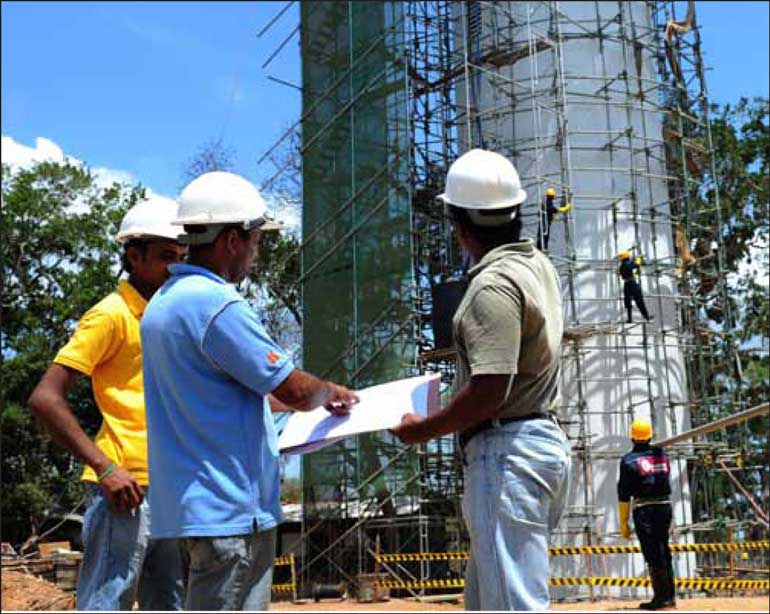
 Sri Lanka’s construction industry is entering a fundamentally different operating environment. The 2027 public-investment program has already been allocated approximately Rs. 2 trillion, making it one of the largest construction-related public investment programs in recent years. In addition, four highway projects have been allocated local funding. This is a major opportunity for the construction industry. But it also presents a critical question: Does the industry have the capacity to absorb, finance and successfully deliver this scale of work? The answer cannot be measured by the number of contractors, the value of tenders or the size of the government allocation alone.
The real test will be whether contractors can turn this investment into mobilised sites, sustained cash flow, productive employment, completed infrastructure and commercially viable businesses.
The Central Bank of Sri Lanka’s Construction PMI reached 61.4 in July 2026, confirming continued expansion in construction activity. At the same time, the sector continues to face constraints relating to skilled labour, materials, finance, supply chains and contractor capacity.
For contractors, therefore, 2027 should not be approached simply as another tendering year. It should be approached as a capacity-readiness year.
The opportunity is Rs. 2 trillion. The challenge is execution. A large capital allocation does not automatically translate into completed projects.
The CIOB’s construction-sector analysis identifies several barriers that can prevent public investment from becoming completed and operational assets: contractor cash-flow problems, limited access to working capital and guarantees, skilled-labour shortages, material and supply-chain disruption, distressed contractors, administrative delays, uneven work allocation and contract-related disputes.
This creates a different environment for contractors. In a period of limited construction activity, the key question is: Where is the work?
In a period of major public investment, the question becomes: Can we take on the work and deliver it without overstretching the company?
That distinction is crucial. A contractor that wins several contracts but cannot finance mobilisation, secure labour, procure materials or manage contractual risk may create greater financial pressure rather than greater profitability.
Know your capacity before you chase growth
The first step for every contractor should be a detailed assessment of its financial and operational capacity.
Before entering the 2027 tender cycle, contractors should assess: existing order book, outstanding receivables, certified but unpaid work, pending claims and variations, existing bank debt, working-capital facilities;, performance-bond capacity, advance-payment guarantees, equipment-financing capacity and projected cash requirements for new projects.
The CIOB proposal specifically identifies working capital, performance bonds, advance-payment guarantees, receivable-backed lending and appropriate debt restructuring as important components of contractor financial capacity.
The objective should be to establish financial headroom before tenders are awarded, rather than approaching banks after a contract is secured.
A strong contractor should know its maximum safe order-book value, maximum monthly cash requirement and maximum number of projects that it can realistically manage simultaneously.
Develop a professional bid/no-bid strategy
A major public-investment program will create opportunities across highways, roads, buildings, water, utilities, rehabilitation and other infrastructure.
But contractors should resist the temptation to pursue every available tender.
Before bidding, each project should be assessed against 6 fundamental questions: Financial: Can we finance it? Technical: Do we have the required experience and capability? People: Can we provide the necessary engineers, managers and skilled workers? Plant: Do we have access to the required equipment? Commercial: Are the contract and payment conditions acceptable? Capacity: Can we add this project without damaging our existing projects?
This should become a formal Bid/No-Bid system, rather than an informal management decision. CIOB also recommends project-readiness screening before projects proceed to tender, including adequate land, design, approvals, financing, cost estimates and procurement strategy. Not every available project is necessarily the right project for every contractor.
Secure finance and guarantees before you need them
One of the greatest constraints during a construction expansion can be the gap between winning a contract and having the financial capacity to mobilise it.
Contractors should meet their banks now and prepare a clear 12–24 month funding plan covering: performance bonds, bid bonds, advance-payment guarantees, working-capital facilities, equipment financing, and overdrafts, receivable-backed financing; and contingency facilities.
The discussion with the bank should not begin with: “We have just won a project. Can you finance us?”
It should begin with: “This is our expected 2027 project pipeline, this is our current order book, these are our projected cash requirements and this is the financial capacity we need.”
That is a much more strategic approach to bankability.
Labour will become a competitive issue
CIOB recommends a national construction labour force mechanism, apprenticeships, certification and skills development. Contractors should therefore start workforce planning now.
Each company should maintain a reliable database of: engineers, quantity surveyors, planning engineers, project managers, foremen, skilled masons; carpenters, steel fixers, welders, electricians, plant operators, mechanics, HSE personnel and QA/QC staff.
Contractors should also strengthen links with vocational and technical training institutions and develop apprenticeship and in-house training programs.
The winning contractor in a large program will not necessarily be the company with the most equipment. It may be the company that can mobilise the right people fastest and retain them throughout the project.
Secure materials and suppliers early
The industry should also prepare for increased pressure on construction inputs.
CIOB identifies material price volatility, long lead times and tender uncertainty as major supply-chain concerns, and proposes greater transparency on prices, availability, lead times and supplier capacity.
Every contractor should identify its critical materials and establish: Primary supplier, Backup supplier, Lead time, Current price, Credit terms, Availability, Price risk.
This is particularly important for highway construction, where large volumes of aggregates, bitumen, asphalt, cement, steel, fuel and heavy equipment may be required.
A contractor should never discover a critical material shortage after mobilisation.
Audit your plant and equipment
A larger project pipeline will also increase competition for construction machinery.
Contractors should undertake a complete plant audit before the program accelerates: What do we own? What is currently used? What is approaching replacement? What do we need for the projects we are targeting?
What should be purchased, leased or hired?
For some contractors, leasing, equipment hire, specialist subcontracting or joint ventures may provide greater flexibility and reduce capital tied up in underutilised machinery.
The objective should be: Project-ready equipment without unnecessary capital overexposure.
Prepare before the tender arrives
Sri Lanka now has a rare opportunity to convert public allocations into procurement, physical progress, completed assets and measurable public outcomes, while addressing contractor liquidity, labour, supply chains, contract management and implementation bottlenecks.
For contractors, that means 2027 preparation should begin now. Prepare the banks. Prepare the workforce. Prepare the plant. Prepare the suppliers. Because when the tenders arrive, it will be too late to start building capacity.
(The author is the President of Ceylon Institute of Builders (CIOB))



