Friday Oct 16, 2026
Friday Oct 16, 2026
Tuesday, 7 April 2026 00:00 - - {{hitsCtrl.values.hits}}
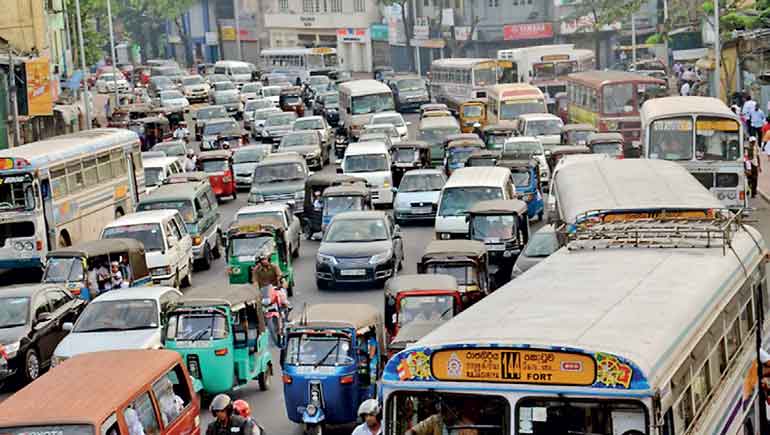
 Sri Lanka appears to be on the verge of facing its worst traffic congestion since the COVID-19 period and the economic downturn in recent years. With the relaxation of vehicle import restrictions, the number of vehicles on our roads has increased rapidly. However, there seems to be little visible planning or mitigation strategy to manage this growing challenge.
Today, commuters spend more than 1 hour and 30 minutes covering just 20 kilometres in the morning, and often even longer during the evening rush. This is not merely an inconvenience — it is a national productivity issue.
As of 2024, Sri Lanka had approximately 8.4 million registered vehicles across all categories. Following the reopening of motor vehicle imports after a five-year ban, 2025 witnessed a significant surge in registrations. Approximately 360,117 new vehicles were registered in 2025 alone, pushing the total vehicle population to over 8.8 million — and the number continues to grow.
Breakdown of Registered Vehicles (Approximate):
nMotorcycles – 4.8 million
nThree-wheelers – 1.18 million
nMotor cars – 910,000
nDual-purpose vehicles – 450,000
nLorries & trucks – 400,000
nBuses – 114,000
nOther categories – 100,000
A substantial portion of these vehicles operate within the Western Province, particularly in Colombo and surrounding urban areas. Yet during peak hours, a noticeable pattern emerges: many vehicles carry only one occupant — the driver.
Meanwhile, countless vehicles remain parked throughout the day in congested car parks across Colombo. The obvious question arises — why?
The answer is simple. Public transport remains overcrowded, often uncomfortable, and lacking in safety and reliability. With only about 114,000 registered buses across the entire country — and not all serving Colombo — commuters feel they have limited options. As a result, private transport becomes the default choice.
Infrastructure limitations
Road expansion in key urban centres is increasingly difficult due to space constraints. Colombo and its suburbs cannot widen roads indefinitely. The solution therefore cannot rely solely on infrastructure expansion.
Traffic management challenges
Traffic congestion is further aggravated at major junctions. While traffic police officers are deployed to manage intersections, inconsistent traffic handling sometimes worsens congestion rather than easing it.
It is important to recognise that many officers serving in Colombo may be posted from other parts of the country and may not be fully accustomed to managing extremely high vehicle volumes during peak hours. The issue may not lie with individual officers, but rather with systemic planning and coordination.
Authorities could consider leveraging modern technology — such as drone surveillance and real-time traffic video analysis — to better train officers and improve decision-making at key intersections.
The bigger picture
If Sri Lanka’s economy continues to grow, urban mobility must evolve alongside it. Efficient public transport is essential to reducing congestion and improving productivity.
The introduction of a Light Rail Transit (LRT) system was once proposed as a long-term solution, with feasibility studies conducted. However, the project was not implemented. Revisiting such initiatives may be crucial if we are serious about long-term traffic reform.
A national conversation
Traffic congestion will not resolve itself. With continued vehicle imports and limited road capacity in a geographically small country, new strategies must be explored.
Solutions may include:
nStrengthening public transport systems
nEncouraging carpooling and ride-sharing
nImplementing staggered office hours
nIntroducing intelligent traffic management systems
nRevisiting mass transit projects
Time lost in traffic is time taken away from economic productivity, personal well-being, and family life. The question is not whether traffic will increase — it already has. The real question is whether we are prepared to address it strategically and sustainably.




