Tuesday Nov 17, 2026
Tuesday Nov 17, 2026
Tuesday, 17 November 2026 05:08 - - {{hitsCtrl.values.hits}}
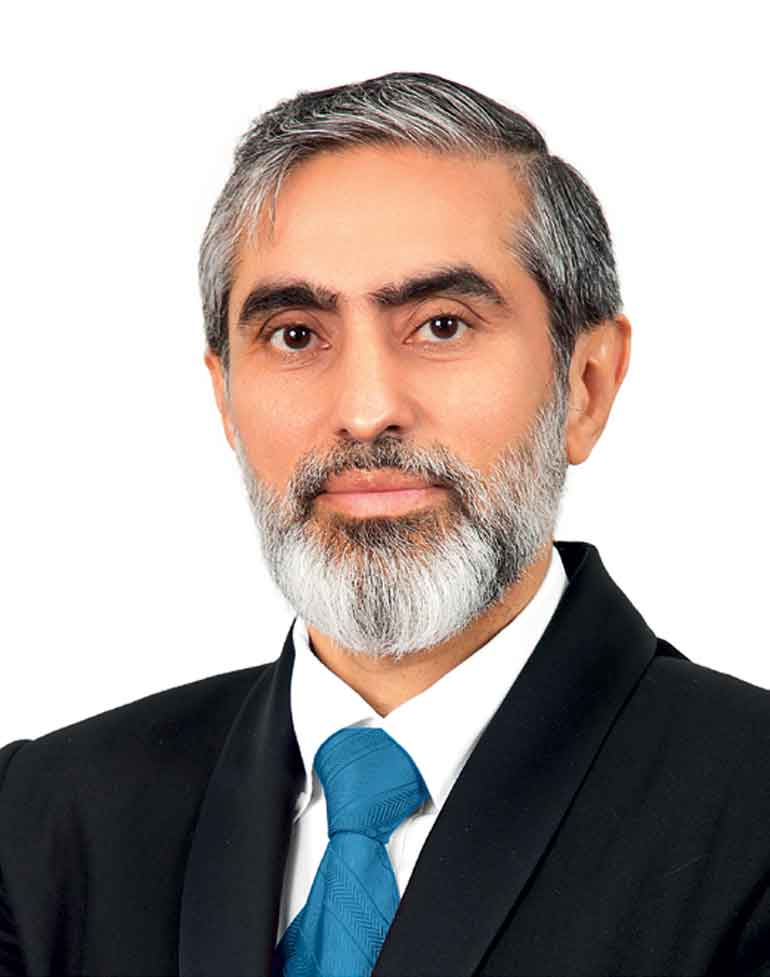
Vidullanka PLC Founder and CEO Riyaz Sangani
 Riyaz Sangani grew up as the Accelerated Mahaweli Development Program was transforming Sri Lanka’s energy landscape. Throughout the 1980s, major dams and power stations, including Victoria, Kotmale and Randenigala, were being built and commissioned, and they were rarely out of the news. It was his first exposure to hydropower. At the time, though, large-scale hydropower was largely the domain of the State.
At university, he discovered that it didn’t have to be that way. His friend Prabodha Sumanasekera’s father had built the plant at Dickoya, Sri Lanka’s first privately developed small hydropower plant to sell electricity to the national grid. The two went to see it. Sangani, who had grown up around his family’s business, saw that a private company could own and operate a power plant.
Sangani was ready to build a business of his own. He incorporated Vidullanka in 1997, a year after Dickoya began operations, with plans to build a plant of his own.
Under the radar
The timing was better than he could have known. The approval process was relatively straightforward, and the sector attracted little attention. “Very few people knew about it, so we were working under the radar,” he says. “Nobody knew, nobody bothered.”
The one fight was price. The early tariff was hard to work with, until a new formula linked payments to the cost of thermal power. When fuel prices rose, so did what hydro developers were paid. Those who got in early found themselves in a sector whose economics kept improving.
None of that made the first project easy. Bambarabatuoya, a 3.2 MW plant in Ratnapura, was meant to take 18 months. A technical mistake brought down the forebay tank, which had to be rebuilt. The project stretched to nearly three and a half years, and interest and cost overruns piled up. “It was all learning,” he says. “Learning the hard way.”
The plant was commissioned in June 2001, and once the cash started coming in, the picture changed. Tariffs were attractive, good sites were still available, and the company now knew what could go wrong. “We were more confident that this time we could do a better job,” he says, “and we wanted to test that out.”
Over the following years, he gradually moved out of the family business and into Vidullanka full time.
Listing out of necessity
The company’s next milestone came out of necessity, not just ambition. For privately held companies, going public can mean giving up a degree of control and opening their decisions and finances to outside scrutiny. For Sangani it was never really a choice. “It was not a choice available,” he says. “We had a lot of debt in the company. If we had stuck to the present state, we wouldn’t have been able to do new projects.”
To grow, Vidullanka had to clear the borrowings Bambarabatuoya had left behind. It raised Rs. 180 million through a private placement and settled all its outstanding debts. Track-record rules kept the company off the main board, so in 2005 it listed on the second board, the first mini-hydropower company on the Colombo Stock Exchange. It moved to the main board in 2008.
Building beyond the island
By 2014, Vidullanka had built seven plants, and Sangani could see the limits at home. Good sites were running out, and between 2010 and 2015 new projects became much harder to get approved. Some went through. Others were stopped.
He had seen this coming. “We knew at some point Sri Lanka will get saturated,” he says. “If we’re going to keep expanding, we have to look for opportunities in other countries.”
Uganda was the opening. European governments were funding a program to promote small hydro there, and approvals were simpler than Sri Lanka’s had become. Vidullanka’s engineers identified the Muvumbe site in 2012, and the company went in on its own, with no local partner. The 6.5 MW plant was commissioned in March 2017, the first hydro plant connected to Uganda’s grid under the GET FiT program. The second plant, Bukinda, was built through the pandemic and commissioned in 2020. Overseas hydro became the group’s biggest earner and its lifeline, keeping the company afloat through COVID-19 and Sri Lanka’s economic crisis. Being early opened the door, but it was execution that kept it open.
With plants running abroad and a team that had built them, the next step was building for others. When Guyana’s energy agency tendered for two mini hydro plants, Vidullanka was one of three bidders and came in lowest, winning a $ 12.85 million contract in 2022. Most recently, it received the award for a mini hydro project in Fiji.
Not every bid succeeds. Across every project Vidullanka has chased, at home and abroad, he puts the success rate at about half. “We keep on trying many countries,” he says. “Some will succeed, some will not.”
Timing it right
Ask Sangani what he would tell a young founder, and the answer is timing.
When he entered hydropower, there were very few players. Power generation in Sri Lanka is now a mature industry with heavy competition, and a newcomer has to be very efficient and very smart to survive in it. Even battery storage, the newest segment, already has many players.
He would look for an area with fewer players and less hype. In energy, that could mean ambitious innovation, technology that serves the industry rather than another power plant. He sees a lot of room for it. It could also mean markets short of technical know-how and capital, which is why Africa worked for Vidullanka. It brought both.
The advice describes his own career. He found hydropower as a news story and a single plant in the hills, got in before the sector was crowded, and went global before the opportunities at home became harder to find.
“Look for places where there is less competition, something new to do,” he says. “Time it right.”
(The author is a Consultant at the TiE Colombo Corporate Office, the Sri Lankan chapter of The Indus Entrepreneurs (TiE), a global network committed to nurturing entrepreneurship through mentorship, networking, and access to capital.)




