Thursday Oct 15, 2026
Thursday Oct 15, 2026
Monday, 16 March 2026 02:50 - - {{hitsCtrl.values.hits}}
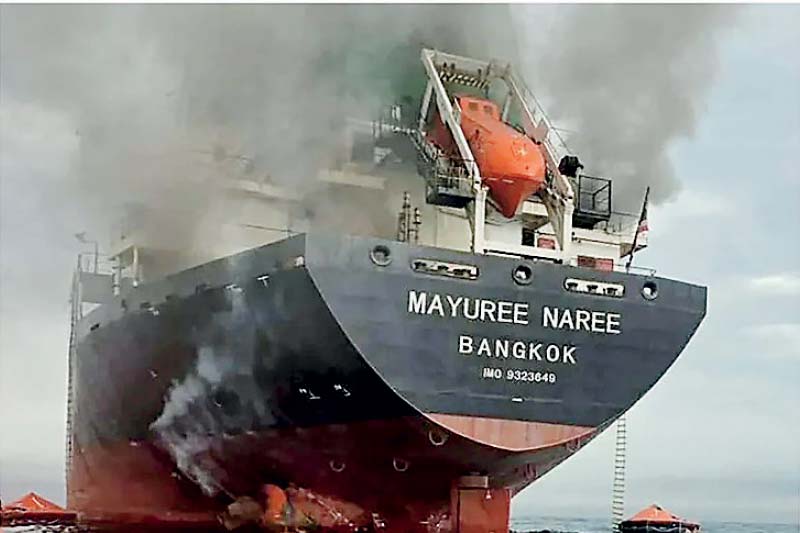
Handout photo released by the Royal Thai Navy shows smoke rising from the Thai bulk carrier Mayuree Naree near the Strait of Hormuz after an attack last week
 Without faster investment in alternative energy infrastructure and broader economic diversification, the country will continue to face recurring exposure to global energy shocks
 Sri Lanka’s economic recovery is increasingly described in terms of cautious optimism. Inflation has fallen sharply from the extreme levels experienced during the economic crisis of 2022, the exchange rate has stabilised, and foreign exchange reserves have gradually improved. Reflecting this progress, Central Bank Governor Nandalal Weerasinghe recently suggested that Sri Lanka may now be in a better position to absorb moderate increases in global oil prices.
With inflation falling to around 1–2% in recent months and foreign reserves recovering to roughly
$ 7 billion, policymakers argue that the country has regained a degree of macroeconomic policy space.
These improvements are real and deserve recognition. Yet optimism must be tempered by structural realities. Sri Lanka remains one of the most energy-import-dependent economies in Asia, importing nearly all of its petroleum requirements. Transportation, electricity generation, industry, and agriculture all rely heavily on imported fuel. In such a context, global oil price volatility continues to represent one of the most significant external risks to macroeconomic stability. As Nobel Prize–winning economist Joseph Stiglitz has observed, “Energy price shocks act like a tax on import-dependent economies, transferring wealth abroad while weakening domestic stability.”
Lessons from history
History offers clear lessons about how disruptive oil price shocks can be. The global economy has experienced several major oil crises over the past five decades. The oil shocks of the 1970s, triggered by geopolitical tensions in the Middle East, generated worldwide inflation and economic slowdown. More recently, crude oil prices surged from around $ 20 per barrel in the late 1990s to more than $140 per barrel in 2008 before collapsing during the global financial crisis. During the COVID-19 pandemic in 2020, oil prices briefly fell below $ 20 per barrel due to collapsing global demand, only to surge again to over
$ 120 per barrel in 2022 amid geopolitical tensions and supply disruptions. These dramatic cycles illustrate how quickly energy markets can destabilise national economies—particularly those heavily dependent on imports.
For Sri Lanka, the economic implications of rising oil prices are immediate and far-reaching. Petroleum imports regularly represent one of the largest components of the country’s import bill, often costing between $ 4–6 billion annually depending on global price movements. When oil prices rise, the import bill expands rapidly, widening the trade deficit and intensifying pressure on foreign exchange reserves.
The transmission of higher energy costs through the domestic economy is equally significant. Fuel prices influence transportation, electricity generation, agriculture, and industrial production. When global oil prices increase, these costs cascade across multiple sectors of the economy, raising production expenses and ultimately contributing to inflationary pressure. In an economy still recovering from a severe crisis, such cost increases can quickly undermine fragile stabilisation gains.
Economic crisis of 2022
Sri Lanka’s experience during the economic crisis of 2022 provides a powerful reminder of this vulnerability. As foreign exchange reserves collapsed to critically low levels, the country struggled to finance essential imports—including fuel. Long queues at petrol stations became the most visible symbol of a deeper structural problem: an economy highly dependent on imported energy but lacking adequate external buffers to manage price shocks.
Since then, the stabilisation program supported by international institutions has helped restore a degree of macroeconomic stability. Inflation has declined sharply from its peak of nearly 70%, monetary policy has tightened, and foreign exchange reserves have gradually improved.
However, the Governor’s observation also carries an important implicit limitation. Improved reserves and lower inflation provide temporary resilience, but they do not fundamentally alter Sri Lanka’s structural exposure to global energy markets. In other words, the country may now be able to manage moderate oil price fluctuations, but a sustained or severe price surge could still generate significant macroeconomic stress.
Several potential risks deserve attention. A sustained increase in oil prices would expand the import bill, widen the trade deficit, and place renewed pressure on foreign exchange reserves. Higher fuel costs would also transmit rapidly into domestic inflation through transportation, electricity generation, and food supply chains. With fiscal space severely constrained following the sovereign debt default, the Government has limited capacity to cushion such shocks through subsidies or large-scale fiscal intervention.
Another constraint that deserves greater attention is Sri Lanka’s ongoing commitment under the economic stabilization program supported by the International Monetary Fund. The recent improvement in reserves cannot be viewed in isolation from the country’s medium-term repayment obligations. As part of the IMF-supported reform program and the broader external debt restructuring framework, Sri Lanka will need to rebuild significantly stronger reserve buffers over the coming years.
By the latter part of this decade—particularly around 2027 and 2028—the country will face renewed external repayment pressures as debt servicing gradually resumes. To manage these obligations while maintaining exchange-rate stability and investor confidence, analysts suggest Sri Lanka will likely need reserves well above present levels, potentially exceeding $ 14 billion. Any sustained increase in oil prices that erodes foreign exchange reserves in the interim could therefore complicate the country’s ability to meet these commitments.
Economists have long warned about the destabilising role of energy shocks in developing economies. As British economist Nicholas Stern once noted, “Energy vulnerability is not merely an environmental issue—it is fundamentally an economic stability issue.”
Yet the most uncomfortable question concerns policy preparedness. Critics argue that Sri Lanka’s energy policy has historically been reactive rather than strategic. Successive Governments have often delayed difficult reforms, relying instead on temporary price controls, politically driven fuel subsidies, or short-term borrowing to finance energy imports. Long-term investments in renewable energy, energy efficiency, and modern public transportation have progressed more slowly than required.
Long-term resilience
The deeper issue is structural. For decades, Sri Lanka’s macroeconomic stability has been closely tied to developments in global commodity markets—particularly oil. When international energy prices remain moderate, the economy tends to experience relative stability. When prices surge, economic pressures intensify rapidly.
Reducing this vulnerability requires more than short-term stabilisation policies. Long-term resilience depends on structural reforms that reduce dependence on imported petroleum. Expanding renewable energy generation, improving energy efficiency, modernising public transportation, and strengthening export earnings are essential steps toward insulating the economy from global oil market volatility.
Although Sri Lanka has made some progress in expanding renewable energy capacity, petroleum continues to dominate the transportation sector and remains a significant component of electricity generation. Without faster investment in alternative energy infrastructure and broader economic diversification, the country will continue to face recurring exposure to global energy shocks.
The global energy landscape itself remains uncertain. Geopolitical tensions, supply disruptions, and the long-term transition toward low-carbon energy systems are likely to keep oil markets volatile for the foreseeable future. For import-dependent economies such as Sri Lanka, this volatility represents a persistent external risk.
Sri Lanka’s current economic recovery should therefore be understood as fragile rather than secure. Macroeconomic stabilisation has created an important opportunity for rebuilding the economy, but it has not eliminated the structural vulnerabilities that contributed to the crisis.
If global oil prices remain moderate, Sri Lanka may continue along a path of gradual recovery. But if another major energy price surge occurs, the island’s economic resilience will once again be tested.
Until meaningful policy progress is made in reducing energy dependency and strengthening external earnings, Sri Lanka’s macroeconomic stability will remain tied to a factor largely beyond its control—the unpredictable price of oil.




