Monday Oct 12, 2026
Monday Oct 12, 2026
Friday, 24 April 2026 03:27 - - {{hitsCtrl.values.hits}}
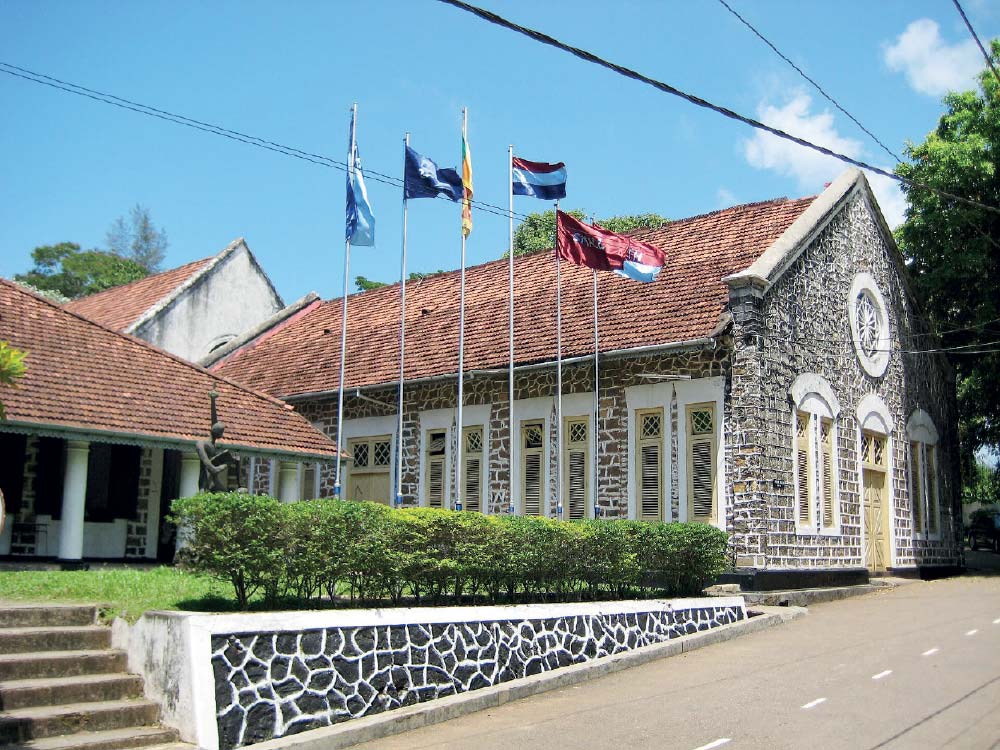
Richmond College Galle
 As Richmond College, Galle, marks its 150th anniversary on 1 May 2026, it does more than celebrate a passage of time. It stands at a reflective crossroads—between a proud past that shaped generations of distinguished citizens, and a future that urgently calls for the revival of values that once defined not only an institution, but a way of life.
For a century and a half, Richmond has not merely educated; it has cultivated. Its legacy is etched not only in academic excellence or sporting triumphs, but in the character of the men it has sent into the world. Statesmen, scholars, professionals, and leaders—many of whom have left an indelible mark on Sri Lanka—have emerged from its classrooms. Yet, beyond these visible accomplishments lies a quieter, deeper achievement: the shaping of individuals grounded in discipline, integrity, humility, and moral courage.
A heritage of leadership and vision
Richmond’s contribution to the Sri Lankan identity is unparalleled. From its halls emerged the Father of Free Education, C. W. W. Kannangara, whose radical vision ensured that knowledge was not the preserve of the elite, but a right for every child in the island. The college’s political legacy is equally formidable, having nurtured a former President Mahinda Rajapaksa and former Prime Minister Wijayananda Dahanayake. These figures represent a tradition of service that has dictated the course of our national history. This list is further enriched with 40th Chief Justice Hon G.P.S De Silva and scholars of highest caliber such as Shakespearean and the first professor of English of the University of Ceylon Evelyn F. C. Ludowyk and prominent educationist & member of the state council and parliament P de S Kularatne , who is also the founder of leading national schools Nalanda Vidyalaya, Ananda Balika Vidyalaya and Dharmapala Vidyalaya Pannipitiya. This "Richmond DNA"—a unique blend of integrity, assertiveness, and quiet confidence—continues to manifest in the modern era with many outstanding personalities excelled and contributed to nation building in variety of fields and list goes endless.
In an extraordinary display of sporting dominance, the current Sri Lankan national cricket landscape is led by three national team captains groomed at Richmond College: Charith Asalanka, Dhananjaya de Silva, Wanindu Hasaranga De Silva, and, alongside the versatile Kamindu Mendis. This surge of talent is the hallmark of Richmond’s storied cricketing tradition, forged through decades of intense competition with Mahinda College in their historic annual encounter, the Lover’s Quarrel.
Their success is not merely a product of technical coaching; it is the "never say die" spirit captured in the College Song:
"Richmond, forever boys, let the air resound,
Richmond to the fore boys, let the cry go round.
Dear to us is Richmond’s honour, we will never say die;
All for Richmond, none for self, shall be ever our cry."
A nation at a moral crossroads
Today, as Sri Lanka grapples with a palpable erosion of values across multiple spheres of public and private life, the Richmond story becomes profoundly relevant once again. It is no secret that the nation is navigating a challenging period. Economic strain, institutional fragility, and social unrest have exposed a deeper malaise—a decline in ethical standards and civic responsibility.Lack of integrity, short-term thinking, and a weakening sense of accountability have contributed to what many perceive as a moral downward spiral.
In such a climate, the question before us is not merely how to rebuild systems, but how to rebuild people. For nations are ultimately shaped not by policies alone, but by the character of their citizens.
Disciplined and refined Richmondites
What made Richmond unique—and what must be rediscovered—is its emphasis on “discipline and refinement.” In today’s context, the idea of a “refined and assertive Richmondite” ( "weo l=o ke;s fydr fndre ke;s ßÉukaâ fmdâfvda") takes on renewed urgency. Modern education systems have increasingly prioritised knowledge acquisition and technical competence. While these are undoubtedly important, they are not sufficient. A brilliant mind without ethical grounding can become a liability rather than an asset.
What Sri Lanka needs today is a generation that combines competence with conscience. Imagine a workforce where professionals are not only skilled, but also principled. Imagine public servants who view power as responsibility rather than privilege. Imagine entrepreneurs who measure success not only by profit, but by impact. Imagine citizens who value truth over convenience and collective good over individual gain. This is not idealism—it is necessity. And this is precisely the kind of citizen that Richmond, at its best, has historically nurtured.
Tradition to transformation
Sustaining this tradition in a rapidly evolving world is no easy task. Government schools, including Richmond, operate under constraints—limited resources and increasing competition from private institutions. Furthermore, students today grow up in a world of digital influence and instant gratification. In such an environment, character building cannot be left to chance; it must be intentional.
As Richmond celebrates its 150th year, this is an opportune moment to move from reflection to action through a multi-dimensional approach to take the “Richmond Brand” to higher echelons. Institutional Commitment to Character Education, Empowering Teachers as Mentors: Alumni Engagement with Purpose, Balancing Academic and Extra Curricular Excellence with Ethics to name a few strategies.
A Richmond model for the nation
The significance of this journey extends beyond Richmond itself. If one institution can successfully demonstrate a model of holistic education that produces refined, responsible citizens, it can inspire a broader transformation across the country. Other schools can learn, policymakers can take note, and society can begin to recalibrate its expectations.
While schools play a critical role, the responsibility of shaping character does not rest with them alone. Parents, communities, and society at large must reinforce these same values. Children must see integrity practiced, not just preached. They must witness honesty rewarded, not undermined. They must grow up in environments where respect, discipline, and responsibility are lived realities. Only then can the seeds planted in schools truly take root.
Let this milestone be a reminder that the true measure of an institution lies not in its buildings or accolades, but in the character of its people. The hope is simple yet profound: that one day, across Sri Lanka, parents and teachers will say to their children—not merely to excel, but to be “like a Richmondite.” Not in name, but in nature.
A generation of such individuals—refined, principled, and courageous—has the power to transform not just institutions, but the very fabric of society. As Richmond steps into its next century and a half, may it lead this transformation once again. For in shaping better individuals, it shapes a better nation. Let the name Richmond Shine!

(The author is an Engineer by Profession and can be contacted through [email protected])




