Monday Oct 12, 2026
Monday Oct 12, 2026
Monday, 18 May 2026 00:22 - - {{hitsCtrl.values.hits}}
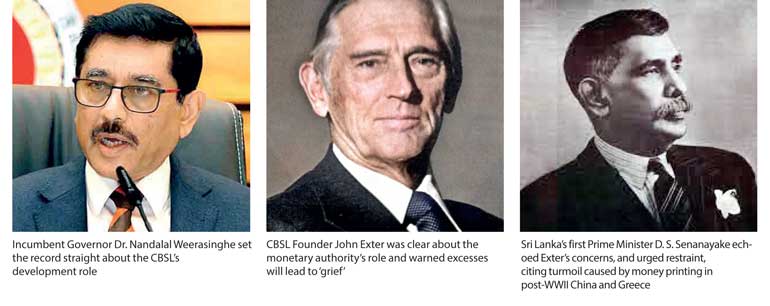

CBSL does not promote growth?
Central Bank of Sri Lanka (CBSL) Governor Dr Nandalal Weerasinghe is reported to have stirred up a hornets’ nest when he had, quite correctly of course, firmly remarked that “I want to make it clear: CBSL does not promote economic growth” in answer to a question from the press when the bank’s Economic Policy Review for 2025 was unveiled to the public recently [1].
Immediately, several high-ranking citizens of the country approached me with the simple question whether I would endorse the controversial stand, according to them, of the Governor. My response was in short, ‘Yes’ but for a long explanation, they should refer to two previous articles which I have published in this series on the issue [2].
Old CBSL’s two objectives
This controversy about the Central Bank’s development role is not a new one. This is because ever since the bank was established in 1950, the general understanding of the public was that the Central Bank must promote economic growth.
That had been engrained in their mind due to the misreading of the objective provisions in the now repealed Monetary Law Act or MLA under which the bank was established. MLA was the fine work of John Exter, a Vice President of the Federal Reserve Bank of New York at that time who functioned as a one-man commission to frame a law for the establishment of a central bank in Ceylon.
His report containing a draft law for the establishment of the Central Bank, with commentaries to explain why those provisions have been suggested, is known as the Exter Report [3]. Exter had proposed four objectives for the new Central Bank which were conventionally listed by later analysts under two main frames called the stabilisation objective and the development objective just for ease of understanding.
Misconstrued development objective
Under the stabilisation objective, the Central Bank was required to stabilise the domestic value of the rupee, or maintain inflation at zero value, and preserve the external value of the rupee or keep the exchange rate at a stable level.
 Under the development objective, the bank was required to promote and maintain a high level of production, employment, and real income in the country, on one side, and encourage and promote the full development of its productive resources, on the other.
It is these two development objectives of the Central Bank which have been misconstrued by many.
Exter qualified that the Central Bank should attain them through monetary action [4]. Monetary action is what the bank does to influence the money stock, commonly known as ‘monetary policy action’. It involves the regulation of the cost of money or interest rates and the availability of money in which money is supplied to the economy by influencing credit levels. Thus, the bank was required to promote economic growth not by directly getting involved in economic activities but indirectly by changing interest rates and credit levels.
Exter’s warning about uncritically adopting Keynesian policies
Exter also warned that printing more money and expanding more credit, which are efficacious policies in developed economies, known as Keynesian stimulating policies, should not be uncritically adopted in an under-developed economy like Sri Lanka which is heavily dependent on foreign trade for economic prosperity [5].
In the first interview which Exter had after the Central Bank was setup, Exter further clarified this point by declaring that the bank’s role was to create the necessary monetary conditions for economic activities to take place and not by producing goods and services by itself [6]. Hence, even in the old MLA, the development objective of the Central Bank was an indirect policy action that created a conducive environment for economic development in the country.
Wisdom of the first PM of Independent Ceylon
When the Central Bank was declared open on 28 August 1950, the then Prime Minister, D. S. Senanayake, echoed this view of Exter when he warned the newly formed bank not to follow Greece or China which had run into problems in the post-World War II years by printing more money than necessary and advised it to be frugal in its policy action [7].
 He is reported to have demonstrated his foresight and wisdom when he had declared: “There are some I know who think that we should not have established the Central Bank. It is true that our experience in the realms of so-called high finance has been brief. We made our decision to establish the Central Bank deliberately and with the full realisation of its great possibilities for harm as well as its great possibilities for good. We were fully aware that central banks have been abused in many countries in the past. We need only to remind ourselves of how excessive use of Central Bank credit reduces the real value of the currency and results in the dissipation of foreign exchange reserves as did in countries like China and Greece after the war”.
Failure to understand DS’ warning
It seems that this wise counsel coming from the country’s first Prime Minister failed to go into the heads and hearts of fellow Sri Lankans.
Hence, they have been chanting, like a Mantra, that the role of the Central Bank is to actively participate in the production of goods and services, and thus, misinterpreting the provisions in the MLA that the bank should ensure a high level of production and full utilisation of the country’s productive resources.
During my time in the Central Bank, I have sat on many recruitment interview panels for new officers to the bank. I have observed that almost all of them, despite their excellent academic qualifications in economics, wished to join the Central Bank because they believed it was the Government institution responsible for the growth of the economy. By joining the bank, they wanted to be a part of that important policy team. They cannot be blamed for this wrong view of the Central Bank because that was how they had been brainwashed by their school teachers. At the universities, instead of erasing this wrong view about the Central Bank from their minds, it had been firmly reinforced! As a result, the bank had to laboriously de-educate and re-educate the newly recruited officers about the true functions of the Central Bank.
Politicians using free CBSL money
This misunderstanding about the functions of the Central Bank is not limited only among students and ordinary citizens. Even the political masters of the country believe that it is the duty of the Central Bank to supply the needed money for the Government to finance its budget and undertake its capital expenditure programs.
This was indeed facilitated in the old MLA which permitted the Central Bank to buy Treasury Bills from the primary auctions and supply the needed cash to the General Treasury. At a time when the Central Bank was the sole banker to the Government, this was a necessary function since the duty of the banker is to supply liquidity to the customer through temporary overdraft facilities.
 In the absence of any other provider of this facility to the Government in the early 1950s, Exter provided for the Central Bank to grant a liquidity facility to the Government called Provisional Advances, a revolving credit facility like an overdraft facility granted by a commercial bank to a customer.
The objective of this facility was to help the Government wade through the liquidity shortages between the realisation of revenue and incurrence of Government expenditure. But this facility was limited by Exter to 10% of the estimated revenue of the Government for the forthcoming year and only for six months.
The reasoning he adduced to this limited facility was that it would not be advisable for a central bank to provide unlimited amounts of funds to a government since it could lead to grief [8].
Thus, finance ministers were required to use this facility with caution as also warned by then Prime Minister D. S. Senanayake at the opening of the bank. However, in practice, all finance ministers abused this facility as a permanent source of an interest free loan facility to finance the Government Budgets.
In the new Central Bank Act, both the purchase of Treasury Bills from the primary market and the provision of Provisional Advances have been removed. Both these facilities are not necessary today when the commercial banking system has developed to a high level enabling it to function as the banker to the Government.
In fact, both State banks provide this service to the Government today. Since there is a cash surplus held by the Government with these two State banks, it could use that money to finance capital expenditure programs instead of using Central Bank financing. Under the old MLA, it was the invisible hand of the Finance Minister which guided the Central Bank’s action. This was considered a deficiency since that invisible hand had led to continued price increases and thereby reducing the real value of the rupee.
 Enactment of new Central Bank Act
This state of affairs was corrected in September 2023, when Sri Lanka abolished its decades-old Central Bank by repealing MLA and established a new-look one by enacting the Central Bank of Sri Lanka Act (CBA) No. 16 of 2023. In CBA, the invisible hand of the Finance Minister alleged to have influence over monetary policy operations has been removed. This can be considered a move in the right direction since two previous attempts at doing so in 2004 and 2017 had been aborted. However, following the economic crisis that crippled the economy in 2022, Sri Lanka sought an Extended Fund Facility (EFF) from the IMF and one of the conditions of the package was the introduction of a legislation to remove the existing Government controls over the Central Bank and permit it to conduct only what it should do, namely, the maintenance of price stability as the main objective and ensuring financial system stability as the ancillary objective. Thus, in the new CBA, there is no provision for a development role for the Central Bank.
Some arguing for repealing new CBA
Certain sections in the country are now arguing that the Government should abolish CBA and go back to a Central Bank guided by the old MLA [9]. This claim is made again due to a misunderstanding of what a central bank can do and what it cannot do.
A central bank could only supply money through its monetary policy action and money is simply a nominal asset which is in the minds of people. Economic growth comes from the development of real assets like real goods and services. That should be done by economic agents who have access to real resources, such as businesses and even governments.
Central Bank’s monetary policy, by stabilising prices in the economy, will create the necessary conditions for these economic agents to participate in real economic activities. Price stability at low levels will fix interest rates at low levels, thereby helping economic agents to invest and attain real economic growth. However, price stability or low interest rates alone do not guarantee that the economic agents will be persuaded to invest in the production of real goods and services.
 A necessary condition for that is ease of doing business so that economic agents could realise the maximum gains out of their investments. That comes from economic reforms, and such reforms are necessary for the country to attain its real economic growth. The Central Bank cannot steer economic reforms in the country and that is the task of the Government which has powers to do so.
What the Central Bank can do is only advising the Government on the need for continuing with economic reforms and making doing business in the country easy. That job is being done by the Central Bank today effectively. If the Government fails to accede to this advice, economic growth, despite low inflation, is a non-event.
With nominal policy powers, CBSL cannot promote growth even if it wants to do so
Under the old MLA or under new CBA, there is no direct role for Central Bank to promote economic growth. That is a task of the Government and other economic agents. The Central Bank will facilitate faster economic growth by keeping inflation at a low level. Hence, Governor Weerasinghe was correct when he said that it is not the Central Bank task to promote economic growth. Even if it wants to do so, with its nominal policy powers, it cannot do so.
(The writer, a former Deputy Governor of the Central Bank of Sri Lanka, can be reached at [email protected] )
(Endnotes)
1 https://www.ft.lk/front-page/I-want-to-make-it-very-clear-CBSL-does-not-promote-economic-growth-Governor/44-791876
2 Available at: https://www.ft.lk/columns/Economic-development-role-of-Central-Bank-under-new-Central-Bank-Act-Part-I/4-777736 and https://www.ft.lk/columns/Development-role-of-Central-Bank-under-new-Central-Bank-Act-Part-II/4-778025
3 Can be downloaded from: https://www.cbsl.gov.lk/sites/default/files/cbslweb_documents/about/Exter%20Report%20-%20CBSL.pdf
4 Exter Report, p 10.
5 Ibid, p 28.
6 See, Wijewardena, W A, 2017, Central Banking: Challenges and Prospects, BMS Publications, Colombo, p 20.
7 See for details: https://echelon.lk/sri-lankas-tragedy-and-the-lost-wisdom-of-d-s-senanayake-on-greece-and-china/
8 Exter Report, p 43.
9 See: https://www.ft.lk/columns/Why-the-Central-Bank-Act-should-be-significantly-amended-by-a-future-Sri-Lankan-government-Part-I/4-755488 and https://www.ft.lk/columns/Why-the-Central-Bank-Act-should-be-significantly-amended-by-a-future-Sri-Lankan-government-Part-II/4-755659




