Saturday Sep 26, 2026
Saturday Sep 26, 2026
Saturday, 26 September 2026 00:00 - - {{hitsCtrl.values.hits}}
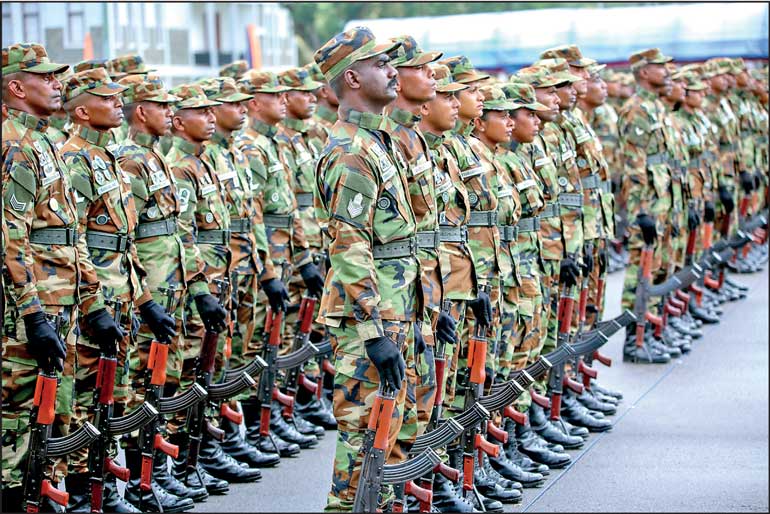
Military involvement in law enforcement raises concerns regarding accountability as well
 First, the good news. The second iteration of the Protection of the State from Terrorism Bill (PSTB2), the law to replace the Prevention of Terrorism Act (PTA), has addressed certain shortcomings in the previous version (PSTB1).
But there’s bad news. The current Government, like past Governments, seems determined to cling to repressive provisions that do not adhere to human rights standards.
Why would a Government that won the election on a mandate of ‘system change’ refuse to ensure that proposed laws adhere to human rights standards? Could it be because the Government plans to engage in lawfare, i.e. instrumentalise the law to exercise greater control of public space and civic activity and stifle dissent?
Definitional deficiencies: Failing at the fundamentals
PSTB2 was issued on 22 September 2026. The definition of terrorism forms the foundation of any counter terrorism law as it determines whether an act can be considered terrorism. While the previous drafts to replace the PTA deviated from the UN Special Rapporteur on Human Rights and Counter Terrorism’s model definition, the current draft adheres to nearly all elements of the SR’s revised model definition presented in 2025. However, it fails on one critical aspect as it includes a broad range of acts, such as damage to public property, the environment, cultural property, electronic systems and acts that create risk to public health, that can constitute terrorism. The Special Rapporteur has specifically stated they do not ‘recommend including acts endangering life or harm to property in an international definition’ (of terrorism).
Since these acts are already offences in some national contexts, the Special Rapporteur proposes safeguards/limits to the acts to prevent them being abused. For instance, where the destruction of public property is concerned, it must be action that ‘intentionally causes a high likelihood of danger to life or major economic loss’. In all examples set out by the SR, two elements are constant- intentionality and the high likelihood of danger to life or major loss. Intentionality is missing in PSTB2, which also does not require the likelihood of danger to life to be ‘high’ or the loss to be ‘major’.
Offences such as aiding and abetting or inducement or dissemination of terrorist publications flow from the definition of terrorism. Therefore, when the definition casts a wide net where acts that constitute terrorism are concerned, those who should be tried for non-terrorist offences can be tried for terrorist offences.
An unwavering commitment to militarisation
Like previous drafts, PSTB2 confers all arrest and search powers the police possess to the armed forces and coast guard. The section that allowed a member of the armed forces or coast guard to arrest persons on ‘reasonable suspicion’, conduct searches without warrants, stop-and-searches, to “take into custody” any material they want, and most worryingly - question people, remain in PSTB2. The armed forces are not trained in law enforcement and have no knowledge of the Penal Code, the Code of Criminal Procedure, or how to follow due process. Hence, their understanding of the kind of action that constitutes ‘reasonable suspicion’ would be limited at best. The section that sets out the circumstances in which the armed forces can arrest persons and the process to be followed does not require them to abide by the new due process safeguards in sections 21 and 22 to which the police have to adhere. Therefore, invasive searches of people’s home and arbitrary arrests, among other violations, are quite likely to take place.
The section in PSTB1 that required the police and the armed forces ‘to take any measure as may be appropriate’ to prevent offences from being committed has been retained. This is a broad, limitless power that can be arbitrarily used to curtail legitimate activities. Similar to PSTB1, PSTB2 too empowers a police officer to obtain the assistance of the military to arrest or take a person to the police station; the rank of the police officer who has the power to make such a request, nor the criteria/reasons for requesting assistance have been stipulated.
Military involvement in law enforcement raises concerns regarding accountability as well. The Department of Police, which is within the purview of the Public Security Ministry will be responsible for implementing the new anti-terror law. At the same time. the military will be involved in similar activities under the same law. PSTB2 does not stipulate whether the military will receive orders from and be accountable to the Public Security Ministry and the Inspector General of Police (IGP), or the Commanders of their force and the Defence Ministry. This can lead to broken or even non-existent chains of command: turning the current culture of impunity into a legalised state of impunity.
Administrative detention: more of the same
In PSTB2, like in PSTB1, when a detention order (DO) is placed before a magistrate, the magistrate has no power to inquire into the necessity to issue a DO or refuse to give effect to it. In PSTB2, if the police do not have a DO the magistrate must remand the person. In PSTB1 the police had to request the Magistrate to remand the person and if magistrate was satisfied there were no grounds to remand the person, the Magistrate could release the person on bail. PSTB2 takes away the power of the Magistrate to decide whether a person must be remanded or can be released on bail or discharged. The Bill, which makes the initial two month period of detention mandatory, undermines judicial authority. Judicial oversight of detention, an integral safeguard in the criminal justice process to ensure due process is followed and arbitrary detention is prevented has been disregarded.
As in the PSTB1, in the current draft too a DO can be issued by the Secretary to the Defence Ministry. In the PTA, a DO is issued by the Defence Ministry.
The initial period of detention under a DO is two months, which can be extended up to a year by the High Court (not the Magistrate as in previous draft). If the extension of a detention order is refused by Court, the Court is still required to either remand the person or release the person on bail. If there aren’t adequate reasons to extend the detention order why should the person be remanded, i.e. detained in prison rather than in police detention? Likewise, if there aren’t enough reasons to detain the person in police or prison custody, why does the Bill prevent the Court from discharging the person (ending the legal proceedings related to the person) and instead require the person to be released on bail?
Section 29 (2) states a person should not held in remand for more than a year from the date the person was remanded. But section 29 (3) states the High Court shall release the person on bail if an indictment has not been filed within one year. Hence, the person can be released on bail only if an indictment has not been filed within a year. Since there is no other provision in the Bill on the granting of bail, it means a person who has been indicted will be remanded until the conclusion of the trial.
PSTB2 establishes an ‘Independent’ Review Committee tasked with reviewing the appeals made by persons detained under a DO challenging the detention. The Committee is empowered only to recommend the revocation of a DO and their recommendation may be rejected by the Minister. Since the Committee is appointed by the Minister and its recommendations may be rejected by the Minister it cannot be considered independent.
Section 51 allows the police to obtain an order from Magistrate to prevent certain acts, including not congregating in a place, not holding a meeting or not engaging in an unspecified activity. However, if it is a matter of urgent national security the police can issue the order without a Magistrate’s order and obtain subsequent approval within 24 hours. Allowing post-facto approval compels the Magistrate to approve the order.
Like PSTA1, PSTA2 empowers the Attorney General to defer criminal proceedings or suspend prosecution for not more than 20 years, with the sanction of the High Court, if the person agrees to certain conditions, such as publicly expressing remorse and apologising using a text issued by the Attorney General. In instances prosecution is suspended, although the Bill states the conditions imposed do not require the person to admit guilt, the conditions include the expression of remorse or issuing an apology and providing reparation to the victim. If the person has not been convicted and is not required to admit guilt, then why is the person expressing remorse or apologising and providing reparations?
Persons may feel compelled to de-facto accept guilt to avoid protracted decades long trials like under the PTA regardless of culpability. Under PSTB2 the Attorney General exercises judicial authority. This dilutes the power of the judge, who is not empowered to conduct an independent scrutiny of the evidence, or evaluate the necessity and proportionality of the conditions imposed but is limited to only approving an arrangement decided by the Attorney General.
Promise to abolish executive presidency vs Expanding the powers of the executive
PSTB2, similar to PSTB1, empowers the President to proscribe an organisation if he ‘has reasonable grounds” to believe that any organisation is engaged in any act amounting to an offence under this law’. The second ground on which PSTB1 allowed the President to proscrive an organisation, i.e. “acting in an unlawful manner prejudicial to the national security of Sri Lanka or any other country” has been removed.
Proscription imposes prohibitions on recruiting members, conducting meetings and programs, entering contracts, using bank accounts, raising funds or receiving grants. It also prohibits lobbying and canvassing on behalf of the organisation, which can be construed to include lobbying to lift the proscription of the organisation. PSTB2, like PSTB1, does not impose a time limit for the order. There are no transparent processes or objective criteria stipulated for the proscription, nor for evidence that has to be presented to justify the order. The appeal against the proscription is to be made to the President; the person who prescribed the organisation, or to the Court of Appeal.
Restriction Orders (ROs) can be issued under the PSTB2 in the same manner as in PSTB1; by a Magistrate upon an application made by a police officer not below a DIG, if he has reasonable grounds to believe that a person has committed, or is making preparation to commit an act of terrorism or poses a credible and serious risk of committing an offence. The restrictions that can be made as part of the order in PSTB2 are specific. They include probition on travel to specific areas, requirement to report to police at stipulated intervals, restrictions on communication with persons or entities reasonably believed to be connected to an offence under the Act and other conditions the Magistrate may deem necessary.
The order is issued for three months at a time but the Bill does not state the maximum period for which ROs can be issued. This may be because there are various criteria the Magistrate has to take into account when making a decision to issue a RO, i.e. guardrails to prevent abuse of the Order. However, the lack of a time limit creates the danger of the RO being issued for months or even years without the person being charged. Historically, restriction orders have had a devastating impact on the lives of those subject to them, with charges rarely being brought against the persons.
The Secretary to the Ministry of Defence (as opposed to the President in the ATB and the Minister in the CTB), based on credible material, can declare any location that is suspected of being used to commit or is likely to be used for the commission or preparation of the commission of an offence under this Act as a prohibited place. The order is valid for 72 hours and requires a magistrate’s order to be extended. There is no maximum period the order can be in force mentioned.
The law also gives the President the power to issue directions pertaining to the way in which the Act shall be enforced, thereby giving law making powers to the President, which impinges on the legislative powers of Parliament.
The past bleeds into the future
In cases where the offence was committed prior to the commencement of the new law and proceedings have not been instituted, the person shall be prosecuted under the repealed law. This means that if the evidence includes a police confession, one of the most egregious sections in the PTA that has enabled torture, it will be included in the trial. Given PSTB2 states that the Attorney-General can choose to defer or suspend proceedings against a person using the new law, there is no reason not to exclude police confessions from the trial even if they were obtained prior to the commencement of the new law.




