Sunday Sep 13, 2026
Sunday Sep 13, 2026
Tuesday, 21 July 2026 06:51 - - {{hitsCtrl.values.hits}}
 Business autobiographies often follow a familiar pattern. They recount the milestones, the setbacks and inevitably, the success that followed. Made in Nepal certainly does all of these things. Yet what surprised this reader most was that it is not really a book about becoming Nepal’s first dollar billionaire. Instead, it is a reflection on what it means to build something enduring from a place the world has too often overlooked.
The book begins, as many family businesses do, with family itself. Chaudhary reflects on his family’s early years with a refreshing honesty, painting a picture of a Nepal that feels worlds away from today’s increasingly global economy. These opening chapters are among the book’s most engaging. They are personal, grounded, nostalgic and offer a glimpse into the values that would later shape one of South Asia’s most successful business groups.
From there, the story gathers momentum, demonstrating remarkable commercial foresight. Readers follow the evolution of a local enterprise into a global conglomerate, with Wai Wai noodles becoming the catalyst for a much larger journey across industries, borders and generations. Chaudhary refused to believe that geography should define ambition. The title Made in Nepal ultimately becomes more than a reference to place; it becomes a statement of confidence.
Gen Z’s have come of age in an era defined by rapid technological change, start-up culture and the pursuit of disruption. We are conditioned to measure success by speed and admire businesses that scale overnight and founders who redefine industries before the age of thirty. Made in Nepal presents a compelling alternative. It reminds us that some of the most meaningful businesses are built patiently, through decades of disciplined decision-making, calculated risk-taking and an unwavering commitment to the long term, irrelevant of political instability, economic uncertainty and changing markets. There is a quiet confidence throughout the book that success rarely follows a linear path. Instead, it is built incrementally, often through consistency rather than spectacle. For Gen Z readers accustomed to carefully curated stories of instant achievement, this perspective serves as both a refreshing reminder and an important reality check.
What stood out throughout the book was Chaudhary’s deep belief in family—not only as the foundation of his success, but also the future of the business itself. Chaudhary writes openly about the trust he places in each of his three sons, giving them the autonomy to lead their respective verticals while remaining their anchor. Chaudhry demonstrates succession planning that feels both timeless and progressive, reminding us that preserving a legacy is not about holding on too tightly, but about giving each generation the confidence, responsibility and space to leave its own mark.
The book focuses more on business philosophy rather than solely on the author’s personal life. Similarly, those expecting a step-by-step entrepreneurial guide may discover that the lessons are presented more through reflection than instruction. However, this is entirely consistent with the book’s purpose. It seeks less to provide formulas for success and more to encourage readers to think differently about building institutions that endure
Another theme that runs consistently throughout the book is identity. In an increasingly globalised world, businesses often feel pressure to distance themselves from their origins in pursuit of international relevance. Chaudhary takes the opposite approach. Rather than seeing Nepal as a limitation, he positions it as an integral part of the company’s identity. Through his own journey, Binod Chaudhary presents a narrative that extends beyond personal success, inviting readers to consider how resilience, ambition and identity can coexist in the making of a global enterprise. The message conveyed is that opportunity today is less about where one begins and more about the mindset with which one approaches the world.
Another noteworthy aspect of the memoir is its treatment of leadership. Rather than portraying leadership as authority or visibility, Chaudhary presents it as responsibility. Throughout the memoir there is a recurring emphasis on relationships, trust, adaptability and reliability—qualities that cannot be measured on a balance sheet and rarely dominate headlines but often determine whether businesses endure across generations. His reflections suggest that the true measure of leadership lies not simply in growing an organisation, but in creating one capable of outlasting its founder. To a generation that values authenticity, these lessons feel particularly relevant at a time when leadership is often measured by curated visibility rather than substance.
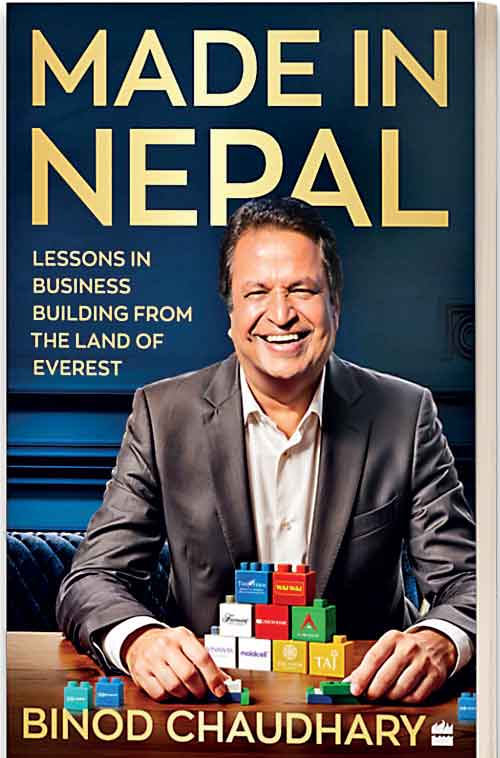
Cover of Nepalese billionaire and Chaudhary Group Chairman Binod Chaudhary’s latest book ‘Made in Nepal’
For Gen Z’s, many of whom increasingly aspire to lead organisations with both commercial and social impact, Chaudhry’s approach feels particularly relevant. The book subtly argues that profitability, sustainability and purpose can exist in unison. Long-term success emerges when businesses contribute meaningfully to the communities, employees and economies that support them.
If there is one observation to make, it is that the narrative occasionally moves too quickly through some of the Group’s defining milestones, leaving the reader wanting deeper insight into the strategic thinking behind its decision making. The book focuses more on business philosophy rather than solely on the author’s personal life. Similarly, those expecting a step-by-step entrepreneurial guide may discover that the lessons are presented more through reflection than instruction. However, this is entirely consistent with the book’s purpose. It seeks less to provide formulas for success and more to encourage readers to think differently about building institutions that endure.
Ultimately, Made in Nepal succeeds because it is not simply a memoir about one entrepreneur’s success. It is a thoughtful reflection on ambition, resilience and the quiet discipline required to build institutions that stand the test of time. Long after the financial milestones have faded from memory, what remains is a philosophy of building—one rooted in patience, integrity and an unwavering belief that world-class businesses can emerge from anywhere.
For a generation often encouraged to chase the next big thing, Made in Nepal is a timely reminder that there is equal value in building something that will still matter fifty years from now.
Binod Chaudhary will be a featured speaker and panellist at the Colombo Literary Festival 2026 on the 24 and 25 July 2026.
(The reviewer is a Director of the Galle Face Hotel and Galle Face Group Hospitality. She focuses on strategy, brand development and the long-term positioning of the Group’s hospitality portfolio. As part of a third-generation family business, she has a particular interest in leadership, legacy and institutional stewardship)




