Saturday Oct 03, 2026
Saturday Oct 03, 2026
Thursday, 4 December 2025 00:34 - - {{hitsCtrl.values.hits}}
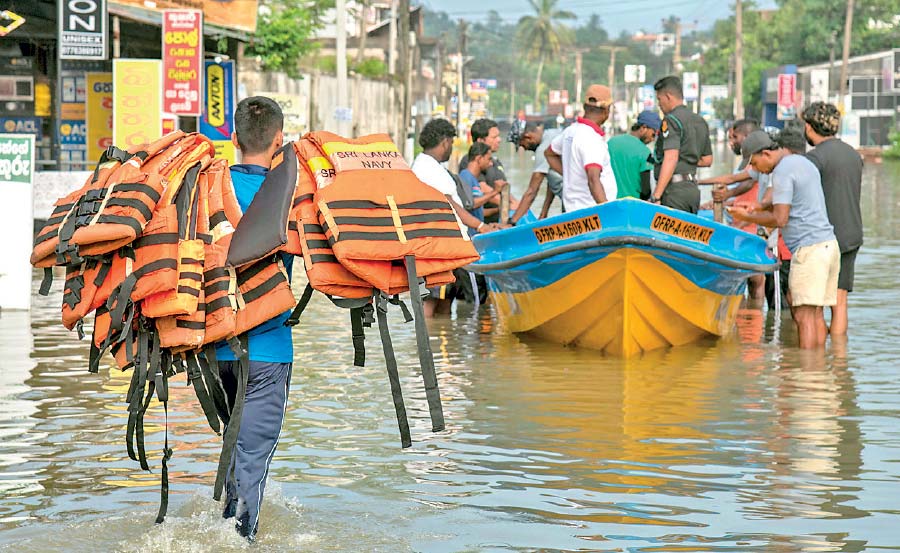
People engaged in relief work following Cyclone Ditwah - Pic by Ruwan Walpola
 What distinguishes this moment is not only the breadth of international support but the willingness of partners to coordinate through established government mechanisms rather than parallel channels. This ensures that aid flows directly into national systems aligned with Sri Lanka’s priorities and minimises duplication, waste, and logistical confusion
 A swift regional response in Sri Lanka’s hour of need
Sri Lanka is once again confronted with the harsh realities of nature’s fury. Cyclone Ditwah, intensified by days of relentless monsoon rains, has left the country grappling with a humanitarian emergency of vast proportions. Over 450 lives have been lost, while a similar number remain missing, with emergency officials warning that these figures could rise as rescue teams reach remote, landslide-prone areas. Entire communities have been swallowed by mud, bridges have collapsed, and thousands of displaced families await food, medicine, and clean water amid worsening health risks. The devastation has placed extraordinary pressure on national institutions already tested by economic and infrastructural challenges.
Yet amid this distress, Sri Lanka has witnessed a profound expression of regional goodwill. India was the first to respond, mobilising air and naval assets and deploying specialised rescue teams within hours of the disaster. Pakistan followed closely, dispatching naval and medical personnel who are now working alongside Sri Lankan authorities in some of the worst-affected zones. At the time of compiling this report, Bangladesh has also announced the deployment of a specialised rescue and medical team, with its contingent expected to arrive shortly along with urgently required material assistance. These regional commitments have not only strengthened Sri Lanka’s immediate response but reaffirmed the depth of neighbourly solidarity in South Asia.
Global support and financial commitments
Beyond the neighbourhood, several countries and international organisations have stepped forward. The United States has pledged $ 2 million to support immediate relief and recovery efforts, reaffirming Washington’s partnership with Sri Lanka in moments of crisis. China has announced emergency relief packages aimed at stabilising key sectors and helping restore essential services. The Maldives—despite its own vulnerabilities as a small island nation—has extended both material supplies and financial assistance. Other bilateral partners have expressed readiness to contribute through monetary pledges, equipment, and technical expertise, while multilateral agencies are conducting rapid assessments to determine Sri Lanka’s medium-term requirements.
What distinguishes this moment is not only the breadth of international support but the willingness of partners to coordinate through established government mechanisms rather than parallel channels. This ensures that aid flows directly into national systems aligned with Sri Lanka’s priorities and minimises duplication, waste, and logistical confusion.
Government prioritisation and a unified national approach
The Government has acted promptly by prioritising reconstruction and establishing a high-level committee chaired by the Labour Minister with the Foreign Affairs Ministry playing a central role. This is both timely and strategic. The participation of the foreign ministry ensures that Sri Lankan diplomatic missions abroad remain key conduits for coordinating relief, negotiating support, and following up on international commitments.
Equally important is the decision to channel all foreign-remitted disaster-relief funds to the Central Bank. A unified financial mechanism strengthens accountability, simplifies monitoring, and enables the state to deploy resources based on real national needs rather than donor preferences or dispersed domestic efforts. This is a welcome contrast to the post-tsunami period, when multiple accounts and intermediaries created confusion and weakened public trust.
This moment offers Sri Lanka an opportunity not only to rebuild but also to strengthen institutions and reaffirm its commitment to transparent governance
Lessons from the Tsunami: avoiding past mistakes
The memory of the 2004 Tsunami remains vivid in the nation’s collective consciousness. Having served during that period, I recall personally handling 165 high-level foreign visits as Chief of Protocol—an unprecedented wave of international attention and expressed solidarity.
The first lesson from the Tsunami is the need to prevent Sri Lanka from becoming a dumping ground for unsuitable or unnecessary items. After the Tsunami, consignments of teddy bears, winter jackets, expired medicines, and assorted goods arrived—many irrelevant to the local context or even inimical to national security. These shipments strained logistics, consumed storage space, and diverted attention from essential relief distribution. Today, material assistance must be screened carefully, coordinated centrally, and matched to identified needs on the ground.
The second lesson concerns pledges. Following the Tsunami, the world promised generously, but many commitments remained symbolic and did not translate into meaningful assistance. Diplomatic visits brought assurances, yet only a fraction materialised into funded projects or sustained support. This is not uncommon in international humanitarian response, but Sri Lanka must be pragmatic. Distinguishing between goodwill gestures and actionable commitments is vital. Formal agreements, structured follow-up, and diligent diplomatic engagement must accompany major pledges.
The third lesson is the importance of transparent accounting. After the Tsunami, shortcomings in financial tracking and documentation undermined public confidence and impeded long-term planning. Today, Sri Lanka has access to digital platforms, real-time dashboards, and modern audit mechanisms. These tools must be utilised fully to ensure every rupee and every relief item is recorded, audited, and publicly reported. Strong financial governance not only protects public trust but reassures international partners whose continued engagement will be essential for recovery.
While the immediate focus remains on lifesaving operations, the country will soon transition to recovery and reconstruction. Sri Lanka’s diplomatic missions abroad will continue to play a central role in sustaining international engagement during this transition
Welcoming genuine assistance and rejecting waste
As relief flows in, Sri Lanka must embrace genuine assistance while maintaining disciplined stewardship. Not all items sent in goodwill are useful, and not all pledges result in material outcomes. Clear communication of priority needs—shelter materials, medical supplies, potable water, engineering support, and logistics—will help guide donors toward meaningful contributions and avoid unnecessary inflows.
This disciplined, needs-based approach serves both Sri Lanka and its international partners. It ensures that their contributions have real impact and that Sri Lanka’s limited logistical capacity is not overwhelmed by unsuitable donations.
As relief flows in, Sri Lanka must embrace genuine assistance while maintaining disciplined stewardship. This disciplined, needs-based approach serves both Sri Lanka and its international partners
Reconstruction and the road ahead
While the immediate focus remains on lifesaving operations, the country will soon transition to recovery and reconstruction. Restoring homes, livelihoods, and essential infrastructure will require substantial resources and careful planning. Future preparedness must be strengthened through improved early-warning systems, resilient urban planning, environmental restoration, and stronger community-level disaster-response mechanisms.
Sri Lanka’s diplomatic missions abroad will continue to play a central role in sustaining international engagement during this transition. Partnerships with UN agencies, development banks, and regional institutions will be indispensable. If effectively managed,
international support can help the country build back stronger and better equipped for future climate-driven disasters.
Amid this distress, Sri Lanka has witnessed a profound expression of regional goodwill
Relief with responsibility
Sri Lanka has received an outpouring of generosity from neighbours and the wider international community. But with generosity comes responsibility. Managing foreign assistance wisely—welcoming what is needed, rejecting what is not, ensuring accountability, and safeguarding national interests—is the surest way to honour this goodwill.
This moment offers Sri Lanka an opportunity not only to rebuild but also to strengthen institutions and reaffirm its commitment to transparent governance. By applying the lessons of the tsunami era, the country can ensure that relief is delivered responsibly and that recovery becomes a foundation for lasting resilience. Compassion must be matched with competence, and gratitude with accountability.
If Sri Lanka succeeds in doing so, this tragedy will become more than a test of endurance. It will become a turning point toward a more prepared, more resilient, and more unified nation.
(The author is a former Chief of Protocol, Ministry of Foreign Affairs.)
References
Reuters – Cyclone Ditwah updates and casualty reports, Nov–Dec 2025.
The Guardian – Flooding and regional climate impacts in Sri Lanka, Dec 2025.
Times of India – Reporting on India’s rescue deployments.
Dunya News – Coverage of Pakistan Navy vessel PNS Saif and humanitarian assistance.
EconomyNext – Updates on India, Pakistan, and Bangladesh support.
U.S. Embassy and State Department releases – Announcement of USD 2 million assistance.
Sri Lanka Disaster Management Centre – Situation updates and official figures.



