Friday Oct 30, 2026
Friday Oct 30, 2026
Friday, 30 October 2026 00:25 - - {{hitsCtrl.values.hits}}


What does regeneration mean?
On 31 October, World Cities Day 2026 will focus on “Regenerating the City: Adequate Housing for All.” For Colombo, the theme raises a central question: has the city merely grown and modernised—or is it actually regenerating?
Colombo has more homes, improved services, comparatively stronger infrastructure and increasingly valuable land. Yet these achievements do not automatically make the city more affordable, inclusive, accessible or resilient. Regeneration means renewing the connected systems of housing, neighbourhoods, infrastructure, ecology, mobility and opportunity—so that the people who live and work in the city share in the value created by urban change.
The test is therefore not whether Colombo is becoming bigger and more valuable, but whether it is becoming better to live in—and better able to support the people who depend on it.
Colombo’s housing transformation
Colombo District has experienced remarkable housing progress. Occupied housing increased from approximately 272,000 units in 1981 to 654,000 in 2024. By 2024, 98.6% of houses were permanent, 97.2% had drinking water within the unit, 98% had national-grid electricity, and 95.5% had exclusive sanitary facilities. 85.5% of households used LP gas.
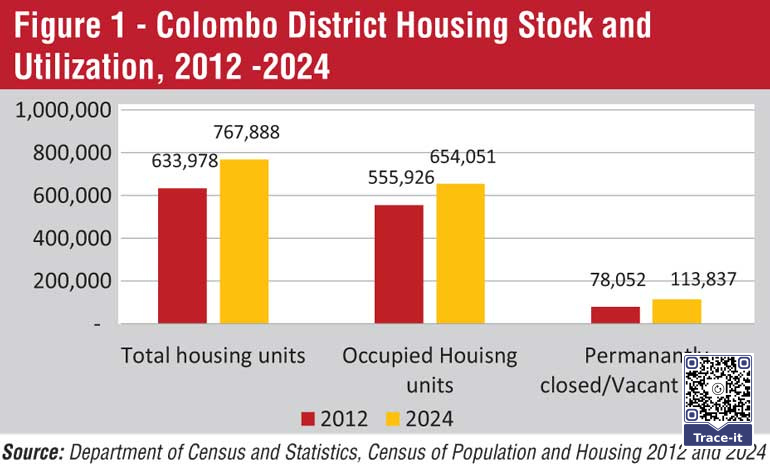
Housing is also becoming more intensive: single-storey houses account for 54.4%, multi-storey houses 32.1% and apartments 13.4%. Between 2012 and 2024, total housing units rose from approximately 634,000 to 768,000, while occupied units increased from 556,000 to 654,000.
Colombo has moved beyond simply producing more dwellings. The next challenge is ensuring that homes are affordable, well located, suitable, and connected to jobs and services.
More housing, greater pressure
The growing stock has created a paradox. Between 2012 and 2024, total housing units increased by 21.1%, occupied units by 17.7%, but vacant or permanently closed units by 45.8%—from 78,052 to 113,837. Their share rose from 12.3% to 14.8% (Figure 1).
The question is therefore whether supply matches effective demand—in price, location, tenure and suitability. An earlier Western Province analysis estimated that Colombo alone could have had approximately 101,600 excess or vacant units by 2015, partly linked to investment demand and second or third homes.
Greater density does not automatically mean greater affordability. National HIES evidence shows housing expenditure represented 26.67% of non-food expenditure among Colombo District households in 2019. Rising land values and construction costs have increased the entry cost for first-time buyers and put pressure on low- and middle-income households. Formal finance can assist those with income and credit access, but may widen exclusion.
Internationally, adequate housing includes security of tenure, services, affordability, habitability, accessibility, suitable location and cultural adequacy. Colombo has improved physical housing conditions, but affordability, location, and access to opportunity remain under pressure.
Land values intensify the pressure
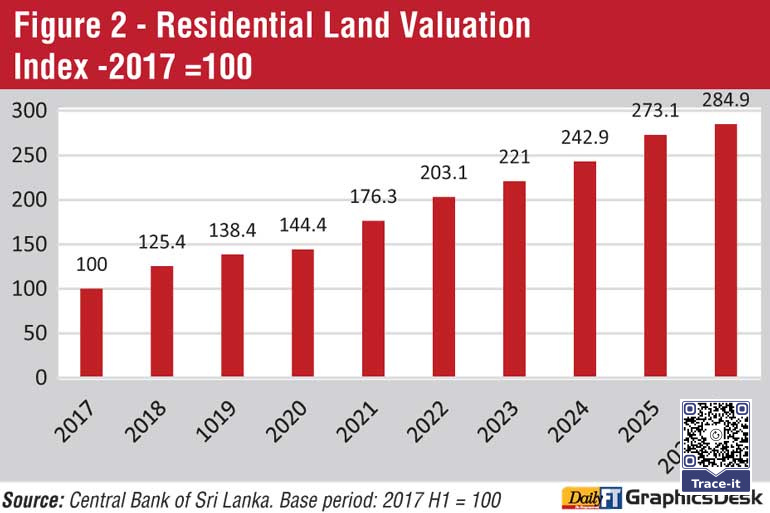
The CBSL Residential Land Valuation Index for Colombo District, with 2017 H1 = 100, rose from 176.3 in 2021 to 221.0 in 2023 H2, 242.9 in 2024 H2, 273.1 in 2025 H2 and 284.9 in 2026 H1—placing the latest index 184.9% above its 2017 H1 base (Figure 2).
As land becomes more valuable, households face difficult choices: pay more, accept smaller or denser housing, or move farther from the city. Moving outward may reduce housing costs, but it can increase commuting time, transport expenditure, and distance from employment, services, and opportunity.
This is not merely an affordability issue. It is a regeneration issue. A city cannot be regenerative if economic growth raises land values while displacing people who depend on the city for employment and daily life. Housing can become more valuable as an investment for those who can afford it, while becoming less affordable as a home for those who need it most.
Adequate housing beyond the front door
Adequate housing does not end at the front door. Location, public space, green-blue infrastructure, services, access to employment and the conditions of daily life all determine whether a home supports a decent urban life.
Colombo has made progress in parks, recreation and the use of wetlands as public assets. More than 20 km of walkways and jogging paths have been developed around Colombo’s wetlands. The Colombo Municipal Council provides 32 city playgrounds, 33 children’s playgrounds and 52 community centres.
Yet provision is not the same as access. Evidence indicates that 373 of 557 Grama Niladhari divisions had no public playground within the division, while 73 were 5 km or more away. For children’s parks, 420 divisions had no facility within the division, with 145 located 5 km or more away. Colombo can therefore expand its overall stock of facilities while neighbourhood-level access remains uneven.
A study of Colombo city’s 47 wards found that green cover declined from 35.67% in 1956 to 22.23% in 2010—a reduction of 13.44 percentage points. Colombo is also becoming more vulnerable to flooding: a recent assessment classified 13.64% of the study area as extremely high flood hazard, with built-up land accounting for approximately 85.6%, compared with 6.5% wetlands and 3.7% tree cover. The Colombo Wetland Complex has declined from approximately 47.5 km² in the 1980s to about 19 km² today.
These figures do not mean that urbanisation alone explains flooding. They do show why natural water-retention areas, expanding impervious surfaces and drainage pressure must be treated as housing and urban-planning concerns—not merely environmental issues. Wetlands and vegetation help protect homes, roads, livelihoods and public investment
Residents, merchants, shopkeepers, property owners, institutions and local authorities should be regarded as partners in maintaining and improving urban precincts. Cleaner streets, shaded walkways, greener commercial areas, pocket parks and well-maintained public spaces can become shared assets. A regenerative city therefore requires collective responsibility, not municipal action alone.
International experience offers concise lessons. Melbourne uses neighbourhood-level urban-forest planning and community participation, while Singapore links parks, waterways and nature corridors with precinct partnerships and shared stewardship. These models should be adapted to Colombo’s own environmental, institutional and social conditions rather than copied mechanically.
Mobility adds another dimension. A lower-cost home farther from employment may reduce housing costs but increase transport expenditure, commuting time and the time available for family and community life. Workforce Mobility Management (WMM) makes this relationship visible: the true cost of housing includes the time and money required to reach work, education, healthcare and essential services.
Adequate homes need adequate neighbourhoods—green, clean, connected, accessible and environmentally resilient.
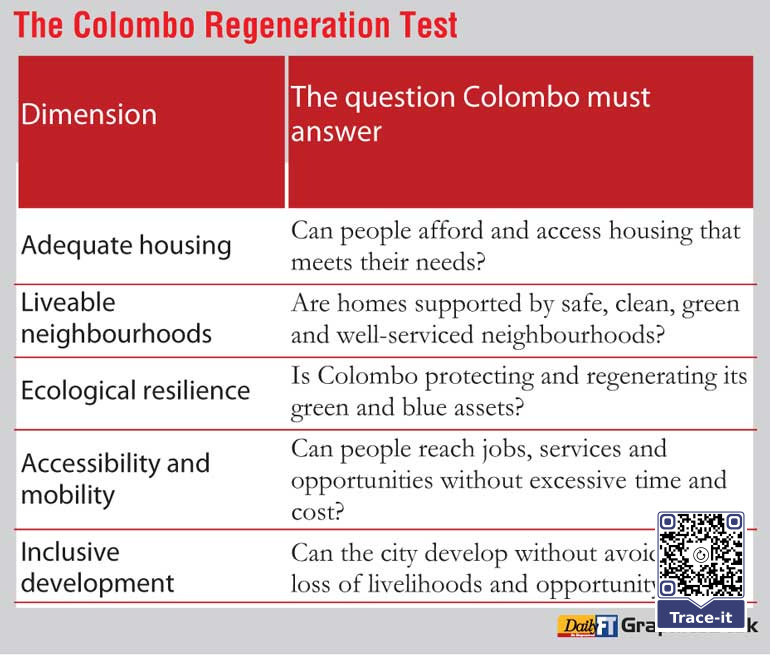
Is Colombo becoming regenerative?
The evidence is mixed. Colombo has improved housing quality, basic services, infrastructure, public spaces and parts of its wetland system. But rising land values, vacant housing, affordability pressures and unequal access to neighbourhood facilities show that regeneration is not benefiting every part of urban life.
The pattern is therefore uneven regeneration. Buildings and infrastructure are improving faster than affordability, access, environmental recovery and social inclusion.
Regeneration must also protect livelihoods. Shops, vendors, carts and other activities may sometimes need relocation for valid reasons such as safety, congestion or planned land use. However, the process should be transparent, reduce hardship, provide workable alternatives and apply rules fairly. Urban improvement should not cause avoidable loss of livelihood. Housing affordability also depends on location. A cheaper home farther from employment may reduce the initial housing cost but increase transport expenses and commuting time. The real housing burden includes land, house price, rent, finance, transport, and time. This connects housing and location with Workforce Mobility Management (WMM). Moving economic activity away from viable locations can also move people farther from their sources of income.
The deeper issue is whether urban growth creates public value. A regeneration dividend should mean affordable housing, better use of vacant units, lower travel costs, fair access to public space, restored wetlands, lower flood risk and protected livelihoods. What is not measured is unlikely to be protected or improved
On this basis, Colombo is regenerating—but unevenly. A regeneration dividend should be visible in affordable housing, better use of vacant units, lower travel costs, fair access to public space, restored wetlands, lower flood risk and protected livelihoods.”
Colombo’s next agenda
Colombo need not choose between development and regeneration. The challenge is to make development itself regenerative—creating economic value while improving housing, neighbourhoods, environmental quality and access to opportunity.
Put affordability at the centre of planning: Consider land values, rents, construction costs, household incomes and finance together.
Use existing housing better: Expand affordable rental options and return suitable vacant units to productive use.
Connect housing, land use and mobility: Measure not only dwelling price but also the time and cost of reaching employment, education and essential services.
Regenerate neighbourhoods and livelihoods, not just buildings: Integrate housing investment with transport, drainage, sanitation, public spaces and green-blue infrastructure, while recognising the locations on which small businesses and daily-income activities depend.
Make regeneration participatory: Residents, merchants, property owners, businesses, institutions and local authorities should share responsibility for creating cleaner, greener and better-maintained precincts. Residents should be partners in shaping and sustaining regeneration, not merely its beneficiaries.
Cities must change, and redevelopment will sometimes be necessary. But change should be strategic, transparent and inclusive—improving the urban environment without unnecessary displacement and providing viable pathways for livelihoods to adapt.
Colombo’s next chapter should not be judged by how much the city builds, but by how well it regenerates.
(The author is a former Chief Financial Officer of HDFC Bank of Sri Lanka and a financial and management consultant specialising in housing finance and workforce mobility. He has written extensively on housing finance, housing policy, housing development, and development issues. The views expressed are his own. He may be contacted at [email protected])




