Monday Sep 14, 2026
Monday Sep 14, 2026
Monday, 5 January 2026 02:52 - - {{hitsCtrl.values.hits}}
 The effects of flawed Electricity Policy extend far beyond the technical boundaries of the sector. They extend throughout the economy and society at large. Decades of poor management, non-competitive investment, and short-sighted decisions have caused over Rs.400 billion in financial losses to the CEB
 Sri Lanka stands at a crossroad in its pursuit of energy security, economic resilience, and sustainable development. The on-going formulation of the National Electricity Policy and its accompanying Tariff Policy must serve as a blueprint for the country’s transition towards a robust, future-proof energy sector. It should be capable of propelling economic growth, ensuring environmental stewardship, and safeguarding the interests of all Sri Lankans. However, recent developments in the policy drafting process and its likely outcome reveal significant procedural lapses and strategic misalignments that, if left unaddressed, will undermine national objectives and compromise the country’s long-term prosperity.
Erosion of due process in policy development
A cornerstone of effective public policy is the adherence to established legal frameworks and transparent procedural norms. The Electricity Act prescribes a clear, two-stage consultation process: first, a thorough engagement with all stakeholders, including major energy consumers, developers, and subject matter experts, prior to drafting proposals. Second, an open public consultation initiated by the Minister, a final revision, before the document is submitted for Cabinet approval.
The ongoing policy development process departs from these statutory requirements. The absence of a phased consultation represents a gross violation of the Electricity Act’s intent and spirit. By sidestepping these critical steps, the process undermines the legitimacy of the resulting policy and erodes public trust in the governance of the electricity sector. Such procedural infringements raise serious questions regarding the legality and acceptability of the current policy framework and risk setting a troubling precedent for future policymaking.
The electricity policy was supposed to align with the broader energy policy. However, the Government has prioritised its early release prior to issuing the broader energy policy, presumably to meet an IMF EFF commitment. This decision undermines national interests and the Government’s credibility.
Sidestepping stakeholder engagement
The exclusion of key stakeholders from the policy formulation process is particularly concerning in an era when collaborative governance is essential for addressing complex, multi-dimensional challenges. Effective electricity policy demands the input of industry experts, financial analysts, renewable energy developers, large-scale consumers, CEB, SLSEA, Ministries of Finance and of Policy, Central Bank, and civil society representatives. Their collective insights are indispensable for ensuring that policy decisions are grounded in technical realities, economic imperatives, and the broader public interest. Instead, it has been done behind closed doors by a Minister-appointed five-member committee, and unaccountable support staff.
Ironically, only a year ago President Anura Kumara Dissanayake declared in his 2025 New Year’s Message: “for the first time in Sri Lanka’s history since independence, we now have the chance to make the dream of a united and developed nation a reality through people-centered governance.”
By forgoing comprehensive early stakeholder consultation, the drafters of the current policy have missed a critical opportunity to harness the nation’s intellectual capital and build consensus around transformative reforms. This oversight weakens the quality and relevance of the policy and diminishes the sense of shared ownership necessary for successful implementation.
Undermining renewable energy: A national resourcePerhaps the most alarming consequence of the current policy approach is its detrimental impact on Sri Lanka’s renewable energy sector. It is a sector widely recognised as vital to the country’s energy security, and environmental sustainability. The draft policy is not aligned with the nation’s commitment to achieve 70% of its electricity from renewable energy by 2030 and is divorced from ground realities (Box 1), and international best practice.
Rather than creating an enabling environment for private sector renewable energy development, the draft policy imposes unnecessary constraints and perpetuates outdated biases. The lack of visionary leadership and the failure to articulate a coherent, long-term strategy for integrating renewables into the national energy mix threatens to stall progress and undermine investor confidence. This approach squanders opportunities for technological innovation and job creation. It jeopardises Sri Lanka’s ability to meet its climate commitments and reduce its dependence on fossil fuels.
Policy failure costs
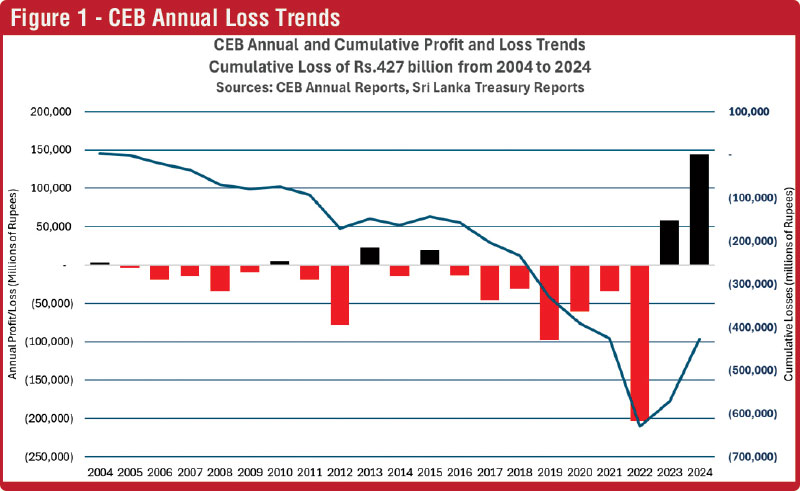
The effects of flawed Electricity Policy extend far beyond the technical boundaries of the sector. They extend throughout the economy and society at large. Decades of poor management, non-competitive investment, and short-sighted decisions have caused over Rs.400 billion in financial losses to the CEB (Figure 1). Since the financial crisis, cost-reflective tariffs agreed with the IMF have prevented such losses. These foregone resources could have been directed toward infrastructure building, social services, and economic
development.
Sri Lankans bear the consequences of these missteps through increased costs, poorer services, and reduced economic opportunities. The country faces high electricity tariffs and experienced power outages, impacting economic output and driving consumers toward expensive/lower quality alternatives. Increased oil and coal reliance strains foreign reserves. In 2024, Sri Lanka spent nearly US$630 billion for importing oil and coal for power generation, or 3.9% of total exports that year.
Moreover, the failure to embrace renewable energy and modernise the sector undermines Sri Lanka’s energy security, leaving the nation vulnerable to external shocks, price volatility, and supply disruptions. In an increasingly interconnected and competitive global landscape, such vulnerabilities carry significant strategic risks that must be urgently addressed.
Constructive recommendations
Despite these challenges, there is a clear path forward. It is one grounded in transparency, inclusivity, and visionary leadership. To restore credibility and effectiveness to the electricity policy-making process, the following recommendations are suggested:
1.Adherence to transparency and legal procedures: Ensure compliance with the procedural mandates of the Electricity Act. This includes:
a)Conducting a comprehensive, two-stage stakeholder consultation, as legally mandated. Firstly, with energy consumers, developers, and subject matter experts before drafting policy proposals. Then, with the broader public.
b)Maintain transparency in the policy process by providing accessible records, incorporating public feedback and justifying decisions.
c)Ensure the policy committee and its support team have no conflicts of interest.
2.Fulfillment of national and international commitments: Embed in the policy, Sri Lanka’s commitments to sustainable development, energy security, regulatory reforms, private sector participation, foster technological innovation and decarbonisation.
3.Integration of technological priorities: Promote grid modernisation initiatives, digital solutions such as smart metering and automation, and storage and other advanced technologies. These measures enhance efficiency and reliability of the electricity supply, and sector sustainability.
4.Prioritise renewable energy integration: Develop a coherent, long-term strategy for accelerating the adoption of renewable energy with which Sri Lanka is richly endowed. This should include clear targets; supportive regulations; incentives for innovation, investment, private sector engagement; and create value for the nation.
5.Align with national and global best practices: Benchmark Sri Lanka’s energy policies against international standards and successful models from comparable economies to identify areas for improvement and adaptation.
6.Strengthen institutional capacity: Invest in building the technical, managerial, and regulatory capabilities of relevant agencies to ensure effective policy implementation and sector oversight. Furthermore, agencies should be held accountable.
Implementing these reforms addresses immediate deficiencies, generates public support, and lays the foundation for a resilient, dynamic, and forward-looking electricity sector. Moreover, it will permit the Ministry to heed the President’s call for “people-centered governance”.
Conclusion
The stakes in Sri Lanka’s electricity policy debate could not be higher. The choices made today will shape the nation’s economic trajectory, environmental legacy, and societal well-being for future generations. It is incumbent upon policymakers, business leaders, and the broader public to demand a policy process that is transparent, participatory, and founded on evidence-based analysis.
Sri Lanka possesses the talent, resources, and ambition to become a regional leader in sustainable energy. Realising this potential demands a decisive break from past practices and a collective commitment to reform. By embracing procedural integrity, fostering stakeholder engagement, and embracing advanced technologies and renewable energy, the country can chart a course toward energy independence, economic vitality, and a more prosperous and secure future for all.
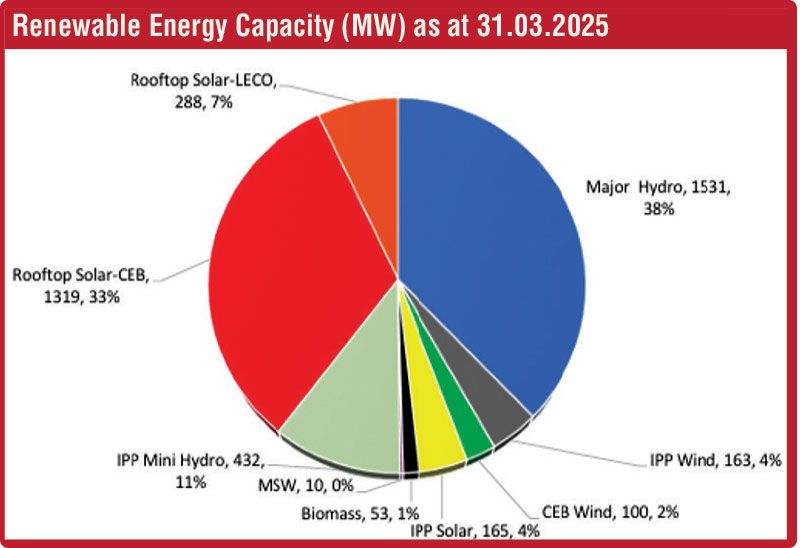
Sri Lanka obtained a significant share of electricity from private renewable energy projects, primarily via the Feed-in-Tariff mechanism and rooftop solar. As of March 2025, the private sector had invested in 2,430 MW renewable energy capacity, supplying 19% of electricity in the first quarter (PUCSL, Renewable Energy Generation Report, Quarter 1, 2025). That private investment is valued at about US$2.5 billion equivalent.
PUCSL reported that mini-hydro, wind, and solar provided power at lower average costs than coal or oil (Daily Generation and Cost Estimation Report, March 18, 2025).
(The author is a Former Lead Energy Specialist, World Bank, Washington DC)




