Wednesday Oct 21, 2026
Wednesday Oct 21, 2026
Tuesday, 10 March 2026 00:36 - - {{hitsCtrl.values.hits}}
 If the operational system of Sri Lanka Cricket (SLC) is functioning effectively, its most visible output should be the consistent production of high-quality cricketers capable of competing at the highest international level. Among these, the development of accomplished batsmen is particularly critical, as batting stability often determines a team’s overall competitiveness.
1.The Batsman
The making of an exceptional batsman requires the integration of several advanced qualities. It involves sustained mental stamina, refined technical proficiency, psychological resilience, and a high degree of tactical intelligence.
These attributes must be reinforced through disciplined execution at the crease, the ability to adapt to different conditions and formats of the game, and the capacity for situational creativity when facing pressure. When these elements combine, they produce a mature sporting character, one capable not only of elegant stroke play but also of strategic decision-making and sustained performance at the highest levels of international competition.
2.The Bowler
Another essential output expected from the operational system of Sri Lanka Cricket is the development of world-class bowlers capable of consistently challenging the best batsmen in international cricket.
An internationally renowned bowler is distinguished by a rare integration of complementary strengths. These include calibrated aggression balanced by patience, technical precision enriched by creative variation, and physical endurance reinforced by psychological fortitude. Equally important is a high level of tactical intelligence, combined with the instinctive judgment required to respond quickly to changing match situations.
At the highest level of the game, bowling becomes the disciplined art of sustained pressure. A great bowler does far more than simply deliver the ball. He constructs passages of play, carefully building pressure through accuracy, variation, and strategic sequencing. By controlling line, length, pace, and field placement, he engineers uncertainty in the mind of the batter and gradually erodes confidence at the crease.
Through relentless discipline and thoughtful execution, marginal mistakes by the batter are transformed into decisive breakthroughs. In this sense, elite bowling is not merely about speed or spin; it is about the ability to control the rhythm of the game and influence the outcome of contests through skill, strategy, and persistence rather than chance. For a cricketing system to succeed at the international level, it must consistently produce bowlers capable of performing this demanding role.
3.The Fielder
Fielding, often underestimated in earlier eras of cricket, has today become one of the defining components of modern international competition. Consequently, an effective operational system within Sri Lanka Cricket (SLC) must also consistently produce fielders of the highest international standard.
An internationally renowned fielder is characterised by the seamless integration of explosive agility and sustained concentration, supported by technical precision executed with fearless commitment. Equally vital is acute game awareness an ability to read the play instantly and make rapid, decisive judgments in high-pressure situations. These qualities are reinforced by a strong understanding of team strategy and fielding structure, yet they are often elevated by moments of individual brilliance that can alter the course of a match.
At the highest level, the elite fielder transcends the conventional defensive role associated with fielding in earlier periods of the game. Instead, he becomes a strategic asset within the team’s overall tactical framework. Through anticipation, athletic execution, and composure under pressure, such a player preserves the bowling side’s momentum, disrupts the opposition’s scoring rhythm, and converts marginal opportunities into decisive advantages.
In modern cricket, a single run saved, a direct-hit run-out, or a spectacular catch can dramatically shift the balance of a contest. The elite fielder therefore safeguards not only physical territory on the field but also the team’s competitive ascendancy. For any national cricket system aspiring to sustained success, the cultivation of such high-calibre fielding standards must be a central objective rather than an afterthought.
4.The All-rounder
Among the most valuable outputs expected from the operational system of Sri Lanka Cricket (SLC) is the development of genuine allrounders. In cricketing terms, the internationally renowned allrounder represents one of the rarest integrations of talent uniting the disciplines of batting and bowling within a single, coherent competitive identity.
Such a player must combine technical mastery in both crafts with a high level of strategic awareness, physical durability, and psychological resilience. An elite allrounder embodies several complementary qualities: offensive authority balanced with defensive responsibility, bowling precision paired with batting fluency, and physical endurance supported by mental adaptability. Equally important is the ability to harmonise individual brilliance with the broader needs of the team.
Unlike specialist players, the allrounder must transition seamlessly between roles. Within the same match, he may be required to construct an innings patiently, accelerate the scoring rate, break a critical partnership with the ball, or contain the opposition during a tense passage of play. This demands not only versatility of skill but also acute situational intelligence the ability to recognise when to consolidate, when to attack, when to accelerate, and when to apply restraint.
At the highest level of the game, the true allrounder becomes a strategic force multiplier. His contribution extends beyond simply performing two roles. Instead, he reshapes the tactical balance of the team. For captains, the presence of a dependable allrounder expands strategic options, stabilises fragile moments in a match, and injects momentum at critical junctures. For any cricketing system aspiring to sustained success, the consistent development of such multidimensional players represents a significant competitive advantage.
Resource allocation for player development
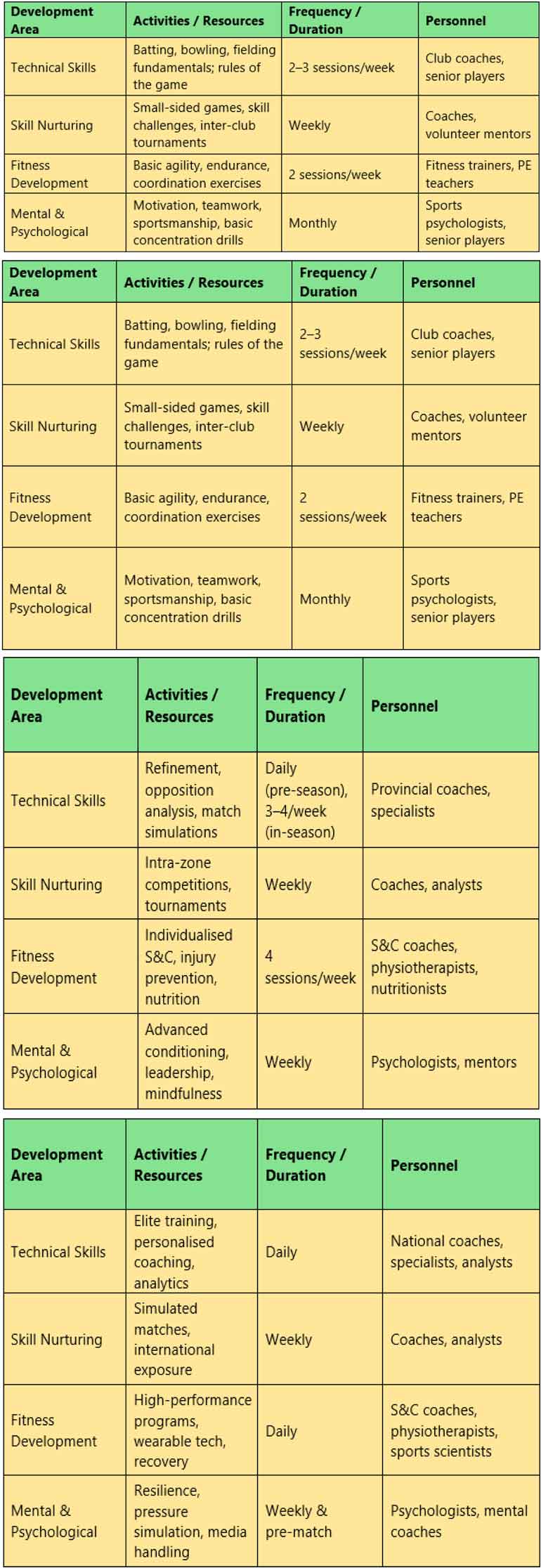
A highperformance cricketing ecosystem requires deliberate, structured, and wellresourced development pathways. The following framework outlines a tiered resource allocation model across all levels of the cricketing structure from grassroots clubs to national squads ensuring that technical, physical, and psychological development is systematically nurtured.
1. Local Clubs (Grassroots Level)
Objective: Identify emerging talent, establish foundational cricket skills, cultivate passion for the game, and introduce basic fitness and mental development habits.
Key Notes:
2. District Teams (First XI & Second XI)
Objective: Consolidate core skills, introduce competitive intensity, and strengthen fitness and mental resilience.
Key Notes:
3. Provincial Zone Teams (First XI & Second XI)
Objective: Prepare players for nationallevel competition through advanced skill refinement, highperformance fitness, and strong mental conditioning.
Key Notes:
4. National Squads (U19, Emerging, A, Senior)
Objective: Maximise elite performance through mastery of technical skills, peak physical conditioning, and advanced psychological resilience.
Key Notes:
Resource allocation priorities across levels
Effective player development requires not only structured pathways but also strategic prioritisation of resources. As players progress through the cricketing system, the nature and sophistication of resource allocation must evolve accordingly.
1. Coaching
2. Fitness and conditioning
3. Skill nurturing
4. Mental and psychological development
Facilities and governance plan
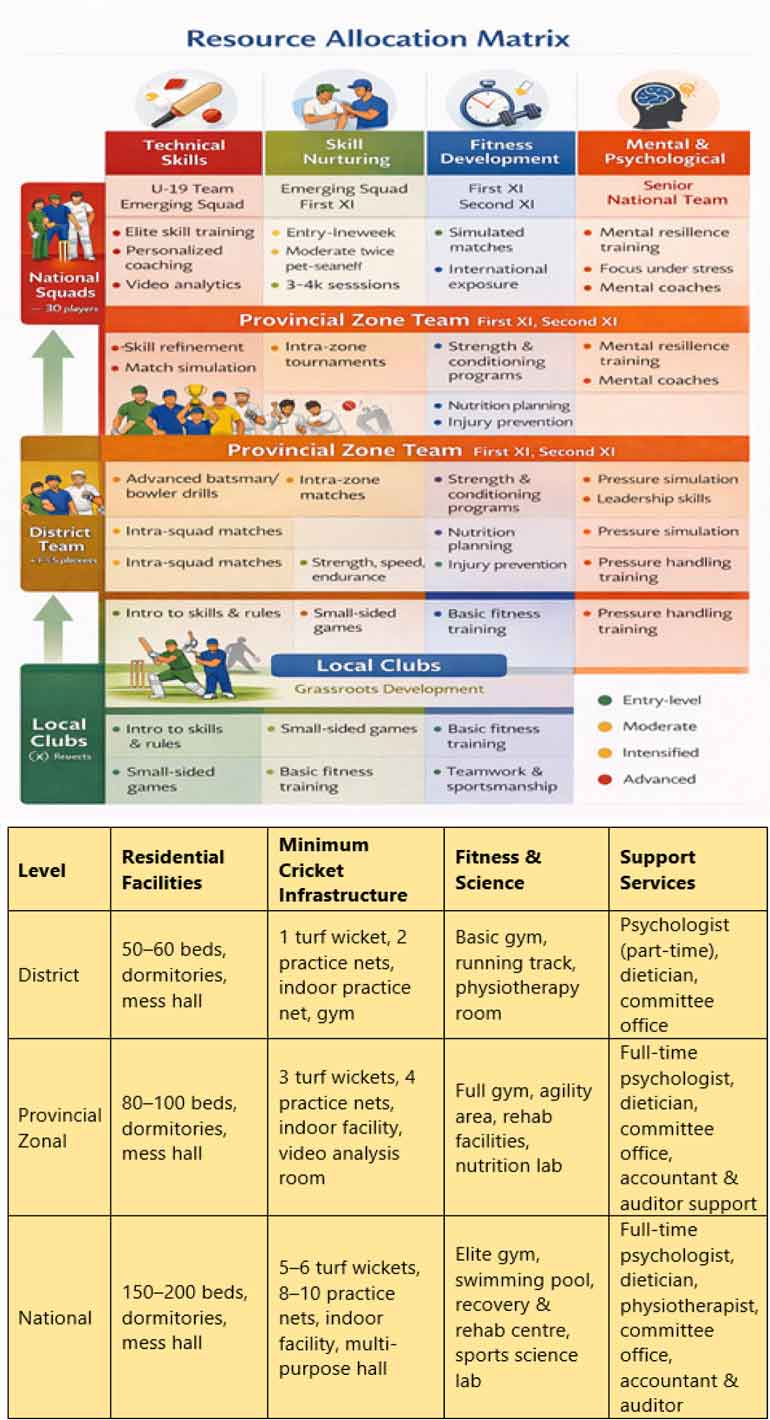
The objective is to establish a tiered, fully facilitated residential cricket system that produces technically, physically, and mentally high-performing cricketers, while ensuring scientific, transparent, and accountable resource allocation. This system will operate across District, Provincial Zonal, and National levels, integrating coaching, fitness, and psychological support with high-quality infrastructure.
Key Notes:
All facilities must be maintained to international ICC standards.
Ultimate test
Is it feasible to implement a ten-year plan to achieve the outcomes outlined above? The decision ultimately rests with the NPP Government and Sri Lanka Cricket, in consultation with the ICC. As spectators and members of the public, we closely observe whether those entrusted with these responsibilities demonstrate the will, competence, integrity, and capability required to fulfill their appointed roles.
This two-part article was written focusing men’s cricket structure. However, the content is equally applicable for female cricket structure and its development.
(The author is an engineer currently working in the Australian NSW Local Government sector. He aims to share his perspectives on various social development issues alongside his professional expertise to inspire others to think critically and differently. He can be reached at [email protected])




