Tuesday Nov 03, 2026
Tuesday Nov 03, 2026
Tuesday, 3 November 2026 04:01 - - {{hitsCtrl.values.hits}}
 Every month, salaried Sri Lankans see tax leave their payslip before they see their pay. For them, the debate on income tax relief is a question of whether the household budget balances after food, transport, school fees and loan instalments. The Government has indicated a proposal to raise the monthly tax-free threshold from Rs. 150,000 to Rs. 200,000 as revenue strengthens, with the timing and design still under discussion, and its stated medium-term policy is to lower tax rates while broadening the base and improving compliance. That intent is understandable and welcome. The real question is how relief is delivered.
Relief and the base must move together
The personal relief was raised from Rs. 1.2 million to Rs. 1.8 million from April 2025, and the first taxable band was widened from Rs. 500,000 to Rs. 1 million, with the 12% band removed. Some observers have reasonably cautioned that a further increase should be weighed against its revenue cost and the narrowness of the base. Those concerns deserve to be taken seriously, and they sharpen the case for careful design.
The base is narrow. Of the 2,547,322 employees in the Inland Revenue Department’s employer returns for 2024/25, about 75.6% had no tax deducted, which is consistent with earnings below the taxable threshold. On my earlier estimate, drawing on IRD and Labour Force Survey data, the system reliably reaches only around a quarter of the employed population. For 2024/25, only 25% of individual income tax returns were filed on time.
Between end-2024 and end-2025, registered income taxpayers rose 19% to about 1.3 million, and registered VAT payers rose from 21,227 to 33,187. The task now is to build on this by bringing the informal sector and self-employed into the net, and by keeping collections balanced between individuals and corporates. Relief that is not matched by a wider base leaves the same compliant taxpayers carrying the load, or leaves a gap that is filled later through higher consumption taxes that fall hardest on ordinary households.
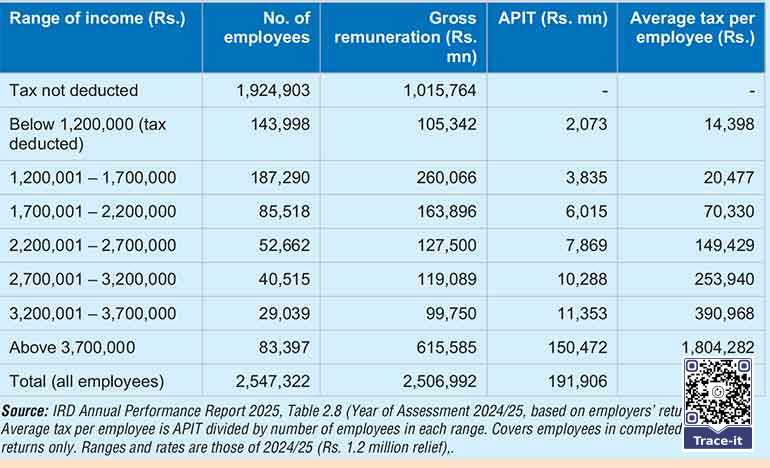
The IRD’s APIT data for 2024/25 show how concentrated the load already is. Of the 2.55 million employees on employer returns, 1.92 million (75.6%) had no tax deducted. Their average gross pay was about Rs. 528,000 a year, or roughly Rs. 44,000 a month, which fits earnings below the threshold. The 622,419 on whom tax was deducted paid about Rs. 308,000 each on average. At the top, the 83,397 employees earning above Rs. 3.7 million (3.3% of the total) accounted for Rs. 150.5 billion, or 78.4% of all APIT, an average of about Rs. 1.8 million each. The table also shows how steeply the average tax rises between income ranges. It describes employees covered by completed employer returns for 2024/25, under the earlier Rs. 1.2 million relief, so it is a guide to the distribution of the load and not a basis for costing any change.
Individuals and corporates: how the balance looks
The balance between corporate and non-corporate taxpayers is the other side of the same question. The IRD’s 2025 data show that corporate taxpayers contributed Rs. 669.6 billion, or 59% of income tax collections, up from 57% in 2024. Non-corporate taxpayers contributed Rs. 461.7 billion, or 41%, down from 43%. Corporate collections grew by about 15% over the year, against about 4.5% for the non-corporate group. The corporate figure includes corporate income tax, dividend tax and remittance tax, while the non-corporate figure includes individual and partnership income tax, APIT , AIT and withholding taxes. The split is therefore by type of tax, not strictly by type of taxpayer.
Why the slabs, not the threshold, should be the key change
Raising the threshold takes everyone between Rs. 150,000 and Rs. 200,000 a month out of the net altogether. Revising the slabs delivers relief to those carrying the burden while keeping them inside the system. Today the first Rs. 1 million of taxable income is taxed at 6%, and the rate then jumps to 18%. An individual reaches the top rate of 36% at about Rs. 358,000 a month, which is hardly an extravagant income in today’s cost-of-living environment.
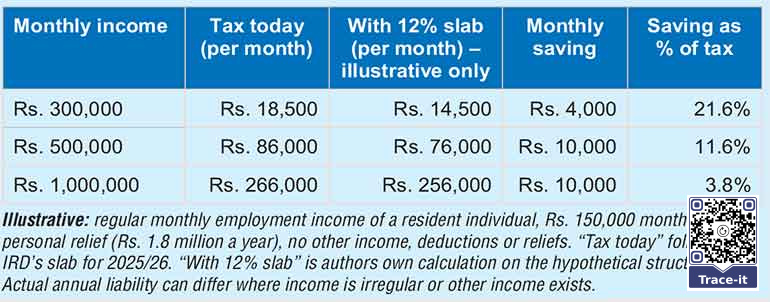
Consider, purely as an illustration and not as any official proposal, reinstating an intermediate 12% slab on the next Rs. 500,000, with the personal relief of Rs. 1.8 million unchanged. The rates would then run: 6% on the first Rs. 1 million, 12%, 18%, 24% and 30% on each successive Rs. 500,000, and 36% thereafter. The 36% rate would begin at Rs. 400,000 a month rather than Rs. 358,333. The effect on three illustrative earners is shown below.
The relief is largest in proportion for the Rs. 300,000 earner, who pays about a fifth less tax. For higher earners the benefit is capped at Rs. 10,000 a month, or Rs. 120,000 a year, so the cost per taxpayer is bounded. The total cost depends on how many taxpayers fall in each band, which the available IRD data, based on the earlier 2024/25 structure, cannot show. The Ministry of Finance and the IRD are best placed to compute and publish that figure preferably before the Budget. Importantly, nobody is removed from the net and everyone above Rs. 150,000 a month remains a taxpayer.
A package, not a single measure
This is an illustration of design, not a finished proposal. The final width and rates are for policymakers, who must weigh the revenue effect and the available fiscal space. The principles, however, are clear:
1. Pair any relief with a credible plan to widen the base, including the informal sector and the self-employed.
2. Keep the burden balanced between individuals and corporates, as it broadly is today, so that salaried earners do not become the default source of new revenue.
3. Deliver relief by reshaping the slabs, so that it reaches the middle and keeps taxpayers within the net.
4. Publish the revenue cost and the distribution of benefits alongside the Budget, so that the public can judge the fairness of the system as well as its yield.
Tax relief that reaches the common man should leave him better off and keep the system strong enough to serve him. A revised individual tax slab structure, alongside a wider base, can do both.
(The views and opinions expressed in this article are those of the author in her personal capacity. Reference has been made to the Inland Revenue Department’s Annual Performance Report 2025)