Wednesday Oct 21, 2026
Wednesday Oct 21, 2026
Friday, 19 December 2025 00:40 - - {{hitsCtrl.values.hits}}
Despite exposing his “real looks” as opposed to his “reel looks” publicly, the superstar continues to retain his charismatic hold on his adoring masses
 Friday, 12 December was a special day for millions of Tamil movie fans. It was the 75th birthday of popular Tamil cinema actor Rajinikanth. The evergreen filmstar has in a film career spanning fifty years, acted in 172 films. He is currently working on his 173rd movie.
Even as Rajinikanth fans celebrated the actor’s diamond birthday on a widespread scale, they were in turn provided with a special treat by their idol. A re-mastered version of the star’s 1999 film “Padayappa” was re-released 26 years later on 12 Dec. The 1999 film was a blockbuster produced by Rajinikanth himself under the aegis of Arunachala Cine creations. The re-released 2025 film is reportedly a hit movie running to packed houses both in India and overseas.
What is remarkable about Rajinikanth is the fact that he continues to act in lead roles despite being a septuagenarian. Only Hindi cinema’s Dev Anand kept acting in lead roles even as an octogenarian but many of Dev Anand’s films were failures in commercial terms. What is noteworthy about Rajinikanth is that his movies continue to be hugely successful at the box office.
“Super Staaru Yaarunnu Kaettaal, Sinnakuzhandhaiyum Sollum” is a hit number from the Rajinikanth film “Raja Chinna Roja” released in 1989. What the opening lines say is that even a small child knows the answer to the question of who is the super star? What the words mean implicitly is that Rajinikanth is indeed the super star of Tamil films. One is adjudged super star on the basis of being a box office draw and amount of remuneration received.
By that yardstick, Rajinikanth has indeed been the super star of Tamil cinema for many years. His films click loudly at the box office, and he is paid a huge sum of money for a film. In recent times 51-year-old actor Vijay has overtaken the 75-year-old Rajinikanth in terms of earnings. Nevertheless, the moniker Superstar still refers to Rajinikanth in the realm of Tamil moviedom. Notwithstanding actor Vijay, “the Superstar” as Rajini is known, is still the single most popular mass figure among actors in Tamil cinema.
Rajini’s fans are generally youths and women. However, most of his youthful die-hard fans are now in their naughty forties, nifty-fifties and sprightly sixties but their fondness for Rajinikanth is as ageless as ever. The actor is popular among Sri Lankan film theatre audiences too and has an established fan base comprising Tamils, Muslims and Sinhalese.
The Rajanikanth saga is a rags to riches story. It is the tale of how a Bus Conductor Shivaji Rao from Bengaluru in India’s Karnataka state came to the Tamil Nadu state capital Chennai and became the celebrated cinema super star Rajinikanth. It is against this backdrop therefore that this column moves away from politics this week and focuses on superstar Rajinikanth.
Shivaji Rao Gaekwad
Interestingly, Rajinikanth, though a highly popular actor in Tamil cinema, is ethnically not a Tamil. He is not even a South Indian. Though born in Bangalore, now known as Bengaluru. Rajinikanth is a Maratha whose family hails from Mavadi Kadepathar in the State of Maharashtra. His given name is Shivaji Rao Gaekwad.
The Gaekwads are of Kshatriya warrior clan lineage. His family moved to Bangalore/Bengaluru in the southern state of Karnataka during the British period. Rajini’s given name at birth Shivaji Rao was derived from the legendary Maratha warrior-king ‘Chatrapathi Shivaji Rao’.
 Shivaji Rao Gaekwad was born on 12 December 1950 at the Vanivilas hospital on Krishnarajendra road in Bengaluru. His father Ranoji Rao was a Police constable and mother Ramabai a homemaker. Shivaji was the youngest of four siblings. He lost his mother at the age of nine. The sister Aswath Balubai looked after him like a foster mother. The family lived in the Bengaluru suburb of Hanumantha Nagar.
Young Shivaji Rao Gaekward completed his primary schooling at Gavipuram Govt Kannada Model Primary school and his secondary education at the Aachaarya Pathsala Public school. After completing his secondary education with a Pre-University Certificate (PUC), Shivaji gave up studies saying he was not interested in higher education.
Shivaji Rao acted in many dramas during school days. He realised that he had a flair for acting. After leaving school he started acting in Kannada stage plays. Acting in amateurish dramas did not pay well. Shivaji tried his hand at many day jobs while appearing on stage in the evenings. He was at times a carpenter, office peon, machine operator and a coolie transporting sacks of rice and flour.
Bangalore transport service
At the age of 20, Shivaji sat for an entrance exam conducted by the then Bangalore Transport Service (BTS) and was selected as a bus conductor. It was then that he met Raja Baadhar, the man described as Rajinikanth’s best friend. Raja Baadhar was the driver of the bus on which Shivaji was the conductor. They worked an eight-hour shift from 6 a.m. to 2 p.m. daily. The driver -conductor duo of Raja Baadhar-Shivaji Rao hit it off well and both became close friends.
The following paragraphs excerpted from the book “Rajinikanth: The Definitive Biography” by Naman Ramachandran. The paragraphs quoting Raja Baadhar provide an insight into how the Bengaluru bus conductor worked then.
“There was no one faster than him in issuing tickets,” remembers Baadhar. “He would give out tickets with a flourish, return change in style. It was all about style. Passengers would look on in amazement.” Laughingly, he adds, “He would always flick back his forelock in those days, that’s why he is bald today.”
“Passengers would let earlier buses go empty and wait for the bus where the entertaining conductor was on duty and crowd in. Shivaji definitely knew how to work a crowd and play to the gallery even then.”
Madras Film Institute
Meanwhile Shivaji Rao’s popularity as an amateur stage actor increased. Many started suggesting that he should get trained and move from stage to screen. Among these was a woman medical student named Nirmala. She was an ardent fan. Nirmala obtained admission forms to the Madras film institute without Shivaji’s knowledge and filled them up. The ball was now in
 Shivaji’s court.
After much deliberation, Shivaji Rao decided to take the plunge by enrolling for the acting course His elder brother Satyanarayana Rao and best friend Raja Baadhar encouraged him in this. They also backed him financially.
Shivaji Rao gained admission to the Madras Film Institute, earlier known as the Adyar Film Institute and presently as the MGR Government Film and Television Training Institute. Shivaji Rao followed a two-year acting course at the Madras Film Institute from 1973 to 1975. He underwent great financial difficulties while studying. Since he was generally low on funds, for two years he was compelled to skip meals regularly to make ends meet. He passed out in 1975.
“Apoorva Raagangal”
Even as a film institute student, Shivaji caught the eye of renowned filmmaker K. Balachander when he delivered a guest lecture to the acting class. When Balachander made the film Apoorva Raagangal (Rare Melodies), he offered Shivaji Rao a small but significant role in the film. Speaking about his choice later, Balachander said, “Of course, when I introduced him in Apoorva Raagangal, it was only a small role, but people would remember him because he comes in the climax. So I thought I’ll give this particular role to him.”
“Apoorva Raagangal” was released on 15 August 1975. It was the film debut of Shivaji Rao in his new Avatar Rajinikanth. Balachander advised the actor to adopt a new screen name and recommended the name Rajinikanth. Incidentally Rajinikanth was the name of the role played by actor AVM Rajan in the film “Major Chandrakanth” directed by Balachander in 1967. The film’s titles said “Arimukam” “(introduction)Rajinikanth”, in which Rajinikanth played Pandiyan the husband of the heroine Sri Vidhya.
Rajinikanth’s entrance in the film was quite dramatic, as he pushed open the gates and walked in. “Newcomer Rajinikanth is dignified and impressive,” wrote The Hindu in its review. Hence, 2025 also marks the 50th anniversary of Rajinikanth’s acting career.
K. Balachander
Rajinikanth was given further boosts by K. Balachander who gave him three minor roles in three consecutive films. While Balachander continued to give Rajinikanth roles in the Tamil and Telugu films directed by him, other filmmakers too followed suit. In the early stages Rajinikanth played somewhat negative roles in films like “Moondru mudichugal” and “Pathinaaru Vayathiniley”. The trend changed with films like “Puvanaa oru Kaelvikkuri” and “Bairavi”. Gradually Rajini began getting positive roles. Soon he started playing lead roles.
Films starring Rajinikanth became commercial successes. Producers began flocking to him. The prestigious AVM studios produced nine films with Rajinikanth. Rajini started acting day and night in films. He averaged about 20 films a year working at times in three shifts. The strain was too much and Rajini suffered a minor nervous breakdown. He recovered soon and continued to act but at a more leisurely pace.
Latha Rangachchaary
 Rajinikanth also decided to settle down and got married to Latha Rangachchaary, a Tamil Brahmin Iyengar woman. Rajinikanth first met Latha a student at the Ethiraj College for women when she interviewed him for the College magazine. Latha’s sister is married to actor YG Mahendran. Her brother’s son Anirudh Ravichandran is a leading music composer-director.
Latha and Rajinikanth were married on 26 February 1981. They have two daughters, Aishwarya and Soundarya; both have directed and produced films. The elder daughter, Aishwarya, was married to popular film actor Dhanush. They separated some years ago and were divorced recently. The younger daughter, Soundarya, was married to industrialist Ashwin Ramkumar; they were divorced in 2017. Soundarya married again in 2019, to actor-businessman Visaghan Vanangamudi. Rajinikanth and Latha have four grandchildren from their two daughters.
Villain, anti-hero, hero
Rajinikanth’s journey as an actor was from villain to anti-hero to hero. Rajinikanth began captivating film goers with his smart appearance, stylish movements, novel mannerisms, rapid manner of dialogue delivery and a striking penchant for uttering punchy one-liners.
Rajini’s stock began to rise from 1980 onwards and very soon the ex-bus conductor’s movies began breaking box-office records. The well-known film producer “Kalaippuli” Thaanu was the first to proclaim Rajinikanth as the “Superstar” of Tamil cinema.
“Reel” looks – “Real” looks
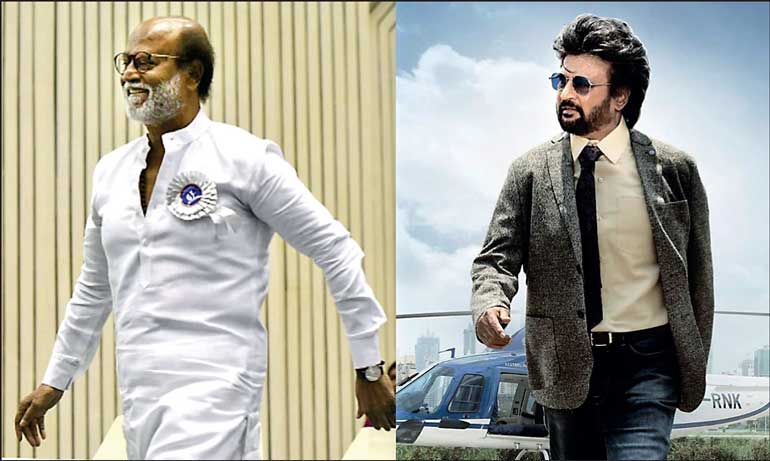
An interesting aspect of Rajinikanth’s personality is that unlike most cinema stars he does not wear make-up or appear to be young looking in real life. He does not try to lighten his dark tone skin or wear a wig to hide his increasing baldness. He does not even dye his grey hair or beard. Despite exposing his “real looks” as opposed to his “reel looks” publicly, the superstar continues to retain his charismatic hold on his adoring masses.
Rajinikanth has in a career spanning five decades acted in 172 films. He is currently acting in his 173rd film. Over a hundred of Rajini’s films are in the Tamil language but the dusky demi-god has acted in Hindi, Telugu, Kannada and Malayalam movies also. Rajinikanth has acted in one English film, “Bloodstone”.
Movies
Among the noteworthy films Rajinikanth has acted in are Aval Appadithaan, Mullum Malarum, Aarilirunthu Arupathu Varai, Sri Raghavaendhar, Nallavanukku Nallavan, Kai Kodukkum Kai, Murattukkaalai, Engayo Kaetta Kural, Moondru Mugam, Naan Mahaan Alla, Thanga Mahan, Naan Sihappu Manithan, Thalapathy, Thillumullu, Arunachalam, Muthu, Baashaa, Manithan, Annaamalai, Padayappaa, Chandramukhi, Kabaali, Pettai, Kala, Jailer, Vettaiyan and Coolie.
Directors
Some of the reputed filmmakers who have directed his films are K. Balachander, S.P. Muthuraman, P. Vasu, Suresh Krishna, K.S. Ravikumar, Maniratnam, Shankar, C.Sundar, P.A. Ranjith, Nelson Dilipkumar and Lokesh Canagaraj.
Actresses
Prominent among the numerous actresses with whom Rajinikanth has acted with are Sri Devi, Sri Priya, Lakshmi, Radhika, Radha, Ambika, Poornima, Revathy, Gautami, Amala, Meena, Roja, Soundarya, Nayantara, Shreya Saran, Trisha and of course the unforgettable “Neelambari” Ramya Krishnan.
Most of Rajinikanth’s films have been money spinners running to houseful audiences for weeks and weeks. He is one of the highest paid actors in Indian filmdom and is reportedly paid more than 100 crore Indian rupees and a share of the profits for a film.
Awards
Rajinikanth was awarded the Padma Bhushan in 2000 and the Padma Vibhushan in 2016 by the Government of India. They are the third- and second-highest Indian civilian honours, respectively. Rajini also received the highest honour in the Indian cinema sphere—the Dadasaheb Phalke Award—in 2019. He has also received the IFFI Satyajit Ray Lifetime Achievement Award. Rajinikanth is also the recipient of a National Film Award, seven Tamil Nadu State Film Awards, the Telugu cinema’s Nandi Award, and a Filmfare award.
A unique feature of the relationship between the movie stars of the Indian south and their fans is the proliferation of fan clubs (Rasikar Mandrangal). These clubs would hold special poojas in temples whenever a new movie of their matinee idol was released. Milk would be poured on cut-outs of actors and camphor lit. The clubs hold annual conventions and also participate in social service projects.
Fan club network
“Superstar” Rajinikanth too has an enormous fan club network. So immense was it that the actor stopped sanctioning and ‘officially’ registering fan clubs since 1996-’97. At that time there were over 50,000 fan clubs with a minimum membership of at least 25 each. Though Rajinikanth stopped sanctioning fan clubs since 1997 that has not deterred his ‘rasikas’ from continuing to form fan clubs. This has resulted in thousands of ‘unofficial’ Rajinikanth fan clubs with millions of members being formed in the past years.
There was a time when Rajinikanth began flirting with the idea of forming a political party and vying for the position of Tamil Nadu Chief Minister. He even made a public announcement to that effect. Rajinikanth’s first task after announcing his political entry was the formal regularisation of his fan clubs both official and unofficial into one entity called ‘Rajini Makkal Mandram’ (Rajini People’s
Forum).
Rajinikanth streamlining his fan clubs into a single co-ordinated entity indicated that the superstar was emulating former Tamil Nadu Chief Minister MG Ramachandran (MGR) who transformed his fan clubs into party branches when he started his own political party the AIADMK in 1972.
Spiritual politics
It appeared that Rajinikanth was setting his sight on the 2021 Tamil Nadu assembly elections. There was speculation that Rajinikanth would combat the dominant Dravidian ideology with his own brand of “Aanmeeha Arasiyal” or spiritual politics. But that did not happen.
Rajini had earlier undergone a kidney transplant. His daughter Aishwarya was the donor. When the COVID pandemic hit the world in 2020, India was hugely impacted. Rajinikanth was warned by doctors that plunging into active politics could pose a fatal health hazard. Rajinikanth pressured strongly by family members and genuine well-wishers abandoned the idea of entering politics. He said it was a message from God.
‘Sri Ragavendhrar’
Rajinikanth is a devout Hindu and a follower of the philosophy propounded by the miracle-working scholarly Saint Shree Ragavendhra Swami. Not only has Rajini named the wedding hall he owns in Chennai as ‘Ragavendhra Kalyana Mandapam’, but has also acted as the holy man in his 100th film ‘Sri Ragavendhrar’ released in 1985.
Moreover, Rajinikanth has a custom of withdrawing frequently to the Himalayas and engaging in meditation. He is also a devotee of Shree Sabarimalai Aiyappan hill temple in Kerala. Rajinikanth has never hesitated to speak publicly about his religious and spiritual beliefs. He has also been supportive of the Modi Government at times. This in turn has created an impression – unfairly perhaps – that Rajinikanth is a kindred soul of the ultra-Hindu rightist ‘Hindutva’ school of thought.
Meeting Rajinikanth
Let me conclude this article on a personal note. I have met Rajinikanth only once. This was in 1994. I was editing my own Tamil Weekly in Toronto at that time. Rajinikanth along with his wife Latha had embarked on a tour of Western cities having a substantial Tamil population with a troupe of artistes, singers, musicians and dancers.
Due to some issues with the organisers, activist supporters of the Liberation Tigers of Tamil Eelam (LTTE) launched a campaign urging a boycott of the Rajinikanth show. The performances were poorly attended in Europe and were miserable flops. In Canada some of the organisers who were also tiger supporters tried hard to make it a success.
A press conference was held in Toronto with Rajinikanth. I was also present. It was the first and only time I met Rajinikanth in person. He answered questions including those of mine openly and boldly. After the conference Rajini and I had a one-on-one conversation for about 15 minutes.
Subsequently I wrote an extensive article in my weekly “Muncharie” about the Rajinikanth tour. I was critical of LTTE supporters for organising the boycott. I was surprised when Rajinikanth telephoned and thanked me. We spoke on the telephone for quite a while. I later learnt that Rajini had read my article and appreciated it saying “Ennamaa Ezhudhiyirukkiraar” (how well he has written). I also wrote an article in English about the Rajinikanth show fiasco for “The Sunday Leader” in Colombo.
A “real” person
Rajinikanth’s conduct at the media meet and his conversations with me made a very good impression. He came off as a simple, humble man without airs or pretences. He spoke frankly and forthrightly without mincing his words. He was a “real” person exuding an aura of honesty and simplicity. I liked Rajinikanth very much then.
(The writer can be reached at
[email protected].)




