Sunday Sep 13, 2026
Sunday Sep 13, 2026
Wednesday, 29 July 2026 00:23 - - {{hitsCtrl.values.hits}}
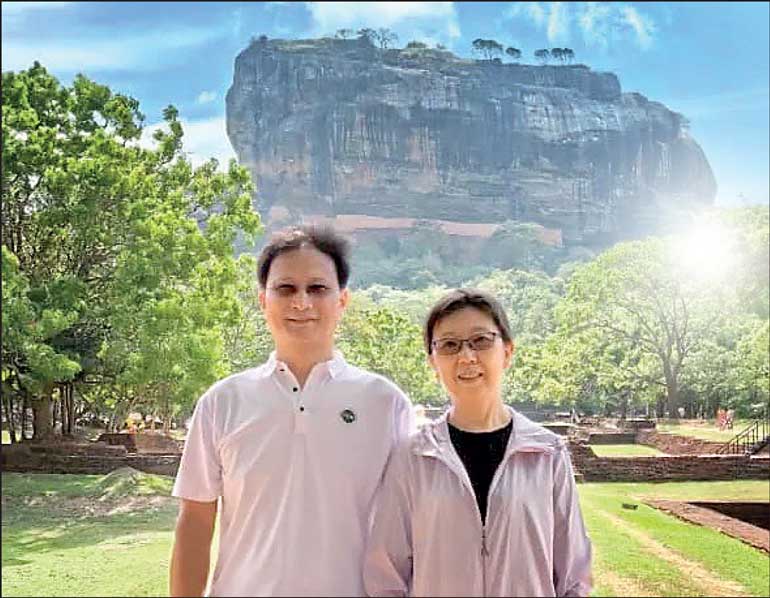
Chinese Ambassador Qi Zhenhong, and wife during their recent visit to Sigiriya
 Since 2022, I have engaged with the outgoing Chinese Ambassador to Sri Lanka, Qi Zhenhong, who has completed a nearly six-year tenure. His period of service has been marked by sustained and consistent engagement, as well as a notably amiable, humble, and approachable demeanour, particularly during one of Sri Lanka’s most severe economic crises. Throughout this time, he has consistently conveyed a clear and steady message: that China regards Sri Lanka not merely as a strategic partner, but as a long-term partner in development, cooperation, and mutual support.
In a wide-ranging 2025 interview with the writer, published in the Daily FT, Ambassador Qi addressed some of the most debated issues surrounding China–Sri Lanka relations, including concerns over debt, infrastructure investment, trade, and geopolitical influence. He strongly rejected the notion of a “Chinese debt trap,” arguing that Sri Lanka’s economic crisis was the result of multiple factors, including domestic policy failures, external shocks, and global economic conditions—not Chinese lending alone.
He emphasised that China is neither Sri Lanka’s only nor its largest creditor overall, and that Chinese-funded projects have primarily focused on infrastructure, logistics, energy, and connectivity. According to Ambassador Qi, these investments were intended to strengthen Sri Lanka’s productive capacity and create a foundation for long-term economic growth.
The Colombo Port City project, he noted, was developed without a direct financial burden on Sri Lanka, while he referred to international studies which argued that China’s involvement in Hambantota Port followed the reluctance of other potential partners to participate. His broader argument was that Chinese engagement should be viewed as development cooperation rather than a source of dependency.
At the same time, Sri Lanka’s experience demonstrates the importance of ensuring that all foreign investments—regardless of their source—are guided by sound economic assessments, transparency, competitive processes, and long-term national interest. Infrastructure can become a powerful engine of growth only when combined with effective governance, commercial viability, and policies that enable Sri Lankan businesses and workers to benefit.
Ambassador Qi highlighted China’s support during Sri Lanka’s most difficult moments. During the COVID-19 pandemic, China provided vaccines, medical equipment, and other essential supplies at a time when countries across the world faced shortages. Chinese vaccines played a significant role in Sri Lanka’s public health response. He also noted that China was the first bilateral creditor to reach an agreement framework on debt restructuring, contributing to Sri Lanka’s broader efforts to restore financial stability.
Trade and infrastructure
Infrastructure remains a defining feature of China’s partnership with Sri Lanka. Ambassador Qi pointed to the Colombo Port City and Hambantota Port as examples of projects that could contribute significantly to future investment and economic activity. The challenge now for Sri Lanka is to ensure that these assets generate broad-based economic returns through investment, employment creation, exports, and integration into global supply chains.
Trade, according to Ambassador Qi, represents the next major opportunity. He renewed China’s call for the conclusion of a comprehensive Free Trade Agreement between the two countries, negotiations for which have remained stalled since 2017. He argued that Sri Lanka should view deeper access to the Chinese market as an opportunity rather than a threat.
With China accounting for a significant share of global trade, even a modest expansion of Sri Lankan exports to China could create meaningful economic opportunities. However, Sri Lanka must also ensure that trade agreements support domestic industries, enhance competitiveness, and create opportunities for local entrepreneurs rather than simply increasing imports.
Beyond economics, Ambassador Qi highlighted the historical and cultural foundations of the relationship. The connections between the two nations stretch back centuries, from the Buddhist pilgrim Faxian’s visit to Sri Lanka to the maritime voyages of Zheng He. Today, educational exchanges, scholarships, cultural programs, and tourism initiatives continue to strengthen people-to-people links.
Looking ahead, Ambassador Qi spoke of a “China–Sri Lanka community with a shared future,” reflecting the vision agreed upon during President Anura Kumara Dissanayake’s visit to Beijing. Cooperation is expected to expand into areas such as agriculture, climate change, marine research, youth development, education, healthcare, sports, and technology.
However, as Sri Lanka navigates an increasingly complex geopolitical environment, its success will depend on maintaining constructive relationships with all major partners—China, India, Japan, the United States, Europe, and others. Sri Lanka’s strategic location in the Indian Ocean provides opportunities, but it also requires careful diplomacy, economic discipline, and a clear focus on sovereignty and national priorities.
Concludes his tenure
As Ambassador Qi concludes his assignment in Colombo and bids farewell, his message is that China views its relationship with Sri Lanka as one built on history, partnership, and shared development. Whether viewed through the lens of economics, diplomacy, or geopolitics, the reality remains that China will continue to be an important partner for Sri Lanka, alongside its relationships with other international partners. We wish Ambassador Qi every success as he embarks on the next chapter of his diplomatic journey and assumes his responsibilities in China or another country.
References
1.Daily FT: China–Sri Lanka ties in a changing world
https://www.ft.lk/columns/China-Sri-Lanka-ties-in-a-changing-world/4-776912
2.Ada Derana article
https://adaderana.lk/news/cmrytg54x0001356pfx48sd5c
3.The Morning article
https://www.themorning.lk/articles/ 0bFNv97lK1PQOFYXg4aF