Monday Oct 12, 2026
Monday Oct 12, 2026
Monday, 11 May 2026 00:20 - - {{hitsCtrl.values.hits}}

 In the first article of this series (https://www.ft.lk/columns/Purposeful-leadership-A-new-series-for-a-changing-world/4-790036) , I introduced purposefulness as a moral orientation grounded in decent human values. In the second (https://www.ft.lk/columns/Purposeful-self-leadership-Leading-yourself-in-a-world-under-pressure/4-790582), I explored purposeful self-leadership, the inner work required to lead oneself with coherence. The third focused on purposeful people leadership, recognising that leadership decisions shape the lives and meaning-making of others (https://www.ft.lk/columns/Purposeful-people-leadership-Leading-others-when-the-world-is-unsettled/4-791305). In this fourth article, I extend the discussion to the organisational level, where purpose, people, and performance converge in complex and often unpredictable environments.
Organisations today operate in a world defined by volatility and uncertainty. Geopolitical tensions, economic cycles, technological disruption, climate-related risks, and shifting societal expectations continually reshape the context in which organisations function. In such an environment, traditional notions of strategy anchored solely on growth targets or market positioning are no longer sufficient. What provides continuity amidst uncertainty is not a static vision statement, but a deeply embedded sense of purpose.
Heart of purposeful organisational leadership
At the heart of purposeful organisational leadership is the articulation of a clear purpose statement. Unlike a conventional vision, which often focuses on future achievement, a purpose statement answers a more fundamental question: why does the organisation exist, and how does it contribute to the flourishing of life? This purpose must be supported by a strong mission that defines how the organisation operates, and a set of values that preserve its culture and guide behaviour, particularly when difficult decisions must be made.
The true test of purpose emerges when organisations face trade-offs. In unpredictable conditions, leaders are often required to make choices that determine the organisation’s viability. These may include restructuring, reallocating resources, postponing investments, or redefining strategic priorities. Purposeful organisational leadership does not avoid such decisions. Instead, it ensures that they are made in alignment with purpose and guided by values. This does not eliminate pain or complexity, but it provides a moral foundation for navigating both.
 People dimension
The people dimension remains central. In an era where technology, particularly artificial intelligence, is transforming the nature of work, organisations are increasingly able to delegate data processing, analysis, reporting, and routine processes to machines. This creates both opportunity and responsibility. Purposeful leaders ask not only how technology can improve efficiency, but also how it can create space for human potential to be redeployed more meaningfully. Can individuals be re-skilled and re-trained? Can roles be redesigned to emphasise creativity, judgement, and human connection? Can growth opportunities be created so that people continue to find relevance and dignity in their work? These are not merely operational questions. They are deeply values-based choices.
These dynamics can be understood across four interrelated dimensions.
From a cognitive perspective, purposeful organisational leadership requires a shift in how leaders think about success. Many organisations remain anchored in goal-driven paradigms where metrics dominate meaning. Purpose introduces a broader lens. It encourages leaders and teams to see beyond targets and ask how their work contributes to a larger good. This shift is not always easy. Within the same organisation, individuals may interpret purpose differently based on their experiences and beliefs. Leaders must therefore create shared understanding while allowing for individual meaning-making.
Organisations are shaped by their environments
From a contextual perspective, organisations are shaped by their environments. A commercial organisation navigating global supply disruptions, an educational institution adapting to digital learning, a government responding to fiscal constraints, or a development agency supporting regional resilience all operate within distinct realities. Similarly, institutions such as a national cricket board must balance performance expectations, commercial interests, and national identity. At a broader level, regional blocs such as the European Union make decisions that affect multiple countries with diverse priorities. In each case, purpose must be interpreted within context. Purposeful organisational leadership involves aligning internal values with external realities without losing coherence.
 From a practical perspective, purpose must be translated into systems, processes, and decisions. It must influence recruitment, performance management, investment choices, partnerships, and operational policies. For example, an organisation guided by purpose may choose to invest in employee development even during downturns or adopt sustainable energy practices despite higher short-term costs. It may prioritise transparent communication during uncertainty, or design customer solutions that create long-term value rather than immediate gain. Purpose, in this sense, becomes operational rather than aspirational.
From a psychosocial perspective, the organisational environment shapes how people feel, think, and behave. Periods of uncertainty can generate anxiety, mistrust, and disengagement. Purposeful organisational leadership recognises these dynamics and seeks to create environments where people feel valued, heard, and supported. This requires emotional maturity, empathy, and the ability to hold space for diverse experiences. Leaders must also manage their own responses, ensuring that fear or pressure does not translate into behaviour that undermines trust.
Common thread
Across these four dimensions, a common thread emerges. Purposeful organisational leadership is not about perfection or certainty. It is about coherence. It is about aligning what the organisation says it stands for with how it operates, particularly when circumstances are difficult.
In an unpredictable world, organisations will continue to face disruptions. Strategies will evolve, technologies will advance, and markets will shift. What must remain stable is the organisation’s commitment to its purpose and values. These provide the anchor that allows adaptation without losing identity.
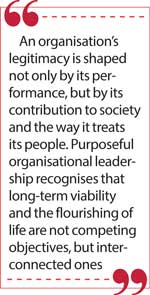
Ultimately, an organisation’s legitimacy is shaped not only by its performance, but by its contribution to society and the way it treats its people. Purposeful organisational leadership recognises that long-term viability and the flourishing of life are not competing objectives, but interconnected ones.
(The author is the Managing Director and Chief Catalyst of Purposeful Leadership Ltd. He holds a PhD from Hult Ashridge, an MBA from the University of Sri Jayewardenepura, and is a Fellow and Gold Medallist of the Chartered Institute of Marketing, UK. He can be reached at www.ranjandesilva.com, www.ranjandesilva.blog, and www.purposefulleadershipco.com)




