Thursday Oct 22, 2026
Thursday Oct 22, 2026
Tuesday, 23 December 2025 00:10 - - {{hitsCtrl.values.hits}}
 The Rs. 2 m question every Sri Lankan employer faces
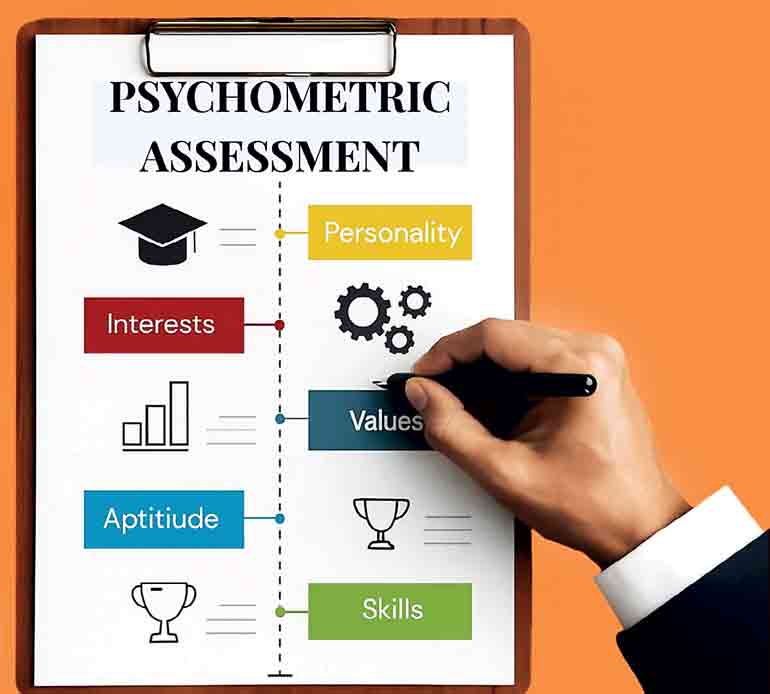
As per global research unstructured interviews predict job performance with only 14% accuracy. You might as well flip a coinUnderstanding the real person behind the CVA CV tells employers what a candidate has done. Psychometric assessments reveal who they are. In today’s complex and demanding business environment, this distinction is crucial.Employers increasingly recognise that personality traits, behavioural patterns, levels of dominance or compliance, emotional responses, and motivational drivers shape how effectively an individual performs, particularly in leadership, customer-facing roles, and team-based environments.However, the effectiveness of psychometrics entirely depends on the quality of the instrument used. Not all assessments are created equal.Why employers must choose scientifically validated toolsOne of the biggest pitfalls in the corporate world is using low-quality, invalidated, or generic personality tests that provide superficial insights. These can mislead employers, distort recruitment decisions, and create lasting reputational risk.To avoid this, global multinationals and progressive Sri Lankan companies rely on robust, scientifically grounded systems such as the DISC profiling methodology by Thomas International which is widely used by successful organisations across the world. This highly reliable behavioural assessment, used across Fortune 500 and blue-chip companies, offers:
- A precise understanding of how individuals behave under pressure
- Insights into decision-making patterns
- Indicators of leadership capability
- Predictability of workplace behaviour
- Ability to understand and influence others
- A strong scientific base with proven validity and reliability
When used correctly, DISC profiling gives employers a clear, unbiased lens into a person’s natural style, allowing them to align the right behaviour with the right role.Hiring the right person for the right job every timeThe cost of a wrong hire is immense. It results in lost productivity, training wastage, employee turnover, and cultural disruptions. Worse, organisations often settle for mediocrity simply because they fail to evaluate behavioural suitability.Psychometric assessments help employers break this cycle by:
- Revealing whether a candidate can naturally excel in the role
- Predicting how they will behave within teams
- How they will make decisions and influence others
- Identifying whether their personality aligns with company culture
- Supporting succession planning and leadership pipelines
- Reducing bias and supporting fair, evidence-based decision-making
Investing in a high-quality assessment system is far more cost-effective than investing in a mediocre hire.Companies invest heavily in recruitment and training only to watch talented professionals leave within months because the role, culture, or management style didn›t align with their natural working preferences. A CV tells you what someone has accomplished. An interview tells you what they want you to believe. But neither reveal who they actually are, how they think under deadline pressure, how they make decisions when information is incomplete, how they respond to criticism, whether they naturally collaborate or prefer independent work, how influential they are to understand and interact with others, their ability to make decisions, or if their behavioural style genuinely matches what the position demands dailyA tool not just for hiring but for building strong organisationsProgressive employers now integrate psychometric assessments into:
- Recruitment and onboarding
- Leadership development
- Conflict management
- Team building
- Performance management
- Coaching and mentoring
- High-potential identification
The result is a workforce where roles align with natural behaviors, boosting morale, productivity, and long-term retention.The ROI that changes everythingOrganisations that are hesitant to invest in quality psychometric assessment often cite cost concerns. This perspective fundamentally misunderstands the economics involved.Consider the numbers for a Sri Lankan context:
- Cost of quality psychometric assessment per candidate: Rs. 10,000 to 20,000
- Cost of a bad hire at manager level: Rs. 2,000,000 to 3,500,000
- Probability of preventing a bad hire with validated assessment: 60 to 70%
- Expected value of assessment: Rs. 1,200,000 to 2,450,000 saved per hire
The mathematics is overwhelming. Investing Rs. 15,000 in robust assessment for a single managerial hire can prevent losses equivalent to 130 to 230 future assessments. For organisations making even five managerial-level hires annually, the cumulative savings become substantial, not to mention the impossible-to-quantify benefits of higher team morale, stronger organisational culture, and sustainably improved performance.More importantly, this is not just about preventing disasters. It is about systematically optimising success. When you consistently place people in roles where their natural behaviors align with daily job requirements, you create a workforce operating at peak effectiveness; a compounding competitive advantage that grows stronger over time.One of the biggest pitfalls in the corporate world is using low-quality, invalidated, or generic personality tests that provide superficial insights. These can mislead employers, distort recruitment decisions, and create lasting reputational risk. To avoid this, global multinationals and progressive Sri Lankan companies rely on robust, scientifically grounded systems such as the DISC profiling methodologyThe strategic imperative for Sri Lankan employersWe have entered an era where talent represents the primary differentiator between market leaders and market followers. The organisations winning this competition aren’t necessarily those with the largest salaries or most prestigious brands. They are the ones making consistently better decisions about people; systematically, scientifically, and strategically.Many Sri Lankan organisations remain hesitant about psychometric assessment, viewing it as a Western import unsuited to local contexts or an unnecessary expense during economic constraints. This perspective is precisely backwards.In challenging economic times, when every hire matters more and resources are constrained, the cost of hiring mistakes becomes even more punishing. This is when data-driven decision-making matters most, not least.Furthermore, validated psychometric tools like DISC profiling are culturally neutral. They measure behavioral patterns that transcend geography, industry, and organiSational context. The same frameworks that help global technology companies build teams and international consulting firms develop leaders work equally effectively for Sri Lankan banks, manufacturing companies, hospitality groups, and IT services providers.The choice before youEvery organisation today faces a fundamental choice to continue relying on outdated hiring methods that fail more often than succeed or embrace scientifically validated tools that transform talent decisions from subjective gambles into strategic advantages.The global and regional evidence is unambiguous. Organisations that systematically use quality psychometric assessments build stronger teams, develop better leaders, and achieve superior business results. They waste less money on hiring failures, lose fewer high performers to preventable departures, and create cultures where people thrive because they are positioned for natural success.We have entered an era where talent represents the primary differentiator between market leaders and market followers. The organisations winning this competition aren›t necessarily those with the largest salaries or most prestigious brands. They are the ones making consistently better decisions about people; systematically, scientifically, and strategicallyThe question is not whether psychometric assessment works. Decades of research and countless organisational success stories have settled that debate conclusively. The real question is whether your organisation will seize this competitive advantage now, implementing these tested and proven methodologies while competitors remain hesitant and fall behind, or whether you will wait until the talent gap becomes so wide that catching up requires years of effort and massive investment. Every day of delay means another opportunity for competitors to build superior teams while your organisation continues making avoidable hiring mistakes. In today’s war for talent, better intelligence doesn’t just help, it wins decisively. The choice is yours, but the clock is ticking.(The author is a Past President of the Chartered Institute of Personnel Management (CIPM) and a leading Chartered HR professional specialising in strategic human capital management. With extensive experience spanning two decades, he has helped numerous Sri Lankan organisations transform their approach to talent acquisition and development through evidence-based methodologies and scientifically validated assessment frameworks. He could be reached via email at [email protected])Recent columns
COMMENTS




