Thursday Oct 22, 2026
Thursday Oct 22, 2026
Thursday, 22 October 2026 00:26 - - {{hitsCtrl.values.hits}}
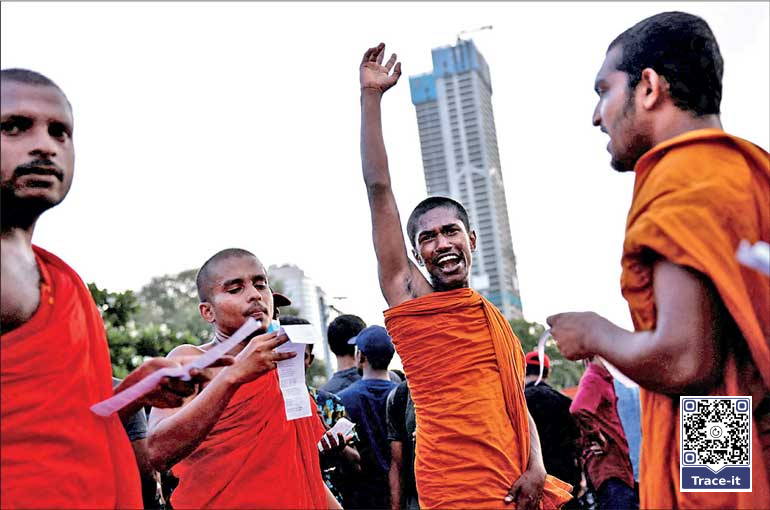
Respect for the Sangha should never be confused with unquestioning acceptance of the conduct of every individual monk. Instances of intimidation, incitement, violence or other unlawful behaviour must be addressed according to the law, irrespective of the religious standing of those involved

Sri Lanka’s Buddhist civilisational heritage
Sri Lanka possesses an extraordinary Buddhist heritage extending over more than 2,300 years, forming part of a Buddhist tradition that spans approximately 2,500 years.
Since the introduction of Buddhism during the reign of King Devanampiya Tissa in the third century BCE, its influence has extended far beyond religious observance. Buddhism has profoundly shaped Sri Lanka’s literature, education, architecture, cultural traditions, moral values, social institutions and national identity.
The ancient cities of Anuradhapura and Polonnaruwa, magnificent stupas, monasteries, Buddhist scholarship and enduring traditions of learning all bear testimony to this remarkable inheritance.
The ancient cities of Anuradhapura and Polonnaruwa, their magnificent stupas, monasteries, Buddhist scholarship and enduring traditions of learning and sophisticated irrigation systems bear testimony to this remarkable civilisational inheritance. The enduring concept of “Wewa and Dagaba” (the irrigation tank and the Buddhist stupa) captures a distinctive feature of Sri Lanka’s historical development, where agriculture, community wellbeing and spiritual life were closely interconnected. The wewa sustained livelihoods and agricultural prosperity, while the dagaba symbolised the spiritual and ethical foundations of society. Together, they reflected a civilisation in which material wellbeing and spiritual development were regarded as complementary aspects of community life.
Protecting such a heritage is not merely a matter of religious preference. It is also about preserving an important foundation of Sri Lanka’s historical and cultural identity.
However, discussions surrounding Buddhism’s constitutional position frequently become entangled in political controversies, religious emotions and competing interpretations of national identity.
A more constructive discussion requires us to distinguish three interconnected responsibilities: protecting Buddhism’s historical and constitutional position, actively fostering the Buddha Sasana, and ensuring that those who profess to uphold Buddhism demonstrate its teachings through their conduct.
These responsibilities should complement rather than contradict one another.
Constitutional recognition of religion is not unique to Sri Lanka
Sri Lanka is certainly not alone in constitutionally recognising a religion that has historically shaped its civilisation. Several European countries, including established constitutional democracies, explicitly recognise Christianity or particular Christian denominations in their constitutions.
Denmark: Section 4 of the Danish Constitution recognises the Evangelical Lutheran Church as the established Church of Denmark and requires the State to support it.
Greece: Article 3 of the Greek Constitution recognises Eastern Orthodox Christianity as the prevailing religion, reflecting its longstanding association with Greek history, culture and national identity.
Iceland: Article 62 declares the Evangelical Lutheran Church to be the State Church and expressly provides that it shall be supported and protected by the State.
Malta: Article 2 declares the Roman Catholic Apostolic Religion to be the religion of Malta, reflecting the country’s historical religious identity.
Liechtenstein: Article 37 recognises the Roman Catholic Church as the national church, extending special constitutional protection while guaranteeing freedom of religion and conscience.
These constitutional arrangements are not identical. Some establish a State Church, while others recognise a prevailing or historically significant religion. The nature of government support and the legal relationship between religious institutions and the State also differ.
Nevertheless, they demonstrate an important principle: constitutional recognition of a historically influential religion is not inherently incompatible with democracy, modern constitutional governance or religious freedom. Such recognition does not automatically justify every religious privilege, nor does it remove the State’s responsibility to safeguard the rights of other religious communities. For Sri Lanka, therefore, the more meaningful question is not simply whether Buddhism deserves constitutional recognition, but how that recognition should be interpreted and translated into constructive national responsibilities.
Sri Lanka’s Article 9: A constitutional duty to protect and foster Buddhism
Article 9 of Sri Lanka’s Constitution states:
“The Republic of Sri Lanka shall give to Buddhism the foremost place and accordingly it shall be the duty of the State to protect and foster the Buddha Sasana, while assuring to all religions the rights granted by Articles 10 and 14(1)(e).”
The wording is particularly important because it establishes two distinct responsibilities: to protect Buddhism and to foster the Buddha Sasana.
Article 9 is not merely a symbolic acknowledgement of Buddhism’s historical contribution. It imposes an affirmative constitutional duty upon the State. At the same time, Sri Lanka’s Constitution protects freedom of thought, conscience and religion, while Article 12 guarantees equality before the law.
Consequently, recognising Buddhism’s foremost position should not be interpreted as authorising discrimination, religious intimidation or the denial of fundamental rights to other communities. Sri Lanka’s Hindu, Muslim, Christian and other religious communities have also contributed immensely to the country’s development. Their dignity, religious freedom and equal citizenship must remain protected. Recognising Buddhism’s special historical position and respecting the rights of all citizens need not be mutually exclusive responsibilities.
However, while considerable public attention has been directed towards protecting Buddhism’s constitutional position, the equally important obligation to foster the Buddha Sasana deserves greater national attention.
Protecting Buddhism and fostering Buddhism are not the same
Protecting Buddhism involves safeguarding its scriptures, religious institutions, monasteries, sacred sites, historical monuments, traditions and freedom of religious practice.
Fostering Buddhism requires something deeper and more enduring. It involves strengthening understanding of the Dhamma, promoting observance of the Vinaya, improving Buddhist education, encouraging ethical behaviour and ensuring that Buddhist teachings continue to make a meaningful contribution to contemporary society.
Preserving temples, restoring historical monuments, sponsoring religious ceremonies and supporting religious institutions are undoubtedly worthwhile activities.
However, such activities alone cannot establish that Buddhism is flourishing spiritually or ethically. We must also ask whether the Buddha’s teachings are genuinely understood, practised and transmitted to future generations.
Are Buddhist educational institutions adequately preparing young people to understand the Dhamma beyond rituals and ceremonial observances?
Are monastic discipline and ethical conduct receiving sufficient attention?
And perhaps most importantly, are those who passionately defend Buddhism equally committed to practising its teachings?
A thought-provoking cartoon: Protecting Buddhism or living according to Buddhism?
I recall seeing a particularly thought-provoking cartoon depicting two queues.
One was labelled “Protecting Buddhism”, while the other was labelled “Living According to the Teachings of Buddhism.” The queue for protecting Buddhism was extraordinarily long, with a large crowd eagerly waiting to demonstrate its commitment.
In striking contrast, the queue for living according to Buddhist teachings contained only one or two people.
The cartoon was humorous, but its underlying message was profound. It highlighted an uncomfortable distinction between loudly proclaiming the need to protect a religion and quietly demonstrating its principles through one’s conduct.
Of course, a cartoon is a caricature, not a factual assessment of Buddhist society. Many Buddhists sincerely practise their religion without seeking publicity, political involvement or recognition. Nevertheless, it raises an important question: Are we sometimes more enthusiastic about defending Buddhism than about living according to the Buddha’s teachings?
Protecting Buddhism is undoubtedly important. But what precisely are we protecting if compassion, tolerance, restraint, wisdom and ethical conduct are inadequately reflected in the lives of those who profess to uphold it?
Buddhism cannot be meaningfully fostered merely through public demonstrations, political declarations, religious ceremonies or demands for constitutional protection. Its enduring strength must also come from the conduct of those who practise it.
Perhaps Sri Lanka’s greater challenge is to ensure that the queue for living according to Buddhist teachings becomes at least as long as the queue for protecting Buddhism.
This simple cartoon captures an important issue that should be central to any serious discussion about fostering the Buddha Sasana.
Ven. Kudapola Rahula Thero: A lesson from colonial history
Sri Lanka’s history provides an important example of Buddhist monks becoming involved in national affairs under circumstances profoundly different from those prevailing today.
Ven. Kudapola Rahula Thero was executed by British colonial authorities on 20 August 1848 during the suppression of the Matale Rebellion.
Thero was accused of involvement with those resisting British rule, including allegations concerning communications with rebels. He was sentenced to death by a colonial military tribunal and executed by firing squad.
The circumstances surrounding his execution and the severity of the colonial authorities’ actions subsequently attracted criticism in the British Parliament.
This episode should be understood against the broader historical background of colonial domination, resistance to foreign authority and the struggle to preserve national dignity and self-determination.
There is a fundamental distinction between confronting foreign colonial authority in circumstances involving national sovereignty and engaging in contemporary political activity primarily to preserve institutional privileges or advance partisan interests.
Today, Sri Lanka is an independent republic. Buddhism already enjoys the foremost constitutional position, and the State has an explicit responsibility to protect and foster the Buddha Sasana.
This should prompt serious reflection on the nature and purpose of contemporary religious political activism.
When Buddhist monks participate in protests and political campaigns, are they genuinely defending the Dhamma, addressing injustice and advancing the welfare of the nation?
Or are some interventions motivated principally by political allegiances, the preservation of institutional privileges or the pursuit of influence?
These questions should not be used to condemn every Buddhist monk who participates in public affairs.
Religious leaders may have legitimate reasons to speak out against injustice, corruption, violence, threats to religious freedom or actions harmful to the public welfare. Peaceful protest is a democratic right, and monks are not excluded from that right.
However, a political protest does not automatically become a defence of Buddhism simply because it is organised or led by Buddhist monks.
The interests of the nation, the interests of a political party and the interests of a religious institution are not necessarily identical.
A dispute over institutional privileges should not automatically be portrayed as an existential threat to Buddhism. Likewise, public interventions by monks should be assessed according to the principles involved, methods employed and public interest served.
The example of Ven. Kudapola Rahula Thero should encourage reflection on courage, sacrifice and national responsibility rather than serve as a blanket justification for every form of religious political activism.
The relevant question is not whether Buddhist monks should remain silent on national affairs. Rather, it is whether their interventions are guided by the Dhamma, genuine public welfare and ethical principles instead of political expediency.
Protecting the Sangha must never mean protecting misconduct
The Maha Sangha occupies a deeply respected position in Sri Lankan Buddhist society.
Throughout history, Buddhist monks have contributed enormously to preserving religious teachings, developing scholarship, advancing education and supporting communities. This contribution deserves recognition and respect.
However, respect for the Sangha should never be confused with unquestioning acceptance of the conduct of every individual monk. Instances of intimidation, incitement, violence or other unlawful behaviour must be addressed according to the law, irrespective of the religious standing of those involved.
Religious robes must never become a shield against accountability or place anyone above the law
Equally, misconduct by individual monks should not be used to discredit the wider Maha Sangha or Buddhism itself.
The distinction between the spiritual purpose of a religious institution and the behaviour of particular individuals is essential. The Buddha’s teachings emphasise compassion, wisdom, restraint, self-discipline and non-violence.
Conduct fundamentally inconsistent with these principles should not be defended merely because it is undertaken in Buddhism’s name. Indeed, public confidence in the Buddha Sasana is better strengthened through principled accountability than through unquestioning institutional protection.
Protecting Buddhism does not mean protecting wrongdoing. It means safeguarding the integrity of its teachings and the institutions entrusted with preserving them.
This is another compelling reason to examine whether the constitutional responsibility to foster the Buddha Sasana is being adequately fulfilled.
A national Buddhist Sanghayana: Turning constitutional responsibility into meaningful action
Sri Lanka could consider facilitating a national Buddhist Sanghayana, supported by the Government, as a constructive initiative towards fulfilling its constitutional duty to foster the Buddha Sasana.
Buddhist Councils, or Sangayanas, have historically played an important role in preserving, examining and reaffirming the authentic Dhamma and Vinaya.
Sri Lanka itself holds a distinguished place in the preservation of Buddhist scriptures and scholarship, including the traditional account of the Tipitaka being committed to writing at Aluvihara.
There is also an important modern precedent.
The Sixth Buddhist Council, convened in Myanmar between 1954 and 1956 with government support and participation from several Theravada Buddhist countries, including Sri Lanka, concentrated on examining, reaffirming and preserving Buddhist teachings.
Its proceedings demonstrated how government support and scholarly cooperation among Buddhist monks could contribute to preserving the Dhamma and Vinaya.
A contemporary Sri Lankan Sanghayana could bring together highly respected and learned members of the Maha Sangha representing the principal Buddhist Nikayas, supported by recognised Buddhist scholars.
Its primary religious purpose should be to reaffirm and strengthen the understanding of the Dhamma and Vinaya rather than reinterpret or compromise Buddhist teachings to accommodate temporary political or institutional interests.
However, a traditional Sanghayana could also provide the foundation for a broader, carefully structured programme aimed at strengthening the Buddha Sasana. Such a programme could address several important national priorities.
1. Strengthening monastic discipline and ethical leadership
There should be serious reflection on the observance of the Vinaya, ethical responsibilities of monastic life and the importance of maintaining public confidence in the Sangha.
Issues of monastic discipline should be addressed through credible arrangements within the relevant Buddhist traditions, while alleged criminal misconduct must remain subject to ordinary law.
2. Improving Buddhist education
The quality and effectiveness of Buddhist education should be examined, including the training of monks, development of educational resources and teaching of Buddhism to schoolchildren and lay communities.
Greater attention could be directed towards understanding the meaning and practical application of the Dhamma rather than concentrating excessively on ceremonial observance or memorisation without comprehension.
3. Engaging younger generations
Young people are growing up in a rapidly changing world influenced by technology, globalisation and changing social values.
The challenge is to communicate Buddhist teachings in ways that are understandable, intellectually meaningful and relevant to contemporary life without compromising their essential principles.
4. Encouraging the practical application of Buddhist teachings
Buddhism’s contribution to society should be reflected in compassion, non-violence, ethical decision-making, peaceful coexistence, personal responsibility and respect for others. Greater emphasis on these principles could help bridge the gap illustrated by the cartoon’s two queues.
5. Strengthening the credibility of Buddhist institutions
Responsible administration, transparent management, ethical leadership and credible processes for addressing misconduct would help strengthen confidence in Buddhist institutions. Institutional integrity is not a threat to religion. It is an important foundation for its long-term wellbeing.
6. Reflecting on the relationship between the Sangha and politics
Religious leaders should retain their freedom to express views on matters of genuine public importance.
Nevertheless, a constructive national discussion could consider how the Sangha might preserve its spiritual independence and avoid becoming closely identified with particular political parties or factional interests. This would strengthen the ability of religious leaders to speak with moral authority on issues affecting society as a whole.
7. Preserving Buddhist scholarship and cultural heritage
The preservation of manuscripts, scriptures, historical documents, ancient monasteries, archaeological sites and Buddhist scholarship should remain an important national responsibility. Digital preservation, translation, scholarly research and improved public access to authentic Buddhist teachings could form part of a long-term programme.
A Sanghayana must remain independent of political influence
An undertaking of this nature would require careful planning, respected religious leadership and scholarly credibility. The Government could provide the necessary logistical, administrative and financial assistance.
However, doctrinal deliberations should remain under the independent authority of appropriately qualified members of the Maha Sangha.
It would be counterproductive for a national Sanghayana to become another politically sponsored ceremonial event generating publicity and declarations but producing little lasting benefit. Nor should a government attempt to dictate religious doctrine or use the council to consolidate political influence over Buddhist institutions.
A sensible arrangement would distinguish the religious work of a Sanghayana from a broader programme of educational and institutional improvement.
The Sanghayana would concentrate on preserving and reaffirming the Dhamma and Vinaya, while an associated programme, developed through consultation with the Sangha and Buddhist scholars, could address contemporary educational, administrative and ethical challenges.
Its success should be judged by tangible and sustainable improvements rather than by the number of ceremonies conducted, speeches delivered or resolutions adopted.
Protecting Buddhism and respecting other religions are compatible responsibilities
Sri Lanka’s Buddhist civilisational heritage is historically significant, but recognising it should not diminish the contributions of other religious communities to the country’s national life.
Hindu, Muslim, Christian and other communities have enriched Sri Lanka through education, commerce, culture, scholarship, professional service and numerous other activities.The constitutional recognition of Buddhism’s foremost place should coexist with freedom of conscience, religious practice and equality before the law.
The European constitutional examples illustrate that special recognition of a historically established religion can exist alongside religious liberty, although the practical scope of religious equality and State neutrality varies between countries.
Sri Lanka should therefore be attentive not only to constitutional wording but also to how constitutional guarantees operate in everyday life. A country can acknowledge its Buddhist inheritance while ensuring that no citizen is treated as less deserving of dignity or legal protection because of religious belief.
The values of compassion, tolerance and respect associated with Buddhism provide a strong ethical foundation for such coexistence.
We must do more than defend Buddhism
Sri Lanka’s Buddhist heritage is too valuable to be reduced to political slogans, ceremonial declarations or disputes over constitutional status. Article 9 already gives Buddhism the foremost place and places a duty upon the State to protect and foster the Buddha Sasana. The challenge is to give meaningful effect to both parts of that responsibility.
Protecting Buddhism requires preserving its religious institutions, sacred heritage, historical traditions and freedom of practice. Fostering Buddhism requires something more demanding: strengthening understanding of the Dhamma, promoting observance of the Vinaya, improving education, encouraging ethical conduct and ensuring that Buddhist principles continue to benefit society.
The historical example of Ven. Kudapola Rahula Thero invites reflection on the difference between principled resistance to colonial authority and contemporary political interventions motivated by narrower interests.
The proposal for a national Buddhist Sanghayana offers one possible avenue for strengthening Buddhist scholarship, monastic discipline, education and institutional credibility. And the simple cartoon depicting two queues reminds us of perhaps the most important question of all.
Are we more committed to protecting Buddhism than to living according to its teachings? The future strength of Buddhism in Sri Lanka should not be measured solely by the prominence afforded to it in the Constitution, the number of temples constructed or the political influence exercised by religious institutions.
It should also be measured by how faithfully the Dhamma is understood, how consistently the Vinaya is observed and how meaningfully Buddhist values are reflected in everyday conduct.
Protecting Buddhism safeguards our inheritance. Fostering Buddhism ensures that this inheritance remains meaningful for future generations. Ultimately, the most effective protection of Buddhism will come not merely from those who defend it most loudly, but from those who demonstrate its teachings most faithfully.
Sri Lanka must certainly protect its Buddhist heritage. But our greater challenge is to ensure that the queue for living according to the Buddha’s teachings becomes at least as long as the queue for protecting Buddhism.



