Monday Sep 28, 2026
Monday Sep 28, 2026
Monday, 28 September 2026 03:26 - - {{hitsCtrl.values.hits}}
 While commending the Government significant improvements made regarding torture, places of detention and confessions, we encourage it to make the last few changes to safeguard our liberties and our second most important export market
 Years of engagement with ministers and committees have led us to conclude that the repeal of the pernicious Prevention of Terrorism Act (PTA) is unlikely. Our engagements with the current and previous Government were premised on the above and the understanding that deadlock would simply perpetuate the PTA. Finally, significant progress has been made.
The Frontline Socialist Party (FSP) has now got activated and is condemning the Prevention of Terrorism Against the State (PTSB) wholesale, criticising provisions such as extending powers to arrest to the armed forces that pragmatists have accepted subject to guardrails. Leaving aside these maximalist and unrealistic demands that may result in the continuance of the PTA, this article assesses the changes made to the draft made available earlier this year in relation to international norms as requested by the European Union in order to continue the GSP+ concession.
Meeting international norms
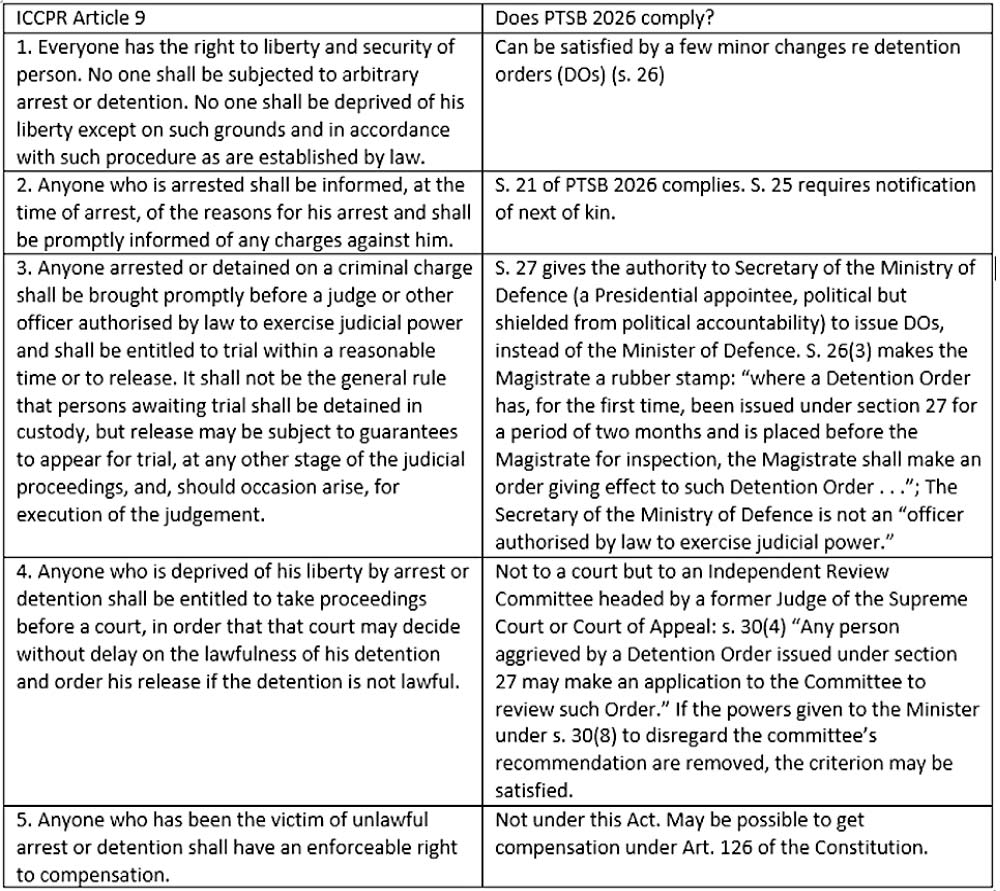
The International Covenant on Civil and Political Rights (ICCPR) is the overarching document that sets out international norms and standards in this area. Sri Lanka acceded to it on 11 June 1980. Therefore, it is a good yardstick.
If the Magistrate is given the discretion to revoke or modify a DO and the Minister’s discretionary powers re recommendations from the Independent Review Committee are removed, it may be possible to claim ICCPR compliance, notwithstanding other shortfalls.
Defining terrorism
In submissions to the Committee, we pointed out the dangers of overbroad definitions and suggested some pathways to minimise the dangers. Progress has been made.
The mental element (mens rea) has been considerably narrowed. The four elements in the previous draft have been brought down to two and the qualification “unduly” has been added to the problematic clause, “compelling a Government or an international organisation, to do or to abstain from doing any act.” It all hinges on how the word “unduly” is interpreted, but this is an improvement. The FSP spokesperson ignores the addition of this qualification, not having studied the previous definitions. Providing an illustration or two of what would not fall within the definition may be helpful in assuaging concerns.
The UN Conventions on terrorism have been included in a schedule of the Act as we proposed.
Normalising the exception
Pragmatists recognise the need for states of exception to deal with extraordinary circumstances such as natural or human-made disasters, including terrorist attacks. The difficulties of investigating terroristic offences and gathering evidence to successfully convict perpetrators cannot be wished away.
It would be helpful to see what kinds of laws were used from the moment the bombs were set off on 21 April 2019. Within hours, calls had been traced and the house in Dematagoda surrounded. All these actions were taken under the provisions of the Public Security Ordinance (Chapter 140). That is the purpose of laws such as the Public Security Ordinance. In an extraordinary situation, actions normally not allowed are permitted. The seriousness of the exception is acknowledged by the provision in the 1978 Constitution that requires Parliament to approve such a declaration within a month and only for a month at a time.
It would be ideal if the matters sought to be addressed by Part VII of the present Bill continue to be addressed under the above Constitutionally defined procedure. The ideal solution has not been adopted but previously proposed provisions have been improved.
The draconian power to proscribe organisations is still with the President (s. 59). The only improvement is that judicial review is now permitted. The provision permitting the Secretary to declare places as “prohibited places” for 72 hours remains. Beyond that the approval of a Magistrate is required. Commendably, the powers given to the President in previous drafts to declare curfew bypassing the Public Security Ordinance and the related Constitutional safeguards have been excised.
In conclusion
The Government may still be facing resistance from those who have become accustomed to the convenience offered by the PTA which allows the police to detain all sorts of suspects (some obviously not associated with terrorism) without doing the hard work of persuading a judge that adequate evidence exists to create a reasonable suspicion of unlawful activity. While commending the Government significant improvements made regarding torture, places of detention and confessions, we encourage it to make the last few changes to safeguard our liberties and our second most important export market.
At a minimum, a judge, preferably a High Court judge, should be authorised to approve or reject the DO issued by the politically appointed Ministry Secretary by amending s. 26(3) and the decisions of the Independent Review Committee should be binding and not subject to the whims of the Minister, by amending s. 30(8). It would be good if the powers to proscribe organisations (s. 59) are removed as the power to declare curfews was.




